Facebook
 Google
 GitHub
 Linkedin
I was tasked to build a constant current source for electrical stimulation, which can generate different pulses and up to 60-70 mA. And i achive it through using the Improved Howland current pump.
Now I was asked to build a “true biphasic” output by using two Howland pumps across the same load: one configured to source and the other configured to sink, then swapping their roles so the current reverses direction through the load. The load is therefore floating (neither electrode is tied to system ground). This is based on what I think and read in different papers that have the same idea as me, like: " Bertemes_paper_CLABIO_final " or " (PDF) Performance Comparison of Three Modified Howland Current Source Circuits in Low-Cost Bioimpedance Analyzer for Bio-Phantom Signal Acquisition "
The problem is measurement: when I run only one pump (source only or sink only), the waveform looks normal on the oscilloscope, but when I run the source + sink pair together, the output looks very strange (mostly spikes/ringing), and it is hard to prove that the intended biphasic pulses are actually present across the load. (The waveforms of both source and sink are identical)
I am using a standard bench oscilloscope with earth-referenced probe grounds (Tek TDS2022C), and I suspect the scope grounding / common-mode behavior of a floating load is distorting what I see. What is the recommended way to measure the load current? Am I on the right track? I appreciate all suggestions.
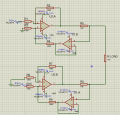
This is how I set up my one pair of source/sink for testing:
Now I was asked to build a “true biphasic” output by using two Howland pumps across the same load: one configured to source and the other configured to sink, then swapping their roles so the current reverses direction through the load. The load is therefore floating (neither electrode is tied to system ground). This is based on what I think and read in different papers that have the same idea as me, like: " Bertemes_paper_CLABIO_final " or " (PDF) Performance Comparison of Three Modified Howland Current Source Circuits in Low-Cost Bioimpedance Analyzer for Bio-Phantom Signal Acquisition "
The problem is measurement: when I run only one pump (source only or sink only), the waveform looks normal on the oscilloscope, but when I run the source + sink pair together, the output looks very strange (mostly spikes/ringing), and it is hard to prove that the intended biphasic pulses are actually present across the load. (The waveforms of both source and sink are identical)
I am using a standard bench oscilloscope with earth-referenced probe grounds (Tek TDS2022C), and I suspect the scope grounding / common-mode behavior of a floating load is distorting what I see. What is the recommended way to measure the load current? Am I on the right track? I appreciate all suggestions.
This is how I set up my one pair of source/sink for testing: