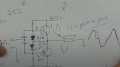
hello in the class B amplifier shown bellow we use diodes to make the PNP and NPN conduct equally.
How does the diodes make them conduct equally?
Thanks.
It doesn’t make them conduct “equally”, it removes the gap when the input signal is between ±0.6V when neither of them is conducting, by adding 0.6V to the NPN base signal and subtracting 0.6V from the PNP base signal, so that when the input signal is 0V, both transistors are just starting to conduct (If you‘re lucky).
Depending on the actual values of Vbe for the transistor, and the forward voltage drop of the diodes and the temperature, they might be biased just right, or they might still not be in conduction, or they might be conducting so much that they overheat.
Look up “emitter follower” and note that the output of an emitter follower is 0.6V less than the input.
[Note that I use the figure of 0.6V for the voltage drop of a silicon diode. It is a generic figure - in a real diode it can vary from 0.5V to 0.8V depending on the current, the temperature and the type of diode.]
The diodes provide a bias voltage to the transistors so that are just on the point of conducting. If the bases were conncted directly together the input signal would not cause them to conduct until it reached +0.6 volts for the NPN and -0.6 volts for the PNP.
Hello i have tried to simulate the structure as shown bellow.
I have tried to calculate the current where i disregard the diodes and do only I=5/2K=0.0025A
But in the simulation i get 0.0018.
Where did i go wrong?
Does my diodes have resistance?
Looking at thisstructure i see regular voltage divider why diodes are better then resistorsfor this purpose?
Hello Ian0, Is there a way i could simulate in LTspice this phenomena.
could you please give me simulation guidelines i could try to follow so i could see this phenomena?
Thanks.
It doesn’t make them conduct “equally”, it removes the gap when the input signal is between ±0.6V when neither of them is conducting, by adding 0.6V to the NPN base signal and subtracting 0.6V from the PNP base signal, so that when the input signal is 0V, both transistors are just starting to conduct (If you‘re lucky).
Depending on the actual values of Vbe for the transistor, and the forward voltage drop of the diodes and the temperature, they might be biased just right, or they might still not be in conduction, or they might be conducting so much that they overheat.
Look up “emitter follower” and note that the output of an emitter follower is 0.6V less than the input.
[Note that I use the figure of 0.6V for the voltage drop of a silicon diode. It is a generic figure - in a real diode it can vary from 0.5V to 0.8V depending on the current, the temperature and the type of diode.]
(5V minus the voltage drop of the diodes) divided by the resistance.
You can only use an approximate value for the diode Volt drop so you will only calculate an approximate answer.
Hello Ian0, Is there a way i could simulate in LTspice this phenomena.
could you please give me simulation guidelines i could try to follow so i could see this phenomena?
Thanks.
Yes. Just put it in SPICE as you drew it in your sketch. Leave out the capacitors and connect the input signal to the junction of the two diodes.
But don’t forget that SPICE simulates a generic circuit, not the exact transistors and diodes you have in your bits box.
If you change the values of resistance, you will see that the crossover distortion changes as you change the current through the diodes.
Since audio output transistors heat up which causes their base-emitter voltage to decrease then their idle current increases a lot.
But if the diodes are mounted on the heatsink of the output transistors then their forward voltage will also decrease when the output transistors heat up which stabilizes the idle current.
Your schematic of an amplifier output stage is missing negative feedback that all audio amplifiers have. The negative feedback reduces any non-linearities causing distortion in the circuit including reducing any remaining crossover distortion.

 Facebook
 Google
 GitHub
 Linkedin