STEM /Community class

Thread Starter

Icanmakeit67

Joined Sep 23, 2018
210
I’m looking for a simple, tested design for a STEM class at out community library. I’ve been assisting for some time now and was looking through our suggestion/feedback box we pass around after each STEM class project. LOTS of people are wanting a simple AM radio project. Not a crystal type but a basic, easily obtainable parts, project that actually works at the end.
We buy parts band have a substantial inventory at present. I’d like something that has a transistor stage and easy to build coil/capacitor tank section. 9v battery powered. We have 50 mm diameter 3D printed hollow tubes/feet kits for the inductor coil and 2.5” 8ohm speakers we provide. Any help would be great. So many I’ve seen online and played with flat don’t work. Our effort here is expected to end in success.
PS
We are using Vero/Strip board for core circuit building with JST 2.54 female plugs/male sockets to connect peripheral elements such as in this case, speaker, coil, variable (35pf-420pf finned/air capacitors), battery, switch and any other items as required.

Thank you in advance
 

MrChips

Joined Oct 2, 2009
34,627
Building and experimenting with AM radio circuits is an excellent way to learn about radio, electronics, and construction techniques. Take the time to gain knowledge and insight at the various stages of the entire design.

You learn about:
  1. LC resonant circuits
  2. RF amplifier
  3. RF to AF demodulation
  4. AF amplifier
  5. Loudspeaker circuits

Instead of using LM386 to drive the loudspeaker, try building your own audio amplifier using discrete transistors. There is so much more to learn about transistor types and amplifier configurations.

After experimenting with all of the above, learn that there are different types of radio circuits. Each has its own merits.
  1. Crystal Radio
  2. Crystal radio with amplification
  3. Regenerative radio
  4. Superheterodyne radio
  5. Double conversion radio

Next, experiment with different types of antennas.
  1. Straight wire antenna
  2. Loop antenna
  3. Ferrite rod antenna

Added to this, learn more about how radio waves are transmitted. Learn how the antenna receives the electric component of the electromagnetic wave and how to receive the magnetic component of the EM wave.
 

Thread Starter

Icanmakeit67

Joined Sep 23, 2018
210
Building and experimenting with AM radio circuits is an excellent way to learn about radio, electronics, and construction techniques. Take the time to gain knowledge and insight at the various stages of the entire design.

You learn about:
  1. LC resonant circuits
  2. RF amplifier
  3. RF to AF demodulation
  4. AF amplifier
  5. Loudspeaker circuits

Instead of using LM386 to drive the loudspeaker, try building your own audio amplifier using discrete transistors. There is so much more to learn about transistor types and amplifier configurations.

After experimenting with all of the above, learn that there are different types of radio circuits. Each has its own merits.
  1. Crystal Radio
  2. Crystal radio with amplification
  3. Regenerative radio
  4. Superheterodyne radio
  5. Double conversion radio

Next, experiment with different types of antennas.
  1. Straight wire antenna
  2. Loop antenna
  3. Ferrite rod antenna

Added to this, learn more about how radio waves are transmitted. Learn how the antenna receives the electric component of the electromagnetic wave and how to receive the magnetic component of the EM wave.
Right and thanks. Would you have a project design usable for our class.
 

lichurbagan

Joined Jul 4, 2025
120
I’m looking for a simple, tested design for a STEM class at out community library. I’ve been assisting for some time now and was looking through our suggestion/feedback box we pass around after each STEM class project. LOTS of people are wanting a simple AM radio project. Not a crystal type but a basic, easily obtainable parts, project that actually works at the end.
We buy parts band have a substantial inventory at present. I’d like something that has a transistor stage and easy to build coil/capacitor tank section. 9v battery powered. We have 50 mm diameter 3D printed hollow tubes/feet kits for the inductor coil and 2.5” 8ohm speakers we provide. Any help would be great. So many I’ve seen online and played with flat don’t work. Our effort here is expected to end in success.
PS
We are using Vero/Strip board for core circuit building with JST 2.54 female plugs/male sockets to connect peripheral elements such as in this case, speaker, coil, variable (35pf-420pf finned/air capacitors), battery, switch and any other items as required.

Thank you in advance
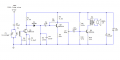
Simple AM Radio with Audio Amplifier can be a suitable project.
 

Thread Starter

Icanmakeit67

Joined Sep 23, 2018
210
Simple AM Radio with Audio Amplifier can be a suitable project.
Would you have a circuit that is proven. We have pulled 3 so far from online but still no working example to start off a class. We always show a finished product before we begin. We charge a small parts fee but it really doesn’t represent actual cost.
 

panic mode

Joined Oct 10, 2011
4,864
one shown in post #4 is simple and easy but details on T1 are lacking. it should be a ferrite rod with some 60-80 turns of thin wire for left side to get you in the ballpark. not sure about the right side but it should not be critical.

can youst links to circuits you tried that did not work for you?
 

panic mode

Joined Oct 10, 2011
4,864
perhaps also show your construction method and test case. anything with high frequencies should be using short connections. do you at least get static? common one is that there is no reception. if so turn ferrite antenna 90deg and try again. another common mistake is using wrong section of the variable cap or ferrite coil as resonant circuit. then you end up in radio band with no stations.

here is one example of a receiver with very few parts:
https://www.edn.com/2-transistor-radio-receiver/
 
Last edited:

panic mode

Joined Oct 10, 2011
4,864
that may work here but that is not the intent...
this capacitor has two sections - one for input LC circuit, and the other is for local oscillator. the two circuits have different frequencies since in superhet construction uses mixer and the difference is what gets amplified in IF stage (for AM that is 455kHz).

so middle pin is common electrode (GND) and the other two are capacitors just mentioned. this type of capacitors will be often called 223P

some of those products have 6 terminals. the other side is the same deal but with smaller values used for FM (IF for FM is 10.7MHz). such capacitors are often called 443DF. if needed, one can combine all of them to get sufficiently large capacitance. ..or... add few more turns of wire on the ferrite rod.
 
Top