Need a review to my class AB Amplifier design

Thread Starter

akithmari

Joined Dec 31, 2025
1
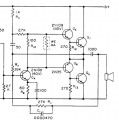
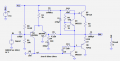
I've been working on this amplifier for about 4 days. Here's the circuit so far.1767160699126.png
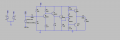
The amplifier working good until the Vpeak input reach 0.6 Vp. the signal get distorted. 1767160778060.png

i don't know how to improve my amplifier. Here's my calculation :

First stage (Common Emitter)
Zi = 2.1k ohm
Zo = 6k ohm
Ic = 1mA
Ve = 1V
Va = 100
Beta = 200

Second stage (Emitter Follower)
Zi = 120K ohm
Zo = 80 ohm
Ie = 1mA
Ve = 6v
Va = 100
Beta = 200

Final Stages (Push Pull AB)
Zi = 850 ohm
Zo = 1.3 ohm
I(idle) = 100 mA
Beta = 400.

i use 100 mA in order to reduce Zo on final stages. LTspice seems doesn't have TIP41/TIP42 so i use available high current BJT like QSX1. What should i do to improve my design?
 

WBahn

Joined Mar 31, 2012
32,702
Why have ±12 V supplies if you are only going to use the +12 V for the circuit?

It's hard to suggest ways to improve a circuit when you don't give any indication of what the specs are that you are trying to meet.
 

Ian0

Joined Aug 7, 2020
13,097
You have two common collector stages, which don't contribute and gain, so you are relying totally on the input stage which has a gain of <5, a maximum output swing of about 10V if it's lucky and very mediocre distortion.
An audio power amplifier design would probably have an open-loop gain of around 100,000 which is reduced to 20 or so by global negative feedback which reduces the distortion.
This is an example of the use of negative feedback. (Note that it is drawn with the negative supply at the top and the negative supply is mislabelled B+)
Screenshot from 2025-12-31 07-58-16.png
LIke your circuit it has a common source input stage (Q4). R6 is the collector load for Q4. And like your circuit, it has a buffered common collector output stage.
Q4 is run with its emitter close to the supply to get the maximum voltage swing at its collector, then global negative feedback is applied through C1 and R11 (27k). R7 and the 2.7k resistor set the base bias
(This is the HC Lin circuit, it is 70 years old in 2026)

I would suggest that you accept that it's about as good as you are going to get from a single stage design, keep your design for guitar distortion pedals and learn how to use negative feedback and a long-tailed pair input stage.
I would recommend that you read:
J Linsley Hood The Art of Linear Electronics
J Linsley Hood Valve and Transistor Audio Amplifiers
D Self Designing Audio Power Amplifiers
Linsley Hood is very good and giving examples of commercial circuits and showing how they work.
 

crutschow

Joined Mar 14, 2008
38,316
Here's an example of a simple audio amp that uses a differential (long-tailed-pair) input stage to give both DC feedback to stabilize the output at near 1/2 the supply voltage, and AC feedback to determine/stabilize the gain and reduce distortion:
C6 and D1 provide a bootstrap voltage for the Q5 drive to increase the positive output voltage before it clips.

1767285225525.png
 
Last edited:

MrAl

Joined Jun 17, 2014
13,667
I've been working on this amplifier for about 4 days. Here's the circuit so far.View attachment 361397
The amplifier working good until the Vpeak input reach 0.6 Vp. the signal get distorted. View attachment 361398
i don't know how to improve my amplifier. Here's my calculation :

First stage (Common Emitter)
Zi = 2.1k ohm
Zo = 6k ohm
Ic = 1mA
Ve = 1V
Va = 100
Beta = 200

Second stage (Emitter Follower)
Zi = 120K ohm
Zo = 80 ohm
Ie = 1mA
Ve = 6v
Va = 100
Beta = 200

Final Stages (Push Pull AB)
Zi = 850 ohm
Zo = 1.3 ohm
I(idle) = 100 mA
Beta = 400.

i use 100 mA in order to reduce Zo on final stages. LTspice seems doesn't have TIP41/TIP42 so i use available high current BJT like QSX1. What should i do to improve my design?
Hi,

The first improvement I can spot right away, without any additional information, is in the output stage.
There it is being assumed that the 1N4148 diode voltage drops are exactly equal to the transistor base emitter diode drops. That's not a good assumption. The usual idea is to add low value resistors in series with the two emitters so as to relax the equality requirement a little.
The other idea is to improve the bias method for the two output transistors which also helps with that.
These two ideas are very important in order to get a clean output and not overheat the two output transistors.

This is without considering why the load for a high current output stage is only 10k :)

Another question is why is there a 1000uf cap in series with the input to a stage that has probably at least a 10k input resistance if not higher. Does this audio amplifier have to work down to 0.02 Hertz :)
A typical design goal for audio is 20Hz to 20kHz operation.

These are just casual observations, we'd need to know more to be more helpful.
 
Last edited:
Top