Need help to review calculations to reduce heat dissipation of LM317T circuit

Thread Starter

floxia

Joined Mar 7, 2023
22
The following LM317T circuit works fine, although I have noticed that it gets a little warm to the touch, even with the heatsink. Therefore, I would like to get the coldest possible operation temperature for the IC by adding a voltage-drop resistor. I am aware of other regulators, although this is a circuit that I already have, so I would like to keep working with what I currently have.
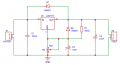
Screenshot 2025-01-30 at 7.28.18 pm.png
Input voltage: 15V
Output Voltage: 7V
Load current: 150mA
Voltage drop: 15V-7V = 8V

Power dissipated: 8V x 0.115A = 1.2W
Ambient temperature: 25°C

Thermal resistance junction-ambient TO-220: 50°C/W
Thermal resistance junction-case TO-220: 5°C/W


I have calculated the temperature of the IC for the values above:

Temperature junction-ambient: (50°C x 1.2W) = 60°C
Temperature junction-case: 60°C - (5°C x 1.2W) = 29°C
Temperature case above ambient: 29°C + 25°C = 54°C

Case temperature over 0-40°C range: 29-69°C


Assuming the voltage drop of LM317 to be 3V and the minimum input voltage to satisfy this condition to be 10V:

Voltage-drop resistor: (15V-10V) / 0.15A = 33Ω
Resistor power rating: (0.15A)² x 33Ω = 0.75W
New power dissipated: 3V x 0.15A = 0.45W

New case temperature above ambient: 25°C: 20.25°C + 25°C = 45°C
New case temperature over 0-40°C range: 20.25-60.25°C


I am not 100% sure of my calculations and can only notice a 10°C temperature reduction.

It would be great if I could get feedback on these calculations to confirm the expected IC temperature of the new circuit below:
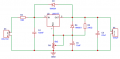
Screenshot 2025-01-30 at 7.28.33 pm.png

Also a feedback on the new circuit schematic would be greatly appreciated!
 

MrAl

Joined Jun 17, 2014
13,680
The following LM317T circuit works fine, although I have noticed that it gets a little warm to the touch, even with the heatsink. Therefore, I would like to get the coldest possible operation temperature for the IC by adding a voltage-drop resistor. I am aware of other regulators, although this is a circuit that I already have, so I would like to keep working with what I currently have.

View attachment 341518
Input voltage: 15V
Output Voltage: 7V
Load current: 150mA
Voltage drop: 15V-7V = 8V

Power dissipated: 8V x 0.115A = 1.2W
Ambient temperature: 25°C

Thermal resistance junction-ambient TO-220: 50°C/W
Thermal resistance junction-case TO-220: 5°C/W


I have calculated the temperature of the IC for the values above:

Temperature junction-ambient: (50°C x 1.2W) = 60°C
Temperature junction-case: 60°C - (5°C x 1.2W) = 29°C
Temperature case above ambient: 29°C + 25°C = 54°C

Case temperature over 0-40°C range: 29-69°C


Assuming the voltage drop of LM317 to be 3V and the minimum input voltage to satisfy this condition to be 10V:

Voltage-drop resistor: (15V-10V) / 0.15A = 33Ω
Resistor power rating: (0.15A)² x 33Ω = 0.75W
New power dissipated: 3V x 0.15A = 0.45W

New case temperature above ambient: 25°C: 20.25°C + 25°C = 45°C
New case temperature over 0-40°C range: 20.25-60.25°C


I am not 100% sure of my calculations and can only notice a 10°C temperature reduction.

It would be great if I could get feedback on these calculations to confirm the expected IC temperature of the new circuit below:

View attachment 341519

Also a feedback on the new circuit schematic would be greatly appreciated!
Hi,

I knew this engineer a long time ago who's original language was not English. When something did not look right to him with a circuit, he would always say, "Something smells fishing", (ha ha) instead of "Something smells fishy". It was kind of funny.

Anyway, the reason I bring this up is because with this problem it seems that something smells fishy.
1/2 watt with a heat sink should not get very warm, although it does depend on the total exposed surface area of the heat sink. I don't think you mentioned what kind of heat sink you are using.
It looks like you are calculating the temperature rise of the case of the part and not considering the heat sink too? Did you try this in real life yet?
There is not that much surface area on a TO220 case (metal part) but with a heat sink that goes up a lot. You can't expect to get a zero degree temperature rise however with any heat sink unless it is a very special type with highly active cooling.
Also be aware that when something feels hot to the touch it may not be that bad because electronic components can work up to higher temperatures than we can put a finger on and not get burnt.

If you only need 7v output then I also think that 10v input is probably enough, as long as the input (15v) will never drop for any reason, including load transients. You may want to check that too if the load is not always constant.
 

DickCappels

Joined Aug 21, 2008
10,661
This might be a little off the main topic but...

What are you worried about? The LM317 is designed to run up to 125º C. Water boils at 100º. Back when transistors were made of stone (in other words, a heck or a long time ago) us teenager hobbyists, who did not have much in the way of real test equipment, let alone a proper thermometer, would wet the end of a finger and touch the suspect transistor. If it was hot enough to fry spit, it was, in our book, too hot.

The LM317 has internal thermal protection as well. If it doesn't shut down it is ok, though it might take a few percent off of the life of the regulator.

The more parts you add to the circuit, the more likely you are to experience problems.
 

MrChips

Joined Oct 2, 2009
34,694
Any linear regulator will still get hot. If you insert a resistor in series, all you are doing is moving the heat dissipation to another component.

If you want less heat dissipation, reduce the input voltage or use a switching regulator.
 

MrAl

Joined Jun 17, 2014
13,680
Any linear regulator will still get hot. If you insert a resistor in series, all you are doing is moving the heat dissipation to another component.

If you want less heat dissipation, reduce the input voltage or use a switching regulator.
Hi,

I don't think the total heat dissipation is the issue here, it's the local heat dissipation ... the heat in one part of the circuit not the entire circuit. Spreading out the heat is a common trick.

I do like your idea better though, find a way to reduce the total heat, which is a more modern goal. Efficiency is much more important these days.
 

AnalogKid

Joined Aug 1, 2013
12,083
Your calculations look ok, but I think designing around only 3 V of drop across the regulator is too little. The datasheet characterizes the part at around 1.6 V for your operating conditions, but that is not a tightly controlled parameter.

Consider allowing for 4 V across the LM317 for a 50% reduction in regulator heat, with R3 = 27 ohms.

ak
 

nsaspook

Joined Aug 27, 2009
16,270
Those were made of Germanium, a much rarer stone.
We still use Germanium to make modern controllers and devices. It's just not just a substrate now, it's a dopant. Germanium can be used for band gap engineering, strained Si (increased mobility) and Pre-amorphisation implants (PAI)
 

MrAl

Joined Jun 17, 2014
13,680
Your calculations look ok, but I think designing around only 3 V of drop across the regulator is too little. The datasheet characterizes the part at around 1.6 V for your operating conditions, but that is not a tightly controlled parameter.

Consider allowing for 4 V across the LM317 for a 50% reduction in regulator heat, with R3 = 27 ohms.

ak
Hi,

If the data sheet says 1.6v then why would you think that 3.0v is not enough? That's getting close to 2x the required voltage overhead.
 

WBahn

Joined Mar 31, 2012
32,748
The following LM317T circuit works fine, although I have noticed that it gets a little warm to the touch, even with the heatsink. Therefore, I would like to get the coldest possible operation temperature for the IC by adding a voltage-drop resistor. I am aware of other regulators, although this is a circuit that I already have, so I would like to keep working with what I currently have.

View attachment 341518
Input voltage: 15V
Output Voltage: 7V
Load current: 150mA
Voltage drop: 15V-7V = 8V

Power dissipated: 8V x 0.115A = 1.2W
Ambient temperature: 25°C

Thermal resistance junction-ambient TO-220: 50°C/W
Thermal resistance junction-case TO-220: 5°C/W


I have calculated the temperature of the IC for the values above:

Temperature junction-ambient: (50°C x 1.2W) = 60°C
Temperature junction-case: 60°C - (5°C x 1.2W) = 29°C
Temperature case above ambient: 29°C + 25°C = 54°C
How does 60°C - (5°C x 1.2W) come out to be 29°C ?

Given the thermal resistances you've stated, I would expect that, with no heatsink, that the junction would be about 60 °C above ambient.

I would also expect there to be a temperature difference of 6 °C between the junction and the case, would then translate to the case-air interface being 54 °C above ambient.

So, while we got to the same place, I don't see how you got there. Where does the 25 °C in your last equation come from?

Then, after coming to the stated conclusion that the case temperature above ambient is 54 °C, you only add 29 °C to your range of ambient temperatures.

Why shouldn't

Case temperature over 0-40°C range: 29-69°C
be a range of if 54-94 °C ?

But what matters is the junction temperature, which at an ambient of 40 °C would be expected to be in the 100 °C range. While that still gives you some margin under the (probable -- check the data sheet from the manufacturer of the actual part you are using) max operating temperature of 125 °C, it is definitely toasty.

Assuming the voltage drop of LM317 to be 3V and the minimum input voltage to satisfy this condition to be 10V:

Voltage-drop resistor: (15V-10V) / 0.15A = 33Ω
Resistor power rating: (0.15A)² x 33Ω = 0.75W
New power dissipated: 3V x 0.15A = 0.45W

New case temperature above ambient: 25°C: 20.25°C + 25°C = 45°C
New case temperature over 0-40°C range: 20.25-60.25°C


I am not 100% sure of my calculations and can only notice a 10°C temperature reduction.
One problem with your approach is that you assume that the maximum power dissipation in the regulator will still occur at the maximum current of 150 mA.

But there are two factors at play. At low currents, the voltage drop across the regulator is high, while at high currents the voltage drop across the regulator is low. But at in between currents, the voltage is in the middle and the current is in the middle.

So let's do the math and see at what current the power dissipation in the regulator maxes out.

If the power-drop resistor is R, then the voltage drop across it is:

Vr = Ireg·R

That maxes the voltage across the regulator

Vreg = (Vin - Vr) - Vout

The power dissipated in the regulator is then

Preg = Vreg·Ireg = [(Vin - Vr) - Vout]·Ireg = [(Vin - Ireg·R) - Vout]·Ireg = [(Vin - Vout]·Ireg - Ireg²·R

Taking the derivative with respect to Ireg, we get

dPreg/dIreg = [(Vin - Vout] - 2·Ireg·R

To find the max, we set this equal to zero and solve for Ireg

[(Vin - Vout] - 2·Ireg·R = 0

Ireg = [(Vin - Vout] / (2R)

For Vin = 15 V, Vout = 7 V, and R = 33 Ω, you get max power dissipation in the regulator at:

Ireg = [(15 V - 7 V] / (2·33 Ω) = 121 mA

At the current, the dissipation is

Preg = [(Vin - Vout]·Ireg - Ireg²·R

Preg = [(15 V - 7 V]·121 mA - (121 mA)² · 33 Ω = 717 mW

Which is more than 50% higher than what it dissipates at 150 mA.

Another thing to consider when using a resistor to offload heat is that it also limits the current. So you want to make sure that your output never needs, even as a transient lasting longer than your output capacitor can handle, so much current that you violate the voltage overhead requirements of the regulator. One the other hand, the resistor does limit the max current, even under short-circuit conditions, and that's not entirely a bad thing. Depends on what's important.

If you just want to shift the heat but not hamper the max current too much, then you can use diodes to do so. While you should check the data sheet for the diodes you choose, you can figure, as a starting point, that each diode will drop about 0.7 V, so if you want to drop 5 V, you can use seven diodes in series. At max current, each diode will be dissipating about 100 mW, so if you get diodes rated at 0.5 W to 1 W, you should have no problem. Just stand them up where they get plenty of air and don't crowd them together to much.
 
Top