Circuit Analysis on AC Circuit

Thread Starter

salhi

Joined Nov 29, 2023
86
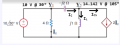
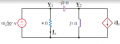
Let the following circuit, i want to find the voltage in the inductance:
1702675593503.png
We have \( V_1 = 10(30°) \iff I_x = \frac{V_1}{4 \Omega} = 2.5 (30°) A \\ \)
We also have by KCL \( \frac{V_1 - V_2}{-2j \Omega} = \frac{V_2}{1j \Omega} + 2I_x \iff \frac{V_1}{-2j \Omega} - 2I_x = \frac{V_2}{1j \Omega} + \frac{V_2}{-2j \Omega} = \frac{V_2}{2j \Omega} = \frac{V_1}{-2j \Omega} - 2 \frac{V_1}{4 \Omega}\\ \) Thus:
\( V_2 = -V_1 -jV_1 =V_1 \sqrt{2} (-135°) = 10 \sqrt{2} (-105°) V \)
Can someone solution-check my proof?
 

MrAl

Joined Jun 17, 2014
13,667
Let the following circuit, i want to find the voltage in the inductance:
View attachment 310075
We have \( V_1 = 10(30°) \iff I_x = \frac{V_1}{4 \Omega} = 2.5 (30°) A \\ \)
We also have by KCL \( \frac{V_1 - V_2}{-2j \Omega} = \frac{V_2}{1j \Omega} + 2I_x \iff \frac{V_1}{-2j \Omega} - 2I_x = \frac{V_2}{1j \Omega} + \frac{V_2}{-2j \Omega} = \frac{V_2}{2j \Omega} = \frac{V_1}{-2j \Omega} - 2 \frac{V_1}{4 \Omega}\\ \) Thus:
\( V_2 = -V_1 -jV_1 =V_1 \sqrt{2} (-135°) = 10 \sqrt{2} (-105°) V \)
Can someone solution-check my proof?
Hi,

Well, he he, I'd love to say 'it is right' but that is for a pure AC analysis (with a possible sign change), which may not exactly apply in this case.
That's because I think what you have there is partly an oscillator. There's an active source in the circuit 2*Ix.
What you should do is do a simulation and see what you think.
Do you have any software to do a simulation? You can compare that with your result.
What I think might happen is you might get a second frequency in there that comes from the tendency to oscillate. So you may get the oscillation frequency mixed in with your input frequency.
I'm not sure yet if there is any way around that.

Perhaps someone else could get into this and do a simulation to check this if you do not want to.
 

WBahn

Joined Mar 31, 2012
32,703
Let the following circuit, i want to find the voltage in the inductance:
View attachment 310075
We have \( V_1 = 10(30°) \iff I_x = \frac{V_1}{4 \Omega} = 2.5 (30°) A \\ \)
We also have by KCL \( \frac{V_1 - V_2}{-2j \Omega} = \frac{V_2}{1j \Omega} + 2I_x \iff \frac{V_1}{-2j \Omega} - 2I_x = \frac{V_2}{1j \Omega} + \frac{V_2}{-2j \Omega} = \frac{V_2}{2j \Omega} = \frac{V_1}{-2j \Omega} - 2 \frac{V_1}{4 \Omega}\\ \) Thus:
\( V_2 = -V_1 -jV_1 =V_1 \sqrt{2} (-135°) = 10 \sqrt{2} (-105°) V \)
Can someone solution-check my proof?
One of the nice things about most engineering problems is that the correctness of the answer can usually be ascertained from the problem itself.

Assuming your answer is correct and that you are given V2 per your answer.

Go through and figure out what the current in the capacitor is, and from that, what the current in the CCCS is. From that, figure out what Ix must be, and from that, see if Ix multiplied by 4 Ω yields 10 V @ 30°.
 

Thread Starter

salhi

Joined Nov 29, 2023
86
Hi,

Well, he he, I'd love to say 'it is right' but that is for a pure AC analysis (with a possible sign change), which may not exactly apply in this case.
That's because I think what you have there is partly an oscillator. There's an active source in the circuit 2*Ix.
What you should do is do a simulation and see what you think.
Do you have any software to do a simulation? You can compare that with your result.
What I think might happen is you might get a second frequency in there that comes from the tendency to oscillate. So you may get the oscillation frequency mixed in with your input frequency.
I'm not sure yet if there is any way around that.

Perhaps someone else could get into this and do a simulation to check this if you do not want to.
Hey, well if i recall before getting banned on EE.SE, i posted a question on simulating this exact circuit in AC mode, i got told in a comment that its impossible to simulate such circuit first reason , how would you represent the complex impedance?
Can you explain to me how i would simulate it if its possible, i have multisim 12.0
 

Thread Starter

salhi

Joined Nov 29, 2023
86
One of the nice things about most engineering problems is that the correctness of the answer can usually be ascertained from the problem itself.

Assuming your answer is correct and that you are given V2 per your answer.

Go through and figure out what the current in the capacitor is, and from that, what the current in the CCCS is. From that, figure out what Ix must be, and from that, see if Ix multiplied by 4 Ω yields 10 V @ 30°.
Well assuming my V2 is valid then, \( \frac{V_1-V_2}{-2j \Omega} = 2I_x + \frac{V_2}{j \Omega} \\
\frac{4I_x}{-2j \Omega} + \frac{V_2}{2j \Omega} = 2I_x + \frac{V_2}{j \Omega} \\
2j \cdot I_x - 2I_x = \frac{V_2}{j \Omega} - \frac{V_2}{2j \Omega} = \frac{V_2}{2j \Omega}\)
Thus \( -2I_x (1-j) = \frac{V_2}{2j \Omega} \iff I_x = \frac{V_2}{4j \Omega} \cdot \frac{1}{-1+j} = 2.5 (-330°) = 2.5(30°)\)
 

WBahn

Joined Mar 31, 2012
32,703
Hey, well if i recall before getting banned on EE.SE, i posted a question on simulating this exact circuit in AC mode, i got told in a comment that its impossible to simulate such circuit first reason , how would you represent the complex impedance?
Can you explain to me how i would simulate it if its possible, i have multisim 12.0
You aren't given a frequency, so just pick one for simulation purposes. Say 1 kHz.

Then use that frequency to determine capacitor and inductor values that yield the given impedances.

Then simulate the resulting circuit.
 

Thread Starter

salhi

Joined Nov 29, 2023
86
You aren't given a frequency, so just pick one for simulation purposes. Say 1 kHz.

Then use that frequency to determine capacitor and inductor values that yield the given impedances.

Then simulate the resulting circuit.
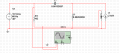
Hey WBahn, can you take a look at what i barely "simulated" , how can i verify my solution? and can you tell me if you have any idea on how to solve such problem theorically without the need of simulation?

1702738035874.png
 

MrAl

Joined Jun 17, 2014
13,667
Hey WBahn, can you take a look at what i barely "simulated" , how can i verify my solution? and can you tell me if you have any idea on how to solve such problem theorically without the need of simulation?

View attachment 310105
Hello again,

Before he gets back here I think I can help to explain what is going on in a simpler way.

It's not even the active source that I thought of in my first thought, and that is because this circuit is just a little bit deceiving.
It has a resistor, R1, yet that resistor has no effect whatsoever on the damping. That means that to the right of the sine source, we have an oscillator just waiting for a little energy so it can go off on it's own for all eternity. In other words, when you excite it with a source like that, the LC combination will act like an oscillator all on it's own, so we end up seeing the frequency from the source plus the frequency from the LC combination.

That's pretty interesting. This is what happens when an LC circuit does not have enough damping. If we added a resistor that was large enough to bring in enough damping this would not happen, but there is only one resistor R1 and that is connected in such a way that it does not draw any energy from the LC section.

Yes, you can prove this theoretically and probably on the bench too, which would also be interesting.
One way is to just analyze the circuit in the time domain and plot the output. One way to do that is to use Laplace Transforms.
Using that approach I see two frequencies, one is the frequency of the source and one is the frequency of the LC section which is w=sqrt(1/(L*C)) often written as sqrt(1/LC).
Also of interest, if we force the source to have the same frequency sqrt(1/LC) we would get an infinite response.

So this circuit is not really a filter it's more like an oscillator.
If we analyze with a step input, we get a frequency output that is probably also sqrt(1/LC).

You might want to try doing the analysis in the time domain. Without giving the solution, I can say that we get a form similar to this:
1/((w1^2+s^2)*(w2^2+s^2))

(that's not for this circuit however) and that indicates that there are two frequencies w1 and w2.
In the time domain that would come out to:
sin(t*w1)/(w1*(w2^2-w1^2))-sin(t*w2)/(w2*(w2^2-w1^2))

which also shows a problem with the denominator if w2=w1. We would end up with an output that increases forever.

One of the other things we have to keep in mind is that this is in theory where L and C are completely ideal elements, and the source has zero internal impedance. To find out what would happen otherwise we'd have to introduce some non-idealities. This does not mean that it won't actually oscillate in practice though because with small damping it might still oscillate.

One last thing...
As @WBahn pointed out, you can solve for L and C once you pick a frequency. You know the impedance of an inductor is j*w*L and for a cap it is 1/(j*w*C) so you can go from there knowing what the given impedance has to be from the schematic.
 
Last edited:

MrAl

Joined Jun 17, 2014
13,667
Hey, well if i recall before getting banned on EE.SE, i posted a question on simulating this exact circuit in AC mode, i got told in a comment that its impossible to simulate such circuit first reason , how would you represent the complex impedance?
Can you explain to me how i would simulate it if its possible, i have multisim 12.0
Hi,

Yes, you would have to do a transient analysis most likely.
A regular AC analysis assumes only one frequency is present.
Most people here use LT Spice. If you use that you can converse with other members about circuits easier.
I could create a file and post it here and you could run it. You'd have to download LTSpice but its free.
 
Last edited:

Thread Starter

salhi

Joined Nov 29, 2023
86
Hello again,

Before he gets back here I think I can help to explain what is going on in a simpler way.

It's not even the active source that I thought of in my first thought, and that is because this circuit is just a little bit deceiving.
It has a resistor, R1, yet that resistor has no effect whatsoever on the damping. That means that to the right of the sine source, we have an oscillator just waiting for a little energy so it can go off on it's own for all eternity. In other words, when you excite it with a source like that, the LC combination will act like an oscillator all on it's own, so we end up seeing the frequency from the source plus the frequency from the LC combination.

That's pretty interesting. This is what happens when an LC circuit does not have enough damping. If we added a resistor that was large enough to bring in enough damping this would not happen, but there is only one resistor R1 and that is connected in such a way that it does not draw any energy from the LC section.

Yes, you can prove this theoretically and probably on the bench too, which would also be interesting.
One way is to just analyze the circuit in the time domain and plot the output. One way to do that is to use Laplace Transforms.
Using that approach I see two frequencies, one is the frequency of the source and one is the frequency of the LC section which is w=sqrt(1/(L*C)) often written as sqrt(1/LC).
Also of interest, if we force the source to have the same frequency sqrt(1/LC) we would get an infinite response.

So this circuit is not really a filter it's more like an oscillator.
If we analyze with a step input, we get a frequency output that is probably also sqrt(1/LC).

You might want to try doing the analysis in the time domain. Without giving the solution, I can say that we get a form similar to this:
1/((w1^2+s^2)*(w2^2+s^2))

(that's not for this circuit however) and that indicates that there are two frequencies w1 and w2.
In the time domain that would come out to:
sin(t*w1)/(w1*(w2^2-w1^2))-sin(t*w2)/(w2*(w2^2-w1^2))

which also shows a problem with the denominator if w2=w1. We would end up with an output that increases forever.

One of the other things we have to keep in mind is that this is in theory where L and C are completely ideal elements, and the source has zero internal impedance. To find out what would happen otherwise we'd have to introduce some non-idealities. This does not mean that it won't actually oscillate in practice though because with small damping it might still oscillate.

One last thing...
As @WBahn pointed out, you can solve for L and C once you pick a frequency. You know the impedance of an inductor is j*w*L and for a cap it is 1/(j*w*C) so you can go from there knowing what the given impedance has to be from the schematic.
Im terribly sorry for the following questions, but can you explain to me what do you mean by oscillator , and what do you mean by the resistor R1 completely going off, we havent gone over none of the concepts you just mentioned, also i dont know why this circuit is subtle to analyze? and also for LTSpice i find it very hard to manipulate for me , i only use multisim , but yes i can download it and to see whats wrong with this circuit, finally infinite thanks!
 

WBahn

Joined Mar 31, 2012
32,703
Well assuming my V2 is valid then, \( \frac{V_1-V_2}{-2j \Omega} = 2I_x + \frac{V_2}{j \Omega} \\
\frac{4I_x}{-2j \Omega} + \frac{V_2}{2j \Omega} = 2I_x + \frac{V_2}{j \Omega} \\
2j \cdot I_x - 2I_x = \frac{V_2}{j \Omega} - \frac{V_2}{2j \Omega} = \frac{V_2}{2j \Omega}\)
Thus \( -2I_x (1-j) = \frac{V_2}{2j \Omega} \iff I_x = \frac{V_2}{4j \Omega} \cdot \frac{1}{-1+j} = 2.5 (-330°) = 2.5(30°)\)
Here you aren't working with the answer you got -- you are just doing some manipulations on the equations you started with. That may or may not tell you anything if you made a mistake in one of the equations -- and it certainly won't tell you if a value of 10sqrt(2) V @ 105° is right or wrong because you never actually use that value in your check.

Let's go through the steps I recommended:

First, make useful annotations on the diagram:

1702767702183.png
1) Figure out what the current in the capacitor is.

\(
I_C \; = \; \frac{V_1 - V_2}{-j2 \; \Omega} \; = \; \frac{\left( 8.660 + j5.0 \right) \; V \; - \; \left( -3.660 + j13.660 \right) \; V}{2 \; \angle -90^\circ \; \Omega} \; = \; \frac{ \left( 12.320 - j8.660\right) \; V}{2 \; \angle -90^\circ \; \Omega} \; = \; \frac{15.060 \; \angle -35.104^\circ}{2 \; \angle -90^\circ \; \Omega} \; = \; 7.530 \; \angle 54.894^\circ \; A
\)

Don't be afraid to do the math.

Now find what I_L is.

Then use I_C and I_L to find what I_CS is, from which you can find Ix.

Compare that value of Ix to the value you get by dividing V1 by 4 Ω.

If they match, within reasonable allowance for roundoff, then your answer is most likely correct (I only say 'most likely' because there is always a change that you have the wrong answer, but then make a math error in your check and coincidentally end up with them matching -- unlikely, but possible).

You know the following

, and from that, what the current in the CCCS is. From that, figure out what Ix must be, and from that, see if Ix multiplied by 4 Ω yields 10 V @ 30°.
 

MrAl

Joined Jun 17, 2014
13,667
Im terribly sorry for the following questions, but can you explain to me what do you mean by oscillator , and what do you mean by the resistor R1 completely going off, we havent gone over none of the concepts you just mentioned, also i dont know why this circuit is subtle to analyze? and also for LTSpice i find it very hard to manipulate for me , i only use multisim , but yes i can download it and to see whats wrong with this circuit, finally infinite thanks!
Hi,

Yes, an oscillator is a device that develops it's own frequency like a sine wave although not limited to that.
Now if you power an oscillator made to be an oscillator with a DC voltage, it produces an output that may be that sine wave, and it will be a frequency dependent on the values like R, C, and L. That's with a DC voltage.
If you power it with an AC voltage of a different frequency, you will get that output frequency and also the frequency of the oscillator itself, so there are two frequencies, and because an AC analysis depends on all the frequencies being the same, an AC analysis will not be able to provide the correct result, because an AC analysis will produce only one frequency at the output.

You may not have learned this yet, but an ideal capacitor and ideal inductor connected together in various ways becomes an oscillator when at least some energy is introduced to the circuit. That means the L and C can produce a frequency dependent on their values, and it is often:
w=sqrt(1/(L*C))
and w=2*pi*f.

Now if you power it with a sine sin(w2*t) that will be a second frequency and so both frequencies may appear at the output.
It depends a lot on the damping of the LC network. If there is enough damping you won't get that second frequency, but without that you do get that second frequency. We could go over damping factors if you like and how that affects a network.

This is why doing a time domain analysis shows two frequencies, one is the frequency of the input sine and the other is the resonate frequency of the LC combination.

R1 does not contribute to the damping because it is always powered directly by the source, and never takes any energy away from the LC part of it. If R1 was in series with C or even in parallel to L, it would take energy from the LC part and that could provide enough damping to stop he LC part from oscillating on it's own.

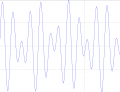
The output will look like a sine wave modulated by another sine wave of a different frequency, although it may just look erratic when the frequencies are close to each other.
In the Laplace domain analysis, we end up with two parts in the denominator of the form s^2+w^2 and one w is one frequency and the other w is another frequency. In the time domain, we see two parts that are cosine and two parts that are sine, and one sine and one cosine can be combined into one sine or cosine with a phase shift, but then we still end up with two sinusoidal parts with phase shifts. The two parts are of different frequencies.

See attachment for a rough idea what this would look like.

There is one little catch to all this though.
If the instructor or the book this problem came from does not know that the output will be two frequencies then the result may be assumed to be a regular AC output. You'd have to find out if that is the case. If the problem was constructed using an AC analysis to check it, it may have not been checked in the time domain so they think the right result is that AC analysis only.
 

Attachments

Last edited:

MrAl

Joined Jun 17, 2014
13,667
Here you aren't working with the answer you got -- you are just doing some manipulations on the equations you started with. That may or may not tell you anything if you made a mistake in one of the equations -- and it certainly won't tell you if a value of 10sqrt(2) V @ 105° is right or wrong because you never actually use that value in your check.

Let's go through the steps I recommended:

First, make useful annotations on the diagram:

View attachment 310134
1) Figure out what the current in the capacitor is.

\(
I_C \; = \; \frac{V_1 - V_2}{-j2 \; \Omega} \; = \; \frac{\left( 8.660 + j5.0 \right) \; V \; - \; \left( -3.660 + j13.660 \right) \; V}{2 \; \angle -90^\circ \; \Omega} \; = \; \frac{ \left( 12.320 - j8.660\right) \; V}{2 \; \angle -90^\circ \; \Omega} \; = \; \frac{15.060 \; \angle -35.104^\circ}{2 \; \angle -90^\circ \; \Omega} \; = \; 7.530 \; \angle 54.894^\circ \; A
\)

Don't be afraid to do the math.

Now find what I_L is.

Then use I_C and I_L to find what I_CS is, from which you can find Ix.

Compare that value of Ix to the value you get by dividing V1 by 4 Ω.

If they match, within reasonable allowance for roundoff, then your answer is most likely correct (I only say 'most likely' because there is always a change that you have the wrong answer, but then make a math error in your check and coincidentally end up with them matching -- unlikely, but possible).

You know the following

, and from that, what the current in the CCCS is. From that, figure out what Ix must be, and from that, see if Ix multiplied by 4 Ω yields 10 V @ 30°.
Hello there,

It does not appear that we can do it that way though. It seems to be a problem because of that LC section. The LC section wants to oscillate on it's own with a different frequency than the input sine. That's what we've been talking about.
 

WBahn

Joined Mar 31, 2012
32,703
Hello there,

It does not appear that we can do it that way though. It seems to be a problem because of that LC section. The LC section wants to oscillate on it's own with a different frequency than the input sine. That's what we've been talking about.
There is no way to determine the oscillating component because it is going to be dictated by the start up conditions of the independent supply. Just making tiny changes in the initial voltage across either the capacitor or the inductor will lead to huge changes in the amplitude and phase of this component.

It can certainly be claimed that whoever devised the problem didn't think carefully enough about this issue, but it is also almost guaranteed that they intended any transient solutions, even if they inadvertently persist due to no mechanism to kill them off given enough time, to be ignored.
 

MrAl

Joined Jun 17, 2014
13,667
There is no way to determine the oscillating component because it is going to be dictated by the start up conditions of the independent supply. Just making tiny changes in the initial voltage across either the capacitor or the inductor will lead to huge changes in the amplitude and phase of this component.

It can certainly be claimed that whoever devised the problem didn't think carefully enough about this issue, but it is also almost guaranteed that they intended any transient solutions, even if they inadvertently persist due to no mechanism to kill them off given enough time, to be ignored.
Hi,

I agree, certainly the amplitude will change with different inputs and initial conditions perhaps, but we usually start out with all initial conditions zero and we use the source amplitude as depicted in the schematic. I'm not sure if initial conditions would change the result except maybe in the early times of the simulation. I did not check for that because there was no mention of initial conditions. It is more energy pumped into the circuit though so amplitude could rise.
My main point though was that doing a pure AC analysis seems to lead to results that are nothing like what we would really see. That's why I was talking about this. I was surprised because I did not look at the drawing carefully enough the first time. When I saw and R, L, and C, I did not notice that the only R was not really part of an "RLC" circuit.
Of course a real inductor has series resistance, and we could look at that too. If we set the damping right I believe an AC analysis will match with the real behavior good enough.

Yeah, I agree too that they probably did not think about the time domain solution when they made this problem. I think it is rare to see a pseudo-oscillator circuit being driven like that with a sine wave, unless maybe making a frequency modulator circuit.
 
Last edited:

Thread Starter

salhi

Joined Nov 29, 2023
86
Here you aren't working with the answer you got -- you are just doing some manipulations on the equations you started with. That may or may not tell you anything if you made a mistake in one of the equations -- and it certainly won't tell you if a value of 10sqrt(2) V @ 105° is right or wrong because you never actually use that value in your check.

Let's go through the steps I recommended:

First, make useful annotations on the diagram:

View attachment 310134
1) Figure out what the current in the capacitor is.

\(
I_C \; = \; \frac{V_1 - V_2}{-j2 \; \Omega} \; = \; \frac{\left( 8.660 + j5.0 \right) \; V \; - \; \left( -3.660 + j13.660 \right) \; V}{2 \; \angle -90^\circ \; \Omega} \; = \; \frac{ \left( 12.320 - j8.660\right) \; V}{2 \; \angle -90^\circ \; \Omega} \; = \; \frac{15.060 \; \angle -35.104^\circ}{2 \; \angle -90^\circ \; \Omega} \; = \; 7.530 \; \angle 54.894^\circ \; A
\)

Don't be afraid to do the math.

Now find what I_L is.

Then use I_C and I_L to find what I_CS is, from which you can find Ix.

Compare that value of Ix to the value you get by dividing V1 by 4 Ω.

If they match, within reasonable allowance for roundoff, then your answer is most likely correct (I only say 'most likely' because there is always a change that you have the wrong answer, but then make a math error in your check and coincidentally end up with them matching -- unlikely, but possible).

You know the following

, and from that, what the current in the CCCS is. From that, figure out what Ix must be, and from that, see if Ix multiplied by 4 Ω yields 10 V @ 30°.
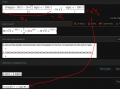
Hello WBahn, i think my method works fine, and also you made a mistake when evaluating Ic , because you choose a positive imaginary value, instead both of the complex parts are negative for V2, i dont think calculating each current apart and then using KCL will be different from what i did, but going with your way , here are the calculations in wolfram alpha i get the correct value for Ix without hacking math numbers manipulation, so whats wrong with this pure AC analysis?

1702822386281.png
 

Thread Starter

salhi

Joined Nov 29, 2023
86
Hi,

Yes, an oscillator is a device that develops it's own frequency like a sine wave although not limited to that.
Now if you power an oscillator made to be an oscillator with a DC voltage, it produces an output that may be that sine wave, and it will be a frequency dependent on the values like R, C, and L. That's with a DC voltage.
If you power it with an AC voltage of a different frequency, you will get that output frequency and also the frequency of the oscillator itself, so there are two frequencies, and because an AC analysis depends on all the frequencies being the same, an AC analysis will not be able to provide the correct result, because an AC analysis will produce only one frequency at the output.

You may not have learned this yet, but an ideal capacitor and ideal inductor connected together in various ways becomes an oscillator when at least some energy is introduced to the circuit. That means the L and C can produce a frequency dependent on their values, and it is often:
w=sqrt(1/(L*C))
and w=2*pi*f.

Now if you power it with a sine sin(w2*t) that will be a second frequency and so both frequencies may appear at the output.
It depends a lot on the damping of the LC network. If there is enough damping you won't get that second frequency, but without that you do get that second frequency. We could go over damping factors if you like and how that affects a network.

This is why doing a time domain analysis shows two frequencies, one is the frequency of the input sine and the other is the resonate frequency of the LC combination.

R1 does not contribute to the damping because it is always powered directly by the source, and never takes any energy away from the LC part of it. If R1 was in series with C or even in parallel to L, it would take energy from the LC part and that could provide enough damping to stop he LC part from oscillating on it's own.

The output will look like a sine wave modulated by another sine wave of a different frequency, although it may just look erratic when the frequencies are close to each other.
In the Laplace domain analysis, we end up with two parts in the denominator of the form s^2+w^2 and one w is one frequency and the other w is another frequency. In the time domain, we see two parts that are cosine and two parts that are sine, and one sine and one cosine can be combined into one sine or cosine with a phase shift, but then we still end up with two sinusoidal parts with phase shifts. The two parts are of different frequencies.

See attachment for a rough idea what this would look like.

There is one little catch to all this though.
If the instructor or the book this problem came from does not know that the output will be two frequencies then the result may be assumed to be a regular AC output. You'd have to find out if that is the case. If the problem was constructed using an AC analysis to check it, it may have not been checked in the time domain so they think the right result is that AC analysis only.
Great insight on oscillators but dont worry i will make effort to study them on my own, to not waste your time, well the point of this problem is ONLY finding the voltage V2, so from what i've conclude from your generous replies, the inductor doesnt care about the input's frequency so it will have a frequency of its own (definition of oscillator)? but why is AC analysis is needed though? isnt basically circuit analysis techniques enough?
 

WBahn

Joined Mar 31, 2012
32,703
Great insight on oscillators but dont worry i will make effort to study them on my own, to not waste your time, well the point of this problem is ONLY finding the voltage V2, so from what i've conclude from your generous replies, the inductor doesnt care about the input's frequency so it will have a frequency of its own (definition of oscillator)? but why is AC analysis is needed though? isnt basically circuit analysis techniques enough?
Basic circuit analysis techniques are enough -- if you are willing to solve the differential equations that result. The point of AC analysis is to turn those differential equations into algebraic equations that are much easier to work with. What you are essentially doing is taking the Laplace transform of everything in the circuit and then evaluating it in such a way that you obtain the steady-state sinusoidal solution.

And it's not that the inductor has a frequency of its own, its that the combination of the capacitor and the inductor have a frequency that results in the energy stored in one of them when the other is storing no energy exactly matches the enerogy stored in the other when it is not storing any. This allows them to shuttle that energy back and forth between them indefinitely (assuming no losses along the path, which is not a good assumption in a real circuit).
 

Thread Starter

salhi

Joined Nov 29, 2023
86
Basic circuit analysis techniques are enough -- if you are willing to solve the differential equations that result. The point of AC analysis is to turn those differential equations into algebraic equations that are much easier to work with. What you are essentially doing is taking the Laplace transform of everything in the circuit and then evaluating it in such a way that you obtain the steady-state sinusoidal solution.

And it's not that the inductor has a frequency of its own, its that the combination of the capacitor and the inductor have a frequency that results in the energy stored in one of them when the other is storing no energy exactly matches the enerogy stored in the other when it is not storing any. This allows them to shuttle that energy back and forth between them indefinitely (assuming no losses along the path, which is not a good assumption in a real circuit).
ah okey i will learn about laplace transform of circuits on my own its out of course context, mind if you take a look at the calculation i've verified using your solution it turns out im right though?
 

WBahn

Joined Mar 31, 2012
32,703
ah okey i will learn about laplace transform of circuits on my own its out of course context, mind if you take a look at the calculation i've verified using your solution it turns out im right though?
Laplace transforms are virtually always covered later, usually in a second-semester circuits course. In the first-semester course, you are just given a technique, usually using terms like "phasor analysis" that magically works. Sometimes you are given some hand-wavy explanation as to why it works.

The situation is actually only a little better when you get to transform methods in the second semester. At least there the curtain is pulled back far enough to reveal that what you are doing is solving differential equations using Laplace transforms, but for most students, they have never seen Laplace transforms and why they work is never covered -- heck, the why isn't even covered in a differential equations class, which is where they are introduced in the math curriculum. To see the why, you need to take a course in math physics, or possibly a complex variables course. Very, very few students ever do that. This has always struck me as an almost unique instance in which a mathematical concept is not developed first prior to being applied, but I have to admit that understanding the 'why' requires such a deeper math grounding than the application does that there's pretty much no alternative, given how powerful and useful transform methods are, whether you understand why they work or not. For most topics, the 'why' and the 'what' are close enough conceptually that the 'why' can be used to push the math grounding along, but this just isn't the case for Laplace transforms.

As for the mistake you caught in my work earlier, you are correct. My eyes are getting bad enough that I missed the negative sign on the -105° when I set that up. That would have resulted in my check not working out, so it would have been caught. To make tracking down the error easier, I should have included the more direct set up in the Latex equations I posted (which I did on the hand-written notes I made). So it should have been:

\(
I_C \; = \; \frac{V_1 - V_2}{-j2 \; \Omega} \; = \; \frac{10 \; \angle 30^\circ \; V \; - \; 10 \sqrt{2} \; \angle 105^\circ \; V}{-j2 \; \Omega} \; = \; \frac{\left( 8.660 + j5.0 \right) \; V \; - \; \left( -3.660 + j13.660 \right) \; V}{2 \; \angle -90^\circ \; \Omega} \; = \; \frac{ \left( 12.320 - j8.660\right) \; V}{2 \; \angle -90^\circ \; \Omega} \; = \; \frac{15.060 \; \angle -35.104^\circ \; V}{2 \; \angle -90^\circ \; \Omega} \; = \; 7.530 \; \angle 54.894^\circ \; A
\)

When you said that both components of V2 should be negative, I looked at my notes and said, "Ah, no. Only the real part is negative." So then I looked at your solution and immediately saw that I was missing that minus sign.

Making that correction should result in (using 'align' to make things better organized):

\(
\begin{align}
I_C \; & = \; \frac{V_1 - V_2}{-j2 \; \Omega} \\
& = \; \frac{10 \; \angle 30^\circ \; V \; - \; 10 \sqrt{2} \; \angle -105^\circ \; V}{-j2 \; \Omega} \\
& = \; \frac{\left( 8.660 + j5.0 \right) \; V \; - \; \left( -3.660 - j13.660 \right) \; V}{2 \; \angle -90^\circ \; \Omega} \\
& = \; \frac{ \left( 12.320 + j18.660\right) \; V}{2 \; \angle -90^\circ \; \Omega} \; \\ & = \; \frac{22.361 \; \angle 56.565^\circ \; V}{2 \; \angle -90^\circ \; \Omega} \\
& = \; 11.180 \; \angle 146.565^\circ \; A
\end{align}
\)

I'm not going to pursue this any further, but it looks like your calculation for Ix works out.
 
Top