Capacitor Charging with Pulses

Thread Starter

JulesP

Joined Dec 7, 2018
458
I did find it but it's all rather different on a Mac:oops:
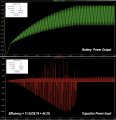
Efficiency.jpeg

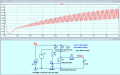
The efficiency will no doubt change with different input PRFs; well it does on the bench due to the capacitor's ability to 'process' the incoming pulses. Too few and there's not much energy input and too fast, they trip over each other to get to the table.
 

crutschow

Joined Mar 14, 2008
38,531
Can’t say I’ve ever seen or used a one button mouse with Mac. That would be very strange.
I guess I'm behind the times, because for many years Mac's only came with a one-button mouse (Jobs didn't want the user to have to remember which button to use. Apparently he had a low opinion of the Apple user memory abilities.)
They finally relented and went to two-buttons with scrolling control in about 2005.
 

Thread Starter

JulesP

Joined Dec 7, 2018
458
Hi Jules,
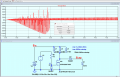
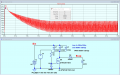
Are these two plots helpful?
E
Yes they are interesting in their differences from mine. My power values are negative so is that because either the current or voltage is negative? You seem to be using my circuit so why is the supply power plot the inverse of mine, but the capacitor one is fairly similar? Hmmmmm
 

Thread Starter

JulesP

Joined Dec 7, 2018
458
I guess I'm behind the times, because for many years Mac's only came with a one-button mouse (Jobs didn't want the user to have to remember which button to use).
Apparently they finally relented and went to two-buttons with scrolling control in about 2005.
I switched over to Mac around 2008, no doubt because of the strong persuasive arguments from by my eldest son who worked for Apple at the time. It’s all his fault . . .
 

crutschow

Joined Mar 14, 2008
38,531
My power values are negative so is that because either the current or voltage is negative?
You sometimes get negative power because of the Spice standards for current direction and voltage polarity.
Thus the power out of a voltage source will plot as a negative value.
You can right-click on the trace title, and add a negative sign at the front of the calculation to make the plot power positive.
 

crutschow

Joined Mar 14, 2008
38,531
I switched over to Mac around 2008, no doubt because of the strong persuasive arguments from by my eldest son who worked for Apple at the time. It’s all his fault . . .
Yes, Apple cult fanatics are a separate breed.
I never bought one, since they always seemed to cost at least 50% more than a PC with equivalent capabilities.
I've used one a few occasions, but never saw any significant advantage over a Windows computer, and Windows computers have more software available.
 

Thread Starter

JulesP

Joined Dec 7, 2018
458
Yes, Apple cult fanatics are a separate breed.
I never bought one, since they always seemed to cost at least 50% more than a PC with equivalent capabilities.
I've used one a few occasions, but never saw any significant advantage over a Windows computer, and Windows computers have more software available.
True up to a point but I have never had a virus attack since no one bothers to make them for Mac. I have every type of software that I could ever use with Windows - it’s a partisan issue
 

ericgibbs

Joined Jan 29, 2010
21,451
Sign "-" used when device lost energy,
but "+" or no sign means that device receives energy.
Hi Danko,
Thanks, but I am already aware of this.;)

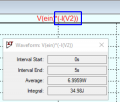
I used the minus sign in order to adjust the LTSpice V2 source current direction, so that it shows the power output of V2 into the circuit in the conventional way.

E
 

Attachments

Thread Starter

JulesP

Joined Dec 7, 2018
458
Hi Danko,
Thanks, but I am already aware of this.;)

I used the minus sign in order to adjust the LTSpice V2 source current direction, so that it shows the power output of V2 into the circuit in the conventional way.

E
Why do you think the current starts to oscillate at 200ms and not before? Perhaps the core has become saturated and the full effect of pulse production has started.
 

Danko

Joined Nov 22, 2017
2,171
Why do you think the current starts to oscillate at 200ms and not before? Perhaps the core has become saturated and the full effect of pulse production has started.
Because fully discharged capacitor shunts D-S of FET through diode and gradually charges through coil from 12 V PS in these 200 ms.
 
Last edited:

Thread Starter

JulesP

Joined Dec 7, 2018
458
Because fully discharged capacitor shunts D-S of FET through diode and gradually charges directly from 12 V PS in these 200 ms.
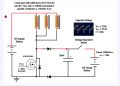
Ok. I still think the model needs tweeking in its series resistances since the bench supply current is in the 150-250mA range not 1-1.5A. The sim is drawing too much so maybe it will better approximate when I include V2 cable and PCB track resistances etc and also on the capacitor side. Tomorrow I will do some Milliohm measurements and use them to add in.
 

Thread Starter

JulesP

Joined Dec 7, 2018
458
I have now added in some series resistances re the battery inputs and the outputs to the capacitor.

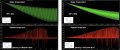
Of interest is the improved efficiency with a higher PWM PRF. Bench observations are that there is a maximum the cap can cope with such that, at for example 250Hz, the effect on the cap drops off. At least with this tool I can now explore with some focused intent.

I am also curious why there are some elements of power to the capacitor that are of opposite polarity to the bulk of it - the bits that look like paint running down the wall. A capacitor with an artistic flair? o_O

Efficiency Comparisons.jpeg
 

ericgibbs

Joined Jan 29, 2010
21,451
Hi Joules,
Having reached this level of discussion and results in the switching/ cap charging circuitry, what is the next step in the project regarding the battery charging/loading as set out in the original circuit?
E
 

Attachments

Thread Starter

JulesP

Joined Dec 7, 2018
458
That's one hell of a big rabbit hole. This query relates to a second research study that is currently underway and which is to try to investigate further the results of the first study completed earlier this year. The way the capacitor responds to inductive pulses will contribute to data used to evaluate the way Pb-Acid and LFP batteries respond to them. I don't wish to start a long discussion on this topic here, for all sorts of reasons, but I will pm you a link and a bit of background.

Any thoughts on the 'dripping paint'?
 
Top