Can I add a second camera source using 2 in 1 RCA splitter cable? Please HELP!

Thread Starter

TONSING

Joined May 28, 2024
15
Alright, my TV has only 1 input RCA port which means only one video source is available/activated at one time say CCTV1.

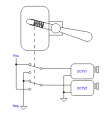
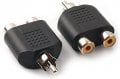
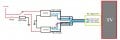
Now, I want to add second video source say CCTV2 to the same input RCA port using 2 input RCA to 1 output RCA splitter cable as shown in attached photos. I add a switch to the power supply side of the second CCTV2 so that I will be able to switch between the 2 CCTVs with only one camera activated at a time. CCTVs has 4 wires - power, ground, video signal and video ground.

The inner rings of the input 2 RCAs are internally connected marked as "BLUE COLOR" and through to the inner ring of the output RCA port.
And, the outer ring of the input 2 RCAs marked as "BLACK COLOR" are also connected together with the corresponding outer ring of the output RCA port. Hence, are grounded.

Now, that when the CCTV1 is ON, the video signal flows from pin 2 (BLUE COLOR) of the splitter RCA, and all the way to the inner ring of the output RCA, hence, displaying images/videos on the TV properly. But, at the same time, since the inner rings of the input RCAs are internally connected, the same video signal is also available at the pin 3 of the lower RCA port.

In this scenario, I have the following questions:-
1. Will this reverse signal voltage flows back into pin 3 of the lower RCA although the CCTV2 is not power ON i.e. switch is OPEN?
2. Will this signal voltage of the CCTV1 have any affect/damages on the CCTV2 although the CCTV2 is power OFF i.e. switch is OPEN?
3. Will there be signal distortion at the TV due to this signal voltage at pin 3?
4. Same confusion for CCTV1 when CCTV2 is ON.
5. If any affect arises due to this video signal voltage, how do I rectify this so that I can use any of the 2 CCTVs at one time using the same 2 in 1 RCA splitter cable? Will diode or capacitor etc works to BLOCK this signal voltage so that the signal voltage does not reach pin 3 when CCTV1 is ON, and does not reach pin 2 when CCTV2 is ON?
rca.jpg


RCA2.jpg
 
Last edited:

Tonyr1084

Joined Sep 24, 2015
9,744
So you want two cameras connected through the splitter. Power CCTV1 (C1) and CCTV2 (C2) off, you want to know if it will work. First off - I don't KNOW if it will or not. Seems like an easy enough test rig to set up. I doubt that splitter is very expensive, so probably a worth while experiment. Looking at your power setup I'm wondering why you need a relay. Do the cameras really draw that much current? My security cameras are 12VDC and they don't draw more than 2 amps each. Probably less, I'd have to check to be sure. Nevertheless, I don't think you need the relay.
 

Tonyr1084

Joined Sep 24, 2015
9,744
C1 video signal might be pulled down by C2 video port. C2 might act to negate C1's video feed. You might end up with a big fat nothing. Only testing will tell. And testing will prove out if it does work - does it work to your satisfaction?
 

Thread Starter

TONSING

Joined May 28, 2024
15
C1 video signal might be pulled down by C2 video port. C2 might act to negate C1's video feed.
Can you please elaborate how C2 will pull down the C1 video signal? But yet the C2 is still powered OFF. How does it pull down the signal of C1?
 

Tonyr1084

Joined Sep 24, 2015
9,744
Can you please elaborate how C2 will pull down the C1 video signal? But yet the C2 is still powered OFF. How does it pull down the signal of C1?
I don't KNOW
Just because a signal is not present its amplifier might still pull the signal from C1 down. As for the relay - all it does is switch power from one camera to the other. A switch will do the exact same thing. However, a DPDT switch might serve the purpose better by grounding the power input to the inactive camera sending both the positive and negative leads to ground (or shorted). I'll draw a picture briefly.
 

Thread Starter

TONSING

Joined May 28, 2024
15
As for the relay - all it does is switch power from one camera to the other. A switch will do the exact same thing.
Okay. I understand this part. Thanks. I can use a SPDT switch to activate the C2.

However, a DPDT switch might serve the purpose better by grounding the power input to the inactive camera sending both the positive and negative leads to ground (or shorted). I'll draw a picture briefly.
Eagerly awaiting because the C2 is arriving tomorrow. Hence, needs immediate SOLID clear answers to all my doubts.
Thanks in advance.
 

Tonyr1084

Joined Sep 24, 2015
9,744
Have an appointment. Will draw it out later. IF I can figure it out. My solution might require a 4PDT switch. No problem, I can sort it out and draw it.
 

Thread Starter

TONSING

Joined May 28, 2024
15
sorry i am looking for activating only one camera at a time. Hence, the discussion/post.
 

Tonyr1084

Joined Sep 24, 2015
9,744
OK, here's my DPDT solution:
Screenshot 2024-11-02 at 12.50.47 PM.png
When the switch is in the down position CCTV1 is powered while CCTV2 has both its power leads grounded. Note the symbol for ground in this case is merely a common ground. Meaning it could have been drawn with a line from ground point to ground point. Or just a simple wire. But something was needed to indicate the negative pole of the power source.

So, will this work? Like I said, you'd have to test it out to see. And like BobTPH said, you can buy an audio/video switch already made.
You can buy A/V switches already made.
No need for this exercise. But if this is something you want to pursue, and again, I don't KNOW if this will work, you can try it.
 

MisterBill2

Joined Jan 23, 2018
27,370
The very short answer is NO! That device shown can not work to use two cameras.
Video signals do not connect in parallel.
BUT there are all sorts of switch boxes that allow you to manually select which one to display.

In addition, because common composite video signals often use a defined impedance transmission line, even an non-powered signal source can have an effect. And really, the typical selector box only switches the signal conductor, not the shield conductor. And there is no need,except to minimize power consumption, to switch off an unwatched camera.
There are many schemes for switching between video signals, such as those used in producing programs, and also for multi camera security systems. And if you are producing video programs such a switch may be worth the effort.
 

Tonyr1084

Joined Sep 24, 2015
9,744
I don't KNOW if it will or not.
Remember, I DID say I didn't know if it would work or not.
Because common composite video signals often use a defined impedance transmission line, even a non-powered signal source can have an effect.
Well, now I know. As I suspected, the two video lines would probably have degraded results if it worked at all. While I was assuming OTHER causes, Mr. Bill has probably hit the nail on the head.

But you don't need a DPDT switch for powering the cameras; you can simply connect two cameras to your splitter and see if the video from one operational camera is good enough while the second camera, not powered, video cable is plugged in.
 

Alec_t

Joined Sep 17, 2013
15,112
A DPDT switch would enable you to switch both the camera supply and the video signal, to save power and avoid possible conflict.
 

Tonyr1084

Joined Sep 24, 2015
9,744
A DPDT switch would enable you to switch both the camera supply and the video signal, to save power and avoid possible conflict.
Hua? Video signal too? How? No, I'm not being a smart-azz, just wondering how a DPDT switch could manage that. Unless you're actually talking about a 4PDT switch. Maybe then it can be switched by switching to CCTV1 and powering CCTV1 at the same time. That MIGHT work. But I'm going to lean on the impedance matching issue.
 

Externet

Joined Nov 29, 2005
2,628
Some CCTV cameras use their video output wire to get its DC feed also, and the shield for common. (power over coaxial)
 

Thread Starter

TONSING

Joined May 28, 2024
15
Do yourself a favor. A Fosmon 4-Way Audio/Video RCA Switch Selector/Splitter Box & AV Patch Cable for Connecting 4 RCA Output Devices to Your TV cost about $12.00 USD on Amazon. Granted you don't need the Audio but this switch gives you 4 channels leaving you two spares and is designed around exactly what you want to do.

Ron
So, in this link, whenever the switch is selected to switch the cameras, does it use relays? When switching takes place, does it power off the other cameras and also cut off the video power wires? Or it cut off the video power wires? What is actually inside this black box? Please kindly elaborate .
 

MisterBill2

Joined Jan 23, 2018
27,370
Why switch the "common" side?? Of course, that is assuming that both cameras have the NORMAL configuration of supply negative being the common, if the output is not isolated. That was the basis for my suggesting that only the video signal line, not the shield be switched, and that likewise, the 12 volt power NEGATIVE side would remain connected and only the positive would be switched.

I AM AWARE that some manufacturers connect the positive supply to the chassis and the shield side of I/O, and if it were within my power, I would forbid importing those products, understanding that it would have a serious impact on their profit. There is no valid excuse for booby-trapping electronic equipment that way.
 
Top