5 second countdown increment, max of 30 seconds

Thread Starter

otibap.z

Joined May 8, 2025
4
I'm building a basic 30-second countdown timer project using only TTL logic components, no microcontrollers. I’m a student and doing this in Multisim.

A push button adds 5 seconds (up to 30 seconds max).
A 7-segment display shows the remaining time (in seconds).
An LED indicator lights up when time remains (OFF if 0).
Time automatically counts down every second.

Please help me
 

crugorocks

Joined May 1, 2025
31
Use a 555 timer in astable mode to generate a 1 Hz square wave (1 pulse/second). The output goes to the clock input of the BCD counter.
 

crutschow

Joined Mar 14, 2008
38,316
The counter counts down to zero from the BCD value set by the push button sequence (priority encoder) circuit.
A BCD to 7-segment converter drives the display.
 

dl324

Joined Mar 30, 2015
18,219
Show what you have so far.

Instead of posting screen shots from Multisim, print to black-and-white PDF and post that. Also, make sure whatever you've drawn is readable (no unnecessary wire jogs, scenic routes, wires over text, etc).
 

WBahn

Joined Mar 31, 2012
32,703
I'm building a basic 30-second countdown timer project using only TTL logic components, no microcontrollers. I’m a student and doing this in Multisim.

A push button adds 5 seconds (up to 30 seconds max).
A 7-segment display shows the remaining time (in seconds).
An LED indicator lights up when time remains (OFF if 0).
Time automatically counts down every second.

Please help me
You need to show YOUR best attempt to get as far as you can and describe the specific issue you are struggling with right now. We can then help you get past that issue so that YOU can continue solving YOUR assigned project.

Don't try to do everything all at once. For the time being, forget about adding five seconds or maxing things out at thirty seconds. Forget about LEDs. Forget about seven-segment displays. Heck, forget about two-digit values. Start with getting a counter that counts down from 9 to 0 and then rolls back over to 9 and keeps going. Even before you do that, you will need a clock signal. Can you use a built in source in Multisim, or do you have to build that up as well, such as with a 555 timer IC?

Until you can get a one-digit BCD down-counter working in this most-basic mode, you can't hope to get anything more complicated working.

Once you have that working, decide which feature you want to add next. Perhaps adding a single 7-seg display to the digit you now have working, or perhaps adding a second BCD digit so that you have a circuit that does nothing but count down from 99 to 00 and then wraps around and keeps going.

At some point, you are going to need to flesh out your system's behaviors more fully. For instance, what should happen after the count reaches zero? Should it stay at zero? Should it start over at 30 seconds (or some other initial value)? What is the exact nature of the push-button's behavior? If you press it three times in a half a second, should it add a total of fifteen seconds to the time? Or can it be more restrictive and just add five seconds if it is pressed when a clock tick occurs? The latter behavior is much easier to implement reliably than the former.
 

Thread Starter

otibap.z

Joined May 8, 2025
4
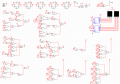
I already have a working Multisim. I use 5x D flipflops for my BCD, but it has too many components for me to properly wire it on a breadboard. Also, how am I going to do the clock in 555? Is there any simpler way to do it?
 

Attachments

dl324

Joined Mar 30, 2015
18,219
It's been several days now. When is this assignment due?

Could you post the text for the problem and your work (truth table, equations, kmaps)?

Also, as I mentioned in my first post, a black-and-white PDF file is better than a screen capture.
 
Last edited:

dl324

Joined Mar 30, 2015
18,219
I implemented the 5-bit counter with about the same number of gates as you (I used about 60). I think this made the +5 much easier to implement vs using a decade and 0-3 counter. I don't know what you did with the BCD decoders. I implemented a 5-bit binary to BCD decoder using about 40 gates.
 

Thread Starter

otibap.z

Joined May 8, 2025
4
I implemented the 5-bit counter with about the same number of gates as you (I used about 60). I think this made the +5 much easier to implement vs using a decade and 0-3 counter. I don't know what you did with the BCD decoders. I implemented a 5-bit binary to BCD decoder using about 40 gates.
This is my problem, it is also my final examination week, which is why I'm not able to reply asap
 

Attachments

dl324

Joined Mar 30, 2015
18,219
This is my problem, it is also my final examination week, which is why I'm not able to reply asap
How about posting the text describing the problem? And posting your work.

EDIT: Posting a PDF with a color screen capture of your circuit is not the same as printing to a black-and-white PDF file from Multisim. Resolution is still poor. And you're still using that worthless connect-by-name netlist style of schematic. Also, the set and resets on the JKFF appear to be HIGH active and you have them all connected HIGH. What is the significance of the black, blue, and green gates? Color coded schematics generally indicate inexperience/lack of knowledge.
 
Last edited:
Top