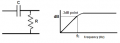
The capacitor followed by a resistor to ground constitute a high-pass filter. You need to post both C and R values to determine the low frequency cutoff.
The capacitor followed by a resistor to ground constitute a high-pass filter. You need to post both C and R values to determine the low frequency cutoff.
I am assuming that the resistor to ground is meant to bias the op-amp's input to reduce noise, and the capacitor is there to eliminate any DC that might be induced or produced by the pickup?
No, the pickup doesn't generate any DC. It's there to remove low frequency noises, such as handling noises, dropping the guitar on the floor, etc. which would otherwise get amplified.
Thanks for joining the conversation Ya'akov ... mind elaborating? ... why would I need to use a capacitor rated for high voltages? .. unless you're talking about a variable/trimmer capacitor?
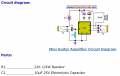
Battery voltage is 3.6 V connected between V+ and V-.
U1 creates a low impedance reference (pseudo ground) at 1/2 supply voltage, i.e. 1.8 V, indicated by the white triangle. C1 filters out noise at the reference voltage created by voltage divider R1 and R2. U1 is configured as a unity gain non-inverting buffer.
U2 is a non-inverting amplifier with a voltage gain of 23. Adjust R4 for desirable gain.
Voltage gain = 1 + R4/R3
U3 is an inverting amplifier with a voltage gain of 22. Adjust R6 for desirable gain.
Voltage gain = R6/R5
Overall voltage gain is 506. If you need more gain, increase R4 first.
Sorry if this is off the rails but I have a long-held notion in my head: Don't most guitar amps start with a JFET as the first stage? Have specialized op-amps changed that?
Sorry if this is off the rails but I have a long-held notion in my head: Don't most guitar amps start with a JFET as the first stage? Have specialized op-amps changed that?
No - they start with an ECC83!
You need >220k input impedance to get a decent treble response because there is about 6H of inductance in the pickup.
Anything much higher than that fails to damp the pickup/cable resonance and gives a big peak the midrange response.
So JFETs or JFET op-amps will work fine.
First, I am not convinced that using an op-amp without power connected would provide any useful output.
Next, all GOOD guitar pickups only respond to magnetic field variations relative to a very small volume around the end of the pole-piece. AND, even the best guitar pickups response drops off at frequencies below 15 Hz. They do not respond to a constant magnetic field. The one possible exception is HALL EFFECT pickups.
It is not likely that any concentration of salt ions will affect that magnetic field.
So the next question would be what the rate of change would be in the concentration of salt ions passing by. Inductive pickups ONLY sense a changing magnetic field, a constant magnetic flux has no effect. In addition, what sort of volume of salt-ion containing fluid is passing by? Is it milliliters per minute or gallons per second?
My limited chem-lab experience only included measuring electrical conductivity to imply ion concentrations.
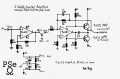
Your comments have been duly noted, Bill. I do understand that a constant magnetic will not generate a signal at the pickup. That is why turbulence is being induced in the fluid. I expect that the whirling ions passing above the pickup will generate some sort of noise. To this effect, I'm building a small pickup using a 4x10mm magnet with roughly 4,000 turns of 42 ga magnet wire tightly wound around it. I intend to connect the assembly to a two stage amplifier similar to the aforementioned µCurrent device.
I will be performing the tests tomorrow evening or friday morning at the latest. Wish me luck.
It may be totally irrelevant here but that description triggered a memory. I was once looking for high impedance op-amps and narrowed in on LMC6035 or LMC660. I never actually used either of them. They have input bias currents in the single pico-amp range.
Setting things up for the test ... Step one: wind a small coil using a custom designed machine I fabricated a few years ago for purposes such as this. The coil is wrapped around a 4x10mm neodymium magnet using 42ga magnet wire. 45 layers of 104 turns each. Wish me luck!
I see it as signal to noise. I don't know how much of a signal your coil will produce. Your testing to date may have proven that you get an adequate signal and this whole point is moot. But if the coil is only sending a tiny signal - a tiny current being passed across the DC-blocking capacitor - then having a low bias current will allow the signal current to not be swamped by the bias current.

 Facebook
 Google
 GitHub
 Linkedin