Building a sensitive pickup

Thread Starter

cmartinez

Joined Jan 17, 2007
8,722
I've been experimenting with guitar pickups as of late, and I must say they're a very interesting subject. My main area of expertise is microcontrollers, And I have little experience with analog circuits. I'm not exactly a noobie, but I'm definitely not an expert.

My question should be easy to answer for those in the know. it's a little dumb, but I'd rather ask the dumb question than stay dumb.
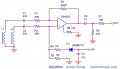
1770057056663.png

In the circuit shown above, why are the decoupling capacitors C1 and C2 being used? ... I mean, I understand that their main purpose is to prevent the flow of DC current and feed a varying voltage signal into the amplifier instead. But why are they there? What would happen if the caps were removed and the coils were connected directly into R1 and R3 instead?
 

wayneh

Joined Sep 9, 2010
18,087
I mean, I understand that their main purpose is to prevent the flow of DC current ...
No expert here, either, but I think that's the nub of it. Without those blocks, there are current paths to ground thru the coils. Even if a little is OK, in the sense of not damaging the coil, any voltage at the coils would likewise appear on the op-amp pins and affect the bias voltage there as @sghioto has noted.
 

Thread Starter

cmartinez

Joined Jan 17, 2007
8,722
I think I'm beginning to understand. The amplifier's voltage is being fed through its positive input pin and NOT through its normal power input. That way the coil is also being biased .. but why?, why does the coil need to be bias? And what is that diode doing there other than preventing the battery from being misconnected?
 

MrChips

Joined Oct 2, 2009
34,628
I wouldn’t call them decoupling capacitors. I would call them AC coupling capacitors.

You are not biasing the coils. You are biasing the inputs of the op amp.
The inputs need to be biased to 1/2 Vs, i.e. 4.5 V.
Without C1 and C2, the pickup coils would pull the inputs to ground or common.

Similarly, C3 is to remove the 4.5 V offset and return the signal biased to ground.
 

Thread Starter

cmartinez

Joined Jan 17, 2007
8,722
I wouldn’t call them decoupling capacitors. I would call them AC coupling capacitors.

You are not biasing the coils. You are biasing the inputs of the op amp.
The inputs need to be biased to 1/2 Vs, i.e. 4.5 V.
Without C1 and C2, the pickup coils would pull the inputs to ground or common.
Thanks for chiming in, Chips. All help is thoroughly appreciated.

The diagram I posted belongs to what is called an active pickup. Its 9v battery supposedly lasts for months due to its very low power draw. I is my understanding that the circuit is basically a pre-amp of sorts. Question, what would a normal pre amp diagram for a passive pickup look like? Would it basically be the same as the one I posted?
 

MrChips

Joined Oct 2, 2009
34,628
Thanks for chiming in, Chips. All help is thoroughly appreciated.

The diagram I posted belongs to what is called an active pickup. Its 9v battery supposedly lasts for months due to its very low power draw. I is my understanding that the circuit is basically a pre-amp of sorts. Question, what would a normal pre amp diagram for a passive pickup look like? Would it basically be the same as the one I posted?
Pre-amp for passive pickup? Not sure I understand.

A non-powered guitar would have a passive gain and tone control.

An active pickup will have a circuit similar to what you have shown, with volume and tone controls added.

A preamp can go in a stomp or fx box. Or it can be a preamp in the main amplifier. There are many variations on this theme.

I’m not at base but you can search for guitar pickup circuits. When I get back I can post some typical circuits.

What are you trying to do?
 

Thread Starter

cmartinez

Joined Jan 17, 2007
8,722
What are you trying to do?
I am trying to use a guitar pickup for a purpose other than a musical instrument. What I am trying to do, is to use the pickup to detect salt ions traveling inside a fluid. For this purpose, I replicated Dave Jones' uCurrent circuit (which has two op-amp stages) and connected it to a pickup and then tested it. But the pickup I connected is a single winding type, and therefore does not have a ground connection as in the diagram. The results I obtained look promising. But Jones' circuit is designed to detect current, and not variations in voltage. And I'm wondering if tweaking the circuit by removing the 10k load resistor (R2 iin the circuit) and adding the capacitors will improve its output.
 

Thread Starter

cmartinez

Joined Jan 17, 2007
8,722
Thanks for joining the conversation Ya'akov ... mind elaborating? ... why would I need to use a capacitor rated for high voltages? .. unless you're talking about a variable/trimmer capacitor?
 

MrChips

Joined Oct 2, 2009
34,628
So, you want to amplify a signal from pickup coils.

I would use balanced power supply, for example ±10 to ±15 V and an op amp such as TL071/2/4, without AC coupling capacitors.

As for detecting moving ions, you’re on your own there.
 

Thread Starter

cmartinez

Joined Jan 17, 2007
8,722
I would use balanced power supply, for example ±10 to ±15 V and an op amp such as TL071/2/4, without AC coupling capacitors.
Thanks ... but I'm restricted to 3.6V battery power ... :(

As for detecting moving ions, you’re on your own there.
yeap ... I'm pretty much aware of that ... but I just love a good challenge ;)


To be clear ... if I were to obtain an output signal of 1V that would be perfect. Said signal could be random noise for all I care. And yes, I do understand that the fluid must be in motion for a signal to be generated.
 

MrChips

Joined Oct 2, 2009
34,628
NCV5230 can run on 1.5 V supply.
If you don’t want to use two batteries for a split supply, simply create a common reference at 1/2 supply voltage. Connect the coil to common and skip the coupling capacitors.
 

Thread Starter

cmartinez

Joined Jan 17, 2007
8,722
NCV5230 can run on 1.5 V supply.
If you don’t want to use two batteries for a split supply, simply create a common reference at 1/2 supply voltage. Connect the coil to common and skip the coupling capacitors.
What about the NCS333A ? I have some of those laying around. Do you think they could work?
 

Thread Starter

cmartinez

Joined Jan 17, 2007
8,722
After some browsing, I'm finding that virtually all of the electric guitar amplifiers out there use an AC coupling (according to MrChips' definition) capacitor in them, followed by a resistor connected to ground.

I am assuming that the resistor to ground is meant to bias the op-amp's input to reduce noise, and the capacitor is there to eliminate any DC that might be induced or produced by the pickup?

In any case, I found that the capacitor and resistor values can vary widely. With the cap range being something from 220pF all the way up to 10µF, and the resistor from 4.7k up to 1Meg ... this is very hard for me to understand ...
 
Top