Building a home made charger at European frequency

Thread Starter

Samantha Groves

Joined Nov 25, 2023
151
Hi.I have decided to design a custom charger for my devices.I am going through the electrical analysis for the time being.So I needed some help with that.

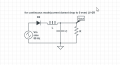
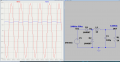
Suppose you had a sine wave coming from your outlet.Suppose you had a diode in series with that AC source.During the half-cycle that the diode conducts ideally there is no voltage drop on the diode and Vin=Vout.During the half-cycle that the diode doesnt conduct the voltage drop on the diode is Vin and Vout=0.Now supposed you added a inductor in series.We again split the cycle into 2 half-cycles when during one diode conducts ,while during other diode doesnt conduct.Because you have cycle after cycle by taking into consideration the equation of the inductor:
dI/dt = V/L you can say that dI/dt = dI_{halfcycle}/T_{halfcycle} = V/L or that dI_{halfcycle} = 2V/Lf_{outlet} (in Europe it is 50Hz).

Suppose you added a resistor in series to all of these components.The resistor draws a average current I=V/R.So if you want to have a continuous mode V/R>2V/Lf or Lf>2R.Am I correct?
 

ronsimpson

Joined Oct 7, 2019
4,645
A schematic would be nice.
I have seen supplies using a large inductor. The problem is the LARGE INDUCTOR. With 50hz the inductor needs to be larger than with 60hz.
Another problem is your supply sits on the power line and has no isolation.
 

Ian0

Joined Aug 7, 2020
13,097
If you have continuous current, then the output voltage must be the average of the input voltage, which is Vpeak/π, or if you use a bridge as @crutschow suggests, Vpeak*2/π. How are you going to utilise 103V (or 206V)?
 

MisterBill2

Joined Jan 23, 2018
27,159
Most often, when developing a circuit for any type of power supply, including a battery charger type, there is a specification for voltage, and usually a current.
R.S. asked that in post #6! I ask for it again in post #10!
So far I have seen a few partial circuits without much hint towards the required design output. Rather strange.
 

Thread Starter

Samantha Groves

Joined Nov 25, 2023
151
Most often, when developing a circuit for any type of power supply, including a battery charger type, there is a specification for voltage, and usually a current.
R.S. asked that in post #6! I ask for it again in post #10!
So far I have seen a few partial circuits without much hint towards the required design output. Rather strange.
I am looking for the circuit of the battery charger I can always use a capacitive voltage divider with low input impedance before feeding it to the rectifier.
 

MisterBill2

Joined Jan 23, 2018
27,159
An easy scheme will be the half wave plus flyback diode scheme charging a 96 volt battery pack, whic might actually be a 96 volt string of 12 volt batteries. 110 volts DC would charge it at a reasonable rate. But the really simple scheme will be a transformer designed to provide whatever voltage is desired. The transformer will also provide adequate isolation, unless an autotransformer scheme is used. In my stack I found a stepdown transformer 120 volts to 100 volts, for operating a sound system intended for a country with 100 volt service. But not isolated! That could be OK for charging a battery sitting on a shelf, but rather hazardous for charging a car battery in place in the car.
 

Thread Starter

Samantha Groves

Joined Nov 25, 2023
151
An easy scheme will be the half wave plus flyback diode scheme charging a 96 volt battery pack, whic might actually be a 96 volt string of 12 volt batteries. 110 volts DC would charge it at a reasonable rate. But the really simple scheme will be a transformer designed to provide whatever voltage is desired. The transformer will also provide adequate isolation, unless an autotransformer scheme is used. In my stack I found a stepdown transformer 120 volts to 100 volts, for operating a sound system intended for a country with 100 volt service. But not isolated! That could be OK for charging a battery sitting on a shelf, but rather hazardous for charging a car battery in place in the car.
Ok thanks.
 

MisterBill2

Joined Jan 23, 2018
27,159
Westill have not been told about what the battery voltage is.
Without knowing the voltage or the current it is rather difficult to design an efficient charging circuit. MZ Groves, being a computer engineer, certainly should be able to inform us as to the battery voltage. That really is quite important for a battery charger.
 

Thread Starter

Samantha Groves

Joined Nov 25, 2023
151
Westill have not been told about what the battery voltage is.
Without knowing the voltage or the current it is rather difficult to design an efficient charging circuit. MZ Groves, being a computer engineer, certainly should be able to inform us as to the battery voltage. That really is quite important for a battery charger.
Well yes sorry for keeping you w8ing.I messed up.Well I want to charge my phone so its 5V ,1A.
 
Last edited by a moderator:

gaber2611

Joined Mar 14, 2013
321
Westill have not been told about what the battery voltage is.
Without knowing the voltage or the current it is rather difficult to design an efficient charging circuit. MZ Groves, being a computer engineer, certainly should be able to inform us as to the battery voltage. That really is quite important for a battery charger.
Right
 

Thread Starter

Samantha Groves

Joined Nov 25, 2023
151
Your proposed circuit has nothing that will drop the voltage to 5V. How are you expecting that to work?
Well im looking for the circuit of the rectifier.I can always use a inductive or capacitive voltage divider(to not waste heat) to reduce the voltage to appropriate levels.
 

Ian0

Joined Aug 7, 2020
13,097
Well im looking for the circuit of the rectifier.I can always use a inductive or capacitive voltage divider(to not waste heat) to reduce the voltage to appropriate levels.
You can, but then you would need isolation, so you would still need an isolating transformer.
 
Top