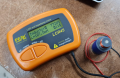
Right, so you're well within the region where the source looks resistive (L/R filter formed by the source resistance and inductance is at about 1kHz). So you have a source impedance of 772Ω, and that will effectively almost short out any circuit input resistance you include. Don't use any coupling capacitors, because they form high-pass filters.
If you are interested in low frequencies, then you need to find an op-amp with a low 1/f noise corner, which rules out a lot of CMOS op-amps. Your source resistance isn't so low you that you could use an op-amp with big bipolar transistors on the input such as a LT1028 because the current noise goes up. The good old NE5532/4 would be perfect.
Nice! ... thanks for the tip. It looks like an interesting chip, and it's low priced too. Unfortunately, I don't have any of those with me at this point. Here's a list of the chips I have available at the moment:
The one I'm currently testing is the best of the lot, which is the MAX4239. But I'm hoping I can make things work with the NCS333 since it's the lowest priced in the list. The circuit I built has two stages in it. I'm thinking about maybe adding a third stage, but I suspect that not only would it be overkill but that maybe noise would become so large as to be unusable too.
The TP5591 has by far the best noise performance at low frequencies.
With an open loop gain of >100dB, you should get enough gain out of a single stage.
Adding more stages just adds more noise, because each amplifies the noise from previous stages then adds its own noise,
The TP5591 has by far the best noise performance at low frequencies.
With an open loop gain of >100dB, you should get enough gain out of a single stage.
Adding more stages just adds more noise, because each amplifies the noise from previous stages then adds its own noise,
I'd go for the TP5591. You don't need the bandwidth of the NE5532, and its 0.1Hz 1/f noise corner if great for low-frequency amplification.
And probably you don't have ±15V supplies at 16mA handy
That I most certainly do not have ... My circuit works with 3.6V, It's a non-negotiable requirement unfortunately. But your supporting the TP5591 makes me feel a lot more confident, thanks.
Btw, I've already tested the design using two stages of the MAX4239AUT+T and the results look promising. I'm definitely reading a signal, but it's a little too noisy for my taste. I'm going to assemble another board using the TP5591 and test it, and then I'll get back with the results.
I've just tested the TP5591 and as you predicted, the results were significantly better. I've almost made it work the way I want it to. But only by using two stages. If I try to use a single stage I get too much noise in the output if I adjust the gain high enough. Also, the value of the resistor to ground at the input (what's it called? a bias resistor?) is also important. If it's too low no signal is produced at the output, and if it's too high then all hell breaks lose and the noise becomes undistinguishable from the signal. As you may have already guessed, my circuit is full of pots and jumpers that allow me to reconfigure it quite easily.
I'll be doing some more testing tomorrow and get back with more observations and results.
Thanks for getting involved ST ... no further requirements at this point. Right now I'm concentrating on getting any type of signal that can be separated from noise in a flow/no-flow situation. From what I'm seeing, I think I'm going to need either a strong RC filter or some sort of a resettable peak-detector to make this thing work using an MCU with ADC capabilities.
Quick question. Is the coil's relative length and position with the magnet relevant? ... that is, is it best to have the coil's length equal to that of the magnet? Or, for instance, would a coil half the length and flush with one of the magnet's poles be more sensitive, relatively speaking?
I've seen designs in which one of the magnet's poles protrudes about 1/8 of its length from the coil. Is that to make the assembly more sensitive, or is there another reason?
I've just tested the TP5591 and as you predicted, the results were significantly better. I've almost made it work the way I want it to. But only by using two stages. If I try to use a single stage I get too much noise in the output if I adjust the gain high enough. Also, the value of the resistor to ground at the input (what's it called? a bias resistor?) is also important. If it's too low no signal is produced at the output, and if it's too high then all hell breaks lose and the noise becomes undistinguishable from the signal. As you may have already guessed, my circuit is full of pots and jumpers that allow me to reconfigure it quite easily.
I'll be doing some more testing tomorrow and get back with more observations and results.
The noise from a single stage is always less that the noise from two stage with the same overall gain.
if overall gain is G1*G2
Then for a single stage, the noise will simply be Vn1*G1*G2.
For two stages it will be (Vn1*G1+Vn2)*G2
There will be noise from the resistors, but increasing the gain by a factor of G2 requires a resistor G2 times as large, but the noise contribution from that larger resistor will only increase by √G2, because noise is √(4kTRf)
Because the op-amp has a restricted bandwidth, you might be getting hf noise, which is attenuated by the op-amp. In which case, a capacitor across the feedback resistor to restrict the bandwidth to the range you are interested in will help.
If you're using a single supply, then you are back to needing coupling capacitors. But if you are interested in low frequencies they will need to be quite large.
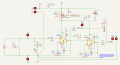
As you can see, the circuit has a few jumpers in it in order to enable or disable certain features more easily. I'm using a single 3.3V supply, and the pickup (represented as L1) is connected directly to the circuit. I had to adjust RV1 to about 13.2k to avoid too much noise being produced at the output, and the RV2 and RV3 are connected as voltage dividers to easily adjust both stage's gain. Currently RV2 is set at 11.50k/89.50k and RV3 is 1k/99k. That is, a gain of 8.78 and 100, if I'm not mistaken.
The opamps I'm currently playing with are the TP5591-TR. The results have been mixed so far. Any recommendations?
Exactly!
Run a simulation to determine the -3db frequency with your actual component values. Then tweak those values to get that frequency approximately one octave higher than your highest frequency of interest.
Would it make sense to put a capacitive load on the coil and thus the op-amp inputs? I'm thinking this would soak up higher frequency noise that you're not interested in.

 Facebook
 Google
 GitHub
 Linkedin