Building a sensitive pickup

AnalogKid

Joined Aug 1, 2013
12,135
I am assuming that the resistor to ground is meant to bias the op-amp's input to reduce noise, and the capacitor is there to eliminate any DC that might be induced or produced by the pickup?
The cap prevents DC produced by the electronics to go backwards into the pickup. The pickup by itself cannot produce DC. If you want to complain about that, dig up Michael Faraday.

In many amps, the resistor sets the load impedance seen by the pickup. This affects the signal's frequency and transient response. The lower the impedance, the greater the high-frequency roll-off of the signal. The system is basically a voltage divider with a series inductor and a shunt resistor. Because of the inductor's frequency/impedance characteristic, the overall circuit is a lowpass filter.

Separate from that, the cap also is in series with the pickup inductance. Depending on exactly where the cap is in the circuit, this can act as a high-pass filter.

Messy.

ak
 

Thread Starter

cmartinez

Joined Jan 17, 2007
8,765
If you want to complain about that, dig up Michael Faraday.
Do you have his contact info so I can file my suggestions?

Very messy. As I said in the first post, I'm far from being an analog expert. I do understand the math, though, and the reasoning behind the suggestions being given. But I'm also getting that this is a very empirical science, depending on a plethora of factors. The way I get things, the only way to achieve what I want is to actually build the thing, test it, and adjust it on the fly. Which is exactly what I'm doing.

Many thanks for your involvement, AK.
 

Ian0

Joined Aug 7, 2020
13,132
Would it make sense to put a capacitive load on the coil and thus the op-amp inputs? I'm thinking this would soak up higher frequency noise that you're not interested in.
Yes, but somewhere you will get a resonance between said capacitor and the 100mH inductance. It will need enough resistance to damp that.
 

Ian0

Joined Aug 7, 2020
13,132
A schematic says a thousand words:


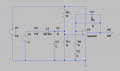
As you can see, the circuit has a few jumpers in it in order to enable or disable certain features more easily. I'm using a single 3.3V supply, and the pickup (represented as L1) is connected directly to the circuit. I had to adjust RV1 to about 13.2k to avoid too much noise being produced at the output, and the RV2 and RV3 are connected as voltage dividers to easily adjust both stage's gain. Currently RV2 is set at 11.50k/89.50k and RV3 is 1k/99k. That is, a gain of 8.78 and 100, if I'm not mistaken.

The opamps I'm currently playing with are the TP5591-TR. The results have been mixed so far. Any recommendations?
Your grounds are a problem, because you only have a single supply.
You will need coupling capacitors, at least 10 times bigger than 1/(2πfR) where f is the lowest frequency you want to detect, and R is the input resistance. Then you will need another similar capacitance between the gain setting resistor and ground. And you will need to bias the non-inverting input to half supply. I'll draw it out.
 

Ian0

Joined Aug 7, 2020
13,132
Screenshot from 2026-02-06 19-19-45.png
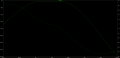
Your high frequency cutoff is set by 1/(2π.R5.C3)
You low frequency cutoff is set by 1/(2π.R4.C2) and 1/(π.R2.C1) where R2 and R3 are the same value, so it's really 2π.(R2/2)
C4 is the filter capacitor suggested by @wayneh , but it will give you a resonance at 1/(2π√(L1.C4)), which is damped by R2 and R3.
 

MisterBill2

Joined Jan 23, 2018
27,530
For a functional check, you could point the megnetic pickup at the speaker of a small portable device, radio or boombox. No idea as to how close , but the ACmagnetic field in front of a speaker will not be very much.
 

Thread Starter

cmartinez

Joined Jan 17, 2007
8,765
View attachment 363168
Your high frequency cutoff is set by 1/(2π.R5.C3)
You low frequency cutoff is set by 1/(2π.R4.C2) and 1/(π.R2.C1) where R2 and R3 are the same value, so it's really 2π.(R2/2)
C4 is the filter capacitor suggested by @wayneh , but it will give you a resonance at 1/(2π√(L1.C4)), which is damped by R2 and R3.
Just to make things clear for me, R1, L1 and V2 put together represent the whole pickup assembly? With V2 representing the voltage produced by excitation?
 

Ian0

Joined Aug 7, 2020
13,132
No. There is a way of accomplishing it, but it is not simpler than adding the coupling capacitors and bias resistors!
 

Thread Starter

cmartinez

Joined Jan 17, 2007
8,765
Here's my goal: I want to filter out all frequencies above 100 Hz, and be able to detect anything below that, going as low as 1Hz, if possible. But the values I'm getting for caps and resistors are off the charts. I guess I could settle for 5 Hz, but I'm still not sure if that'd be realistic.
 

Ian0

Joined Aug 7, 2020
13,132
Try: R2, R3=22k, which gives C1>15uF.
R4=470Ω (so its noise is less than the thermal noise of the pickup) which gives C2>330uF
R5 = 470k to give 60dB gain, which gives C3=3.3nF

Calculating C4 for a 100Hz rolloff with L1 gives 22uF, but that is too large, because of the source resistance.
Ignoring L1 and calculating C4 for a 100Hz bandwidth with the 772Ω source resistance gives 2.2uF (which really should be a film capacitor)
The 47u and 470u have bias voltages across them so can be ordinary electrolytics.Screenshot from 2026-02-06 22-28-15.pngScreenshot from 2026-02-06 22-27-55.png
 

wayneh

Joined Sep 9, 2010
18,104
The 47u and 470u have bias voltages across them so can be ordinary electrolytics.
I'm having trouble seeing that for C1. Can't the coil pull the other end well above or below ground? The simulation may use only positive values of V2 but I think in real life it can go negative? I guess the same argument applies to C4.
 

Thread Starter

cmartinez

Joined Jan 17, 2007
8,765
And here's a thought ... since I plan to use a battery for this circuit, I'm planning on switching on every couple of seconds, take a sample, and switch it off again. How long would it take for it to stabilize after applying power? Also, wouldn't C2 draw a significant amount of current during power up? Could that be somehow minimized?

And yeah, I know that I'm beginning to sound like a picky Diva ... trust me, I don't mean to, I just want the best and most efficient circuit possible for this application.
 

Ian0

Joined Aug 7, 2020
13,132
I'm having trouble seeing that for C1. Can't the coil pull the other end well above or below ground? The simulation may use only positive values of V2 but I think in real life it can go negative? I guess the same argument applies to C4.
No - the simulation uses an AC signal for V2. The output of V2 goes between -10mV and +10mV.
Non-inverting input of the op-amp is biassed to half supply, so that the voltage there varies between 1.81V and 1.79V. Therefore there is 1.8V across the capacitor at all times.
 

Ian0

Joined Aug 7, 2020
13,132
And here's a thought ... since I plan to use a battery for this circuit, I'm planning on switching on every couple of seconds, take a sample, and switch it off again. How long would it take for it to stabilize after applying power? Also, wouldn't C2 draw a significant amount of current during power up? Could that be somehow minimized?

And yeah, I know that I'm beginning to sound like a picky Diva ... trust me, I don't mean to, I just want the best and most efficient circuit possible for this application.
Only R2/R3 and the op amp will take any current. You could probably find an op-amp with a shut-down feature which would solve that part of it.
R2 and R3 can be increased in value without any detrimental effect, provided that the op-amp has sufficiently low bias current, because from a noise point of view, they are shorted out by R1 (the coil resistance), but it might involve using an op-amp that you don't have in stock!
You can easily calculate the amount of charge C2 will take, it is Q=CV. It will only take this once every time it is switched on, so the average current is CV/t where t is the time it is switched on for.
The time taken to stabilise is directly proportional to the low-frequency response. As it stabilises in an exponential way, it depends on how stable you need the centre point of the waveform before you take measurement.
C2 would not need to stabilise if you were to replace it by two capacitor of half the size, one where it is, and one connected to the positive supply.
 
Top