Building a DIY Regulated Buck Converter using no ICs

Thread Starter

RebelliousResistor

Joined Mar 18, 2025
18
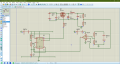
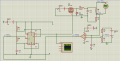
So i am trying to build this circuit using nothing but basic components (RLC) with a 555 timer for the PWM and Op Amps for feedback to ensure it is regulated. It needs to be able to take an input of 20V +- 4V and output a steady 5V@0.5A. My idea is to take a voltage divider at the buck converter power stage output and feed it along with a constant reference voltage to an op amp to amplify the error. Then that signal would be put into pin 5 of the 555 timer to control the Duty cycle. I have attached my circuit and I am unsure why Proteus is giving me logic 0 throughout the circuit and not functioning the way i intend it too. Any ideas on how to fix it would be greatly appreciated. I will attach my schematic as a screenshot.
 

Attachments

ElectricSpidey

Joined Dec 2, 2017
3,312
Using the 358 and a 555 seems to contradict the title of the post.

When I clicked on this post, I was expecting to see a design without any ICs and was very curious.
 

Ian0

Joined Aug 7, 2020
13,097
The common-drain MOSFET with 5V on the gate is never going to have more than 2V on the source.
When you have dealt with that major problem, the control circuit does stand a chance of working, perhaps over quite a small range of output voltages. One thing you will need is a capacitor from output to inverting input of the error amplifier, because otherwise you will have a comparator which will output a squarewave similar to the PWM waveform, when you really need it to output a linear control voltage.
You will end up with a constant-off-time controller, which means the operating frequency slows down as the output voltage increases.
[edit] with a bipolar 555 you won't get 5V on the output, perhaps 3.5V, which means the MOSFET may never switch on.
 
Last edited:

Irving

Joined Jan 30, 2016
4,996
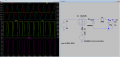
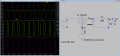
I don't know/use Proteus, however your basic concept is ok (apart from BAT1 being reversed). BUT... you'll have a problem doing it with an N-channel MOSFET if you're driving the gate at 5v. Consider what happens at start up. The voltage at C2 is zero and so the source of Q1 is 0. The 555 output goes high pulling the gate to 5v and C2 starts charging through L1 until the source of Q1 rises to around 3 or so volts and then Q1 will turn off.... so you'll be lucky to get 2v out of the circuit. You need to drive the gate to at least 7 or volts for this to work. Below are 2 runs of an LTSpice simulation. The first at a gate drive of 5v, the second at 10v..

1743864913341.png

1743864990557.png
 

crutschow

Joined Mar 14, 2008
38,316
You do know that op amps and 555s are ICs(?).

The feedback loop for your circuit needs compensation to be stable due to the phase-shift of the L1C2 output.
Here are some articles on that.

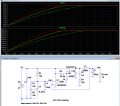
Below is the LTspice sim of a simple hysteretic type (bang-bang) buck-converter using a comparator, which does not require feedback compensation:
The output is shown for battery voltages of 16V, 20V, and 24V.
The output has ≤50mV of ripple at 0.5A load current:

1743864421530.png
 
Last edited:

Thread Starter

RebelliousResistor

Joined Mar 18, 2025
18
You do know that op amps and 555s are ICs(?).

The feedback loop for your circuit needs compensation to be stable due to the phase-shift of the L1C2 output.
Here are some articles on that.

Below is the LTspice sim of a simple hysteretic type buck-converter using a comparator, which does not require feedback compensation:
The output is shown for battery voltages of 16V, 20V, and 24V.
The output has ≤50mV of ripple at 0.5A load current:

View attachment 346208
Thank you for taking the time to help me, yes i have been made aware that my title has become misleading because i did not know that they were ICs since im new to this. The circuit you have provided is helping me significantly to be able to complete my circuit without the use of any IC
 

Thread Starter

RebelliousResistor

Joined Mar 18, 2025
18
Isn't the UC3842 as ubiquitous as the LM358 and NE555 these days? It's been around since the early 1980s!
Yes, you are correct and I did come across that when i was doing my research for this project, however i have been tasked to do it using just those ICs since they are the only ones on hand in the LAB that im doing this project in
 

Thread Starter

RebelliousResistor

Joined Mar 18, 2025
18
The common-drain MOSFET with 5V on the gate is never going to have more than 2V on the source.
When you have dealt with that major problem, the control circuit does stand a chance of working, perhaps over quite a small range of output voltages. One thing you will need is a capacitor from output to inverting input of the error amplifier, because otherwise you will have a comparator which will output a squarewave similar to the PWM waveform, when you really need it to output a linear control voltage.
You will end up with a constant-off-time controller, which means the operating frequency slows down as the output voltage increases.
[edit] with a bipolar 555 you won't get 5V on the output, perhaps 3.5V, which means the MOSFET may never switch on.
I have taken your advice and help into consideration and i now how the following circuit that i attached. It seems to be working decently but i still am unable to achieve 5V exactly and a method to change the duty cycle is evading me since the voltage output of that opamp is not changing with time and hence not affecting pin 5 and the duty cycle doesnt change. Any idea on what could be the issue here?
 

Attachments

Ian0

Joined Aug 7, 2020
13,097
I have taken your advice and help into consideration and i now how the following circuit that i attached. It seems to be working decently but i still am unable to achieve 5V exactly and a method to change the duty cycle is evading me since the voltage output of that opamp is not changing with time and hence not affecting pin 5 and the duty cycle doesnt change. Any idea on what could be the issue here?
For that circuit, you are going to need 30V on the gate of the MOSFET to make it work.
 

Thread Starter

RebelliousResistor

Joined Mar 18, 2025
18
As I noted that, even if you get the op amp to control the PWM duty-cycle, it won't be stable without frequency compensation of the feedback loop.
Thank you, i will do some reasearch into this and apply it to my circuit. If im not mistaken i wouldnt need another op amp would i? The compensation will be done on the same op amp (miller compensation), (sorry if that is a stupid question). Also what would you suggest i do to ensure the current does not exceed 0.5A.
 

Motanache

Joined Mar 2, 2015
652
try in smaller steps:
- Does IC 555 produce square wave signal?
If not, look for other schemes to be inspired by

- Output value of the rectangular signal is 0...12V use a MOSFET or if it is 0..7V a logic level MOSFET

- Does the MOSFET switch at the rate given by 555? read the current through the drain or put a small value resistor in the drain on which you read the voltage

- If yes up to this point, find an Enable or similar pin that starts/stops the operation of the 555

- The SMPS can work in Burst mode.

- The operational amplifier used as a comparator will turn on the 555 when the output voltage is below a limit and turn it off when it is above the limit.

I could make the diagram, but I don't know if I can help you in this way, the joy is for you to do it,
 
Top