BJT Common Emitter Large and Small Signal Research

Bordodynov

Joined May 20, 2015
3,431
I never claimed that the bipolar transistor has no steepness. It has steepness and it has current amplification. For you, it is the former that matters. When I consider voltage gain I use the concept of steepness, but because of this fact the current gain of the transistor does not disappear. In reality the signal source has parasitic parameters, i.e. it is not a perfect voltage source or current source. Regarding the arguments. Using the graphical method of setting the mode is an anachronism.
 

Bordodynov

Joined May 20, 2015
3,431
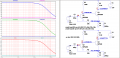
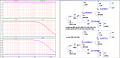
To confirm the concept that the bipolar transistor is a current amplifier (has steepness) and simultaneously a voltage amplifier, I took not the simplest circuit, but a two-stage amplifier. I took two versions of the circuit. The second version uses a transistor with about seven times less gain. I calculated the total gain, the voltage gain of the first stage and the second stage.
Now let's get to the main point. In the second diagram I have shown the current gain of the second transistors. Then I derived the ratio of the collector current of the second transistor to the current of the first. It is almost the same value as the current gain of the transistors. In other words, the second transistor amplifies the output current of the first, i.e. the second transistor is a current amplifier.
Conclusion: the transistor is a voltage amplifier and a current amplifier.
There is a duality.

2021-06-04_08-35-10.png2021-06-04_08-54-00.png
 

LvW

Joined Jun 13, 2013
2,035
Bordodynov - the only thing you have shown is that there is a base current, which has a fixed relation to the collector current. Nobody has denied this. But all currents are always the result of corresponding voltages.
 

Bordodynov

Joined May 20, 2015
3,431
I showed that the output current of the second stage is equal to the output current of the first stage multiplied by the current gain of the second transistor.
What is not clear here? And it is not necessary (but possible) to take into account the voltage at the input of the second transistor. I didn't say for nothing that you have an obsession to think of the transistor as a voltage amplifier. And I showed in my diagram that you can consider the transistor (in this case the second transistor) as both a voltage amplifier and a current amplifier.
The first transistor I drive a voltage source. In order to apply your concept I have to do some additional calculations, namely to calculate the input resistance of the second stage. Then you can calculate the voltage at the base of the second transistor. If you stick to my concept, just multiply the input signal by gm and get the output current of the transistor. Multiply by the current gain of the second transistor to get the output current of the second transistor (and you don't need to know gm2). And using Ohm's law we get the output voltage. In this case for the first transistor I used the concept of voltage control of the transistor and for the second transistor, the concept of the transistor as a current amplifier. That is, I use what is convenient and more economical in terms of calculation than you do. Although this is all theory and there are plenty of circuit simulators now. Well, let the academics develop their theories. I do not care about them. I am touched by the dogmatism of some people, so I got into the debate.
 

LvW

Joined Jun 13, 2013
2,035
What is not clear here? And it is not necessary (but possible) to take into account the voltage at the input of the second transistor. I didn't say for nothing that you have an obsession to think of the transistor as a voltage amplifier.
..................
That is, I use what is convenient and more economical in terms of calculation than you do. Although this is all theory and there are plenty of circuit simulators now. Well, let the academics develop their theories. I do not care about them. I am touched by the dogmatism of some people, so I got into the debate.
.... a lot of misunderstandings (perhaps unavoidable in written communications?)

* I did not claim that something would be "not clear". But my point is (and was from the beginning) that such a simulation cannot reveal if the collector currents are controlled/determind by Ib or Vbe. But THIS was the main question - as far as I understood this discussion.
Each simulation program is based on mathematical relations only without regard to cause-and-effect questions.

* And, of course, I agree that in some cases it is more "convenient" to use the current-control concept.
But - I think - this is not the main question here.

* As engineers we are using sometimes rules and assumptions (when they are "convenient") during design and analysis of circuits - even when they are not completely in accordance with physical laws.

* Example 1: In a resistive voltage divider we assume that the voltage across the resistors is produced by the current through it. Simple calculations that is correct by 100%. But - from the physical point of view - it is not correct.
* Example 2: Equivalent circuit diagram for the BJT based on "re" (T-model). This model is not in accordance with reality because "re" is not the "intrinsic emitter resistance" (as it is called sometimes). But it works!

* To me, a good engineer should know what he is doing - and why! That means: He must not ignore contradictions between used formulas/models and physical laws - instead, he should be aware of this situation.
This has nothing to do with "dogmatism" - without theoretical knowledge (developed by "academics") it would not be possible to invent novel circuits (Best example: Barrie Gilbert and all his inventions - all based on the theory of BJT voltage control)
___________________________________
Final comment: Because circuit simulation cannot help to answer the main (physical) question "Ic determined by Ib or Vbe", I never have used simulation results to explain my position. Instead I rely on real measurements, observations, circuit properties, working principles and theoretical derivations.
 
Last edited:
Top