common emitter amplifier

Thread Starter

ElectronicNewbie0

Joined Oct 18, 2025
54
Hello im still building some basics circuits in order to learn yet.

I have built a common emitter amplifier now, what i have assigned to myself is making a circuit that has as input a 6 AC Sine wave, and as output i want a 12V AC.

I chose a load resistance of 424 Ohm , so RC=424Ohm and supply voltage VCC is VCC=12V.

The calculations i did are these, i dont know exactly if its the best way to build such circuit or what exactly so feel free to tell me please.

IC(max) = (VCC-VRE)/RL = (12-1)/12 = 9.2mA ( here i chose the VRE to be around 10% of VCC so around 1V ), secondly the ic calculated is fine for the transistor i chose, which is the 2N2222 that can withstand 800mA as IC

After this i calculated the Q point with zero input signal applied to the base, which is Ic(max) / 2 = 4.58mA

Once i calculated this value, now i can calculate IB, i looked the datasheet and it says that the current gain is around 75 for an IC of 10mA, so as approximation we choose a beta of 37.5

ib=IC/B = 4.58mA / 37.5 = 122uA

Now instead of using a separate " resistor " to set the current at the base of the transistor, R1 and R2 can now be chosen to give a suitable quiescent base current
A general rule of thumb is a value of atleast 10times IB flowing through the resistor R2.

R2= (VRE + VBE) / 10*IB = (1+0.7)/10*122uA = 5.7kOhm
R1= VCC- (VRE+VBE) / 11*IB = 12-1.7/1342uA = 7.6kOhm

Now since i calculated IC and IB i can find IE, IE is equal to IE=IC+IB = 4.58mA + 122uA = 4.7mA
with this given i calculated then RE = VRE / IE = 1V / 4.7mA = 212Ohm

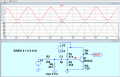
my output isnt as expected, i have no idea why this happens, anyone got any clue? Thanks!
 

Attachments

WBahn

Joined Mar 31, 2012
32,703
Hello im still building some basics circuits in order to learn yet.

I have built a common emitter amplifier now, what i have assigned to myself is making a circuit that has as input a 6 AC Sine wave, and as output i want a 12V AC.

I chose a load resistance of 424 Ohm , so RC=424Ohm and supply voltage VCC is VCC=12V.

The calculations i did are these, i dont know exactly if its the best way to build such circuit or what exactly so feel free to tell me please.

IC(max) = (VCC-VRE)/RL = (12-1)/12 = 9.2mA ( here i chose the VRE to be around 10% of VCC so around 1V ), secondly the ic calculated is fine for the transistor i chose, which is the 2N2222 that can withstand 800mA as IC

After this i calculated the Q point with zero input signal applied to the base, which is Ic(max) / 2 = 4.58mA

Once i calculated this value, now i can calculate IB, i looked the datasheet and it says that the current gain is around 75 for an IC of 10mA, so as approximation we choose a beta of 37.5

ib=IC/B = 4.58mA / 37.5 = 122uA

Now instead of using a separate " resistor " to set the current at the base of the transistor, R1 and R2 can now be chosen to give a suitable quiescent base current
A general rule of thumb is a value of atleast 10times IB flowing through the resistor R2.

R2= (VRE + VBE) / 10*IB = (1+0.7)/10*122uA = 5.7kOhm
R1= VCC- (VRE+VBE) / 11*IB = 12-1.7/1342uA = 7.6kOhm

Now since i calculated IC and IB i can find IE, IE is equal to IE=IC+IB = 4.58mA + 122uA = 4.7mA
with this given i calculated then RE = VRE / IE = 1V / 4.7mA = 212Ohm

my output isnt as expected, i have no idea why this happens, anyone got any clue? Thanks!
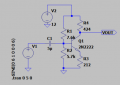
Let's consider what is needed to keep the transistor out of saturation and out of cutoff.

1761925007531.png

If the transistor is in cutoff, then the currents in both R3 and R4 are zero and Vout is 12 V. But for that to happen, the base of Q1 has to be down around 0.7 V.

If the transistor is in saturation, then the voltage across it is about 0.2 V (but things have already gone sideways at this point, so let's use 0.5 V where we probably still have a decent beta). That means that about 11.5 V appears across the combination of R3 and R4 (so we are assuming that the base current is still reasonably small) making the current about 18 mA, which produces a drop of about 7.7 V across R4, making Vout about 4.3 V, which is the lowest it can go.

Neglecting the base current, your bias network puts the base of Q1 at about 5.1 V, which puts the emitter at about 4.44 V with a current of about 21 mA. Assuming that this is almost all coming from the collector, then your quiescent Vout is around 3.1 V, which would require that the Vce of the transistor would be about -1.3 V, which isn't possible. Thus your transistor is in deep saturation even with no input signal.

Now, let's consider your input signal. It's at 1 Hz, which means that the impedance of that capacitor is about 32 kΩ, while the effective resistance of the bias network is the parallel combination of R1 and R2 (neglecting R3, which is also in parallel, but gets multiplied by beta, so it is reasonably negligible if beta is 100 or more), so that's 3.3 kΩ, hence you are only getting about 10% of your input signal to the base of Q1. You are also going to see a significant phase shift since your signal frequency is about a decade below the cutoff frequency of your bias network.

Now, I'm doing these calculations on the fly, so I might well have messed something up, but the results seem to be in pretty good agreement with your simulation.
 

ericgibbs

Joined Jan 29, 2010
21,390
hi EN0,
No, it is necessary to calculate the correct component values, your original circuit will not work.
WB's post explains the design requirements.

E
 

Thread Starter

ElectronicNewbie0

Joined Oct 18, 2025
54
Let's consider what is needed to keep the transistor out of saturation and out of cutoff.

View attachment 358008

If the transistor is in cutoff, then the currents in both R3 and R4 are zero and Vout is 12 V. But for that to happen, the base of Q1 has to be down around 0.7 V.

If the transistor is in saturation, then the voltage across it is about 0.2 V (but things have already gone sideways at this point, so let's use 0.5 V where we probably still have a decent beta). That means that about 11.5 V appears across the combination of R3 and R4 (so we are assuming that the base current is still reasonably small) making the current about 18 mA, which produces a drop of about 7.7 V across R4, making Vout about 4.3 V, which is the lowest it can go.

Neglecting the base current, your bias network puts the base of Q1 at about 5.1 V, which puts the emitter at about 4.44 V with a current of about 21 mA. Assuming that this is almost all coming from the collector, then your quiescent Vout is around 3.1 V, which would require that the Vce of the transistor would be about -1.3 V, which isn't possible. Thus your transistor is in deep saturation even with no input signal.

Now, let's consider your input signal. It's at 1 Hz, which means that the impedance of that capacitor is about 32 kΩ, while the effective resistance of the bias network is the parallel combination of R1 and R2 (neglecting R3, which is also in parallel, but gets multiplied by beta, so it is reasonably negligible if beta is 100 or more), so that's 3.3 kΩ, hence you are only getting about 10% of your input signal to the base of Q1. You are also going to see a significant phase shift since your signal frequency is about a decade below the cutoff frequency of your bias network.

Now, I'm doing these calculations on the fly, so I might well have messed something up, but the results seem to be in pretty good agreement with your simulation.
Hello, thanks for the detailed analysis

Yeah the main issue Is the voltages value i get on collector and emitter then?
What i could do Is changing R1 and R2 in order to have a lower voltage on the base? like i do calculations in order to have 1.7V on base? Instead of 5.1V which Is wrong cus i enter in saturation
 

WBahn

Joined Mar 31, 2012
32,703
Hello, thanks for the detailed analysis

Yeah the main issue Is the voltages value i get on collector and emitter then?
What i could do Is changing R1 and R2 in order to have a lower voltage on the base? like i do calculations in order to have 1.7V on base? Instead of 5.1V which Is wrong cus i enter in saturation
What is it you are trying to accomplish? Design an amplifier with a gain of two? This is easily done with you existing circuit topology using a 12 V supply. Design an amplifier with a 12 V amplitude sine wave output? This is very difficult using a 12 V supply since a 12 V amplitude sine wave as a peak-to-peak voltage excursion of 24 V.

Clearly state what it is you are trying to accomplish. It's impossible to help you figure out how to do something if we don't know what it is you are trying to do.
 

Thread Starter

ElectronicNewbie0

Joined Oct 18, 2025
54
hi EN0,
No, it is necessary to calculate the correct component values, your original circuit will not work.
WB's post explains the design requirements.

E
Yeah first of all i changed the value of R1 and R2, i need to have a vbe of 1.7V
What is it you are trying to accomplish? Design an amplifier with a gain of two? This is easily done with you existing circuit topology using a 12 V supply. Design an amplifier with a 12 V amplitude sine wave output? This is very difficult using a 12 V supply since a 12 V amplitude sine wave as a peak-to-peak voltage excursion of 24 V.

Clearly state what it is you are trying to accomplish. It's impossible to help you figure out how to do something if we don't know what it is you are trying to do.
Yeah what im trying is to accomplish Is a circuit that has a gain of 2, so having a peak to peak voltage excursion of 24V. Btw i got what u meant in the previous topic, now i changed values in order to have 1V on RE, so vbe= 1.7V
 

WBahn

Joined Mar 31, 2012
32,703
Yeah first of all i changed the value of R1 and R2, i need to have a vbe of 1.7V
You can't get a Vbe of 1.7 V. It is going to be effectively clamped at around 0.7 V. If you go much above that, in the real world, you will let the magic smoke out of the transistor.

Yeah what im trying is to accomplish Is a circuit that has a gain of 2, so having a peak to peak voltage excursion of 24V. Btw i got what u meant in the previous topic, now i changed values in order to have 1V on RE, so vbe= 1.7V
You need to understand the difference between Vbe and the voltage at the base relative to the ground reference. Vbe is the voltage at the base minus the voltage at the emitter.

If you want a voltage swing of 24 V, then you will need to use a considerably larger supply than 24 V. If you plan to build this, you also need to take into account the power dissipation in your collector and emitter resistors, as well as the transistor itself.

You also need to adjust your input bias network so that the signal frequency is in the passband, instead of being a decade below it. Why are you trying to amplify a 6 V amplitude sine wave that is at 1 Hz?

EDIT: Fixed Quote tags.
 
Last edited:

Thread Starter

ElectronicNewbie0

Joined Oct 18, 2025
54
You can't get a Vbe of 1.7 V. It is going to be effectively clamped at around 0.7 V. If you go much above that, in the real world, you will let the magic smoke out of the transistor.
Yeah what im trying is to accomplish Is a circuit that has a gain of 2, so having a peak to peak voltage excursion of 24V. Btw i got what u meant in the previous topic, now i changed values in order to have 1V on RE, so vbe= 1.7V
[/QUOTE]

You need to understand the difference between Vbe and the voltage at the base relative to the ground reference. Vbe is the voltage at the base minus the voltage at the emitter.

If you want a voltage swing of 24 V, then you will need to use a considerably larger supply than 24 V. If you plan to build this, you also need to take into account the power dissipation in your collector and emitter resistors, as well as the transistor itself.

You also need to adjust your input bias network so that the signal frequency is in the passband, instead of being a decade below it. Why are you trying to amplify a 6 V amplitude sine wave that is at 1 Hz?
[/QUOTE]

Okay alright, i understood, i misstyped, i meant having VB like at 1.7V, so VE Is 1V

So if i just need a signal in voltage i dont really care about how much current i got as IC, It can be 10mA or 100mA, no difference for me.

Well the 1Hz i chose it by myself actually, not a real reason, its for learning purpose only
 
Last edited:

WBahn

Joined Mar 31, 2012
32,703
So if i just need a signal in voltage i dont really care about how much current i got as IC, It can be 10mA or 100mA, no difference for me.
It matters if you don't want smoke coming out of your components. Or if you need to deliver power to whatever is being driven by your output.

Well the 1Hz i chose it by myself actually, not a real reason, its for learning purpose only
You can use any frequency you want, but since you are using frequency-selective components (primarily the capacitor), the frequency has a profound effect on the result.

How about picking some design goals that are more reasonable, say 1000 Hz for the frequency and a gain of 20 for the amplifier, with an input signal amplitude of 200 mV (which would give you a desired output signal amplitude of 4 V, requiring a peak-peak voltage excursion of 8 V, which would give you about 2 V of headroom on each end (which may or may not be enough to avoid most of the distortion that comes with pushing the rails too hard). For output drive capability, let's pick something pretty tame, such as 50 Ω. Set your input filter cutoff frequency to the low end of the usual audio range at about 20 Hz.

Note that the 2N2222 transistor is quite long in the tooth and you would probably be better served with something different. But for your purposes here, it should work fine.

You don't have to try to get everything to spec all at once. Focus on one thing at a time, get it working, then bring in something else, which may require significant changes to what you already have. That's fine. Figuring out why you need to make the change, as well as what that change needs to be, is where learning it going to happen.
 

Thread Starter

ElectronicNewbie0

Joined Oct 18, 2025
54
It matters if you don't want smoke coming out of your components. Or if you need to deliver power to whatever is being driven by your output.


You can use any frequency you want, but since you are using frequency-selective components (primarily the capacitor), the frequency has a profound effect on the result.

How about picking some design goals that are more reasonable, say 1000 Hz for the frequency and a gain of 20 for the amplifier, with an input signal amplitude of 200 mV (which would give you a desired output signal amplitude of 4 V, requiring a peak-peak voltage excursion of 8 V, which would give you about 2 V of headroom on each end (which may or may not be enough to avoid most of the distortion that comes with pushing the rails too hard). For output drive capability, let's pick something pretty tame, such as 50 Ω. Set your input filter cutoff frequency to the low end of the usual audio range at about 20 Hz.

Note that the 2N2222 transistor is quite long in the tooth and you would probably be better served with something different. But for your purposes here, it should work fine.

You don't have to try to get everything to spec all at once. Focus on one thing at a time, get it working, then bring in something else, which may require significant changes to what you already have. That's fine. Figuring out why you need to make the change, as well as what that change needs to be, is where learning it going to happen.
Okay, alright thanks! I will work on it with the requirements u gave me!
 

Thread Starter

ElectronicNewbie0

Joined Oct 18, 2025
54
It matters if you don't want smoke coming out of your components. Or if you need to deliver power to whatever is being driven by your output.


You can use any frequency you want, but since you are using frequency-selective components (primarily the capacitor), the frequency has a profound effect on the result.

How about picking some design goals that are more reasonable, say 1000 Hz for the frequency and a gain of 20 for the amplifier, with an input signal amplitude of 200 mV (which would give you a desired output signal amplitude of 4 V, requiring a peak-peak voltage excursion of 8 V, which would give you about 2 V of headroom on each end (which may or may not be enough to avoid most of the distortion that comes with pushing the rails too hard). For output drive capability, let's pick something pretty tame, such as 50 Ω. Set your input filter cutoff frequency to the low end of the usual audio range at about 20 Hz.

Note that the 2N2222 transistor is quite long in the tooth and you would probably be better served with something different. But for your purposes here, it should work fine.

You don't have to try to get everything to spec all at once. Focus on one thing at a time, get it working, then bring in something else, which may require significant changes to what you already have. That's fine. Figuring out why you need to make the change, as well as what that change needs to be, is where learning it going to happen.
Hey i tried to look into It again
I chose basically everything ( beside the 50 Ohm load issue, i have no idea what this really means )

So lets start:

First of all , i chose IC to be 2mA, and VC to he at VCC/2, in order to have maximum swing

So i calculated RC to be 3kOhm, so VC will be 6 volt, afterwards i chose RE to be 500 Ohm RE=500 Ohm in this way i got a drop on RE of 1V ( thats usually the voltage i need as VE, 10% of VCC ).
re'=25mV/ie=25mV/2mA=12.5Ohm

So at this point to have a gain of 20 , AV= 20 in AC, at 1KHz, i calculated that the capacitor in parallel to the emitter resistor has to be around 0.9uF.
So the impedance XC Is= =1/2πfc=1/2π•1000•0.9•10-⁶=177 Ohm
at 1 KHz i will have the parallel , which Is RE(AC)=500•177/500+177=130.7Ohm

So AV will be AV=RC/Retot=3000/130.7+12.5=-20.95 ( which Is acceptable.

At this point i calculated R1 and R2, i need to have VB around 1.7V, so also by respecting the rule of thumb of having the divider current>=10x base current, i chose R1 to be 10.3kOhm and R2=1.7kOhm.

Then i chose the input capacitor in order to have a high pass filter at 20Hz
High pass filter at input

fc=1/2π•Rin•Cin=1/2π•20•670=11.9uF


Thats what i made for now, what do u think i did wrong in this design? and why? ( I kinda think that the 50 Ohm thing will make me reconsider the entire design, but its fine for now )
 

MrChips

Joined Oct 2, 2009
34,628
You cannot design using the DC parameters and then throw in a 50-ohm DC load. The load is going to alter the DC operating conditions of the circuit.

You either have to design the DC circuit with the DC load in place or you AC-couple the 50-ohm load to the circuit.
 

Thread Starter

ElectronicNewbie0

Joined Oct 18, 2025
54
You cannot design using the DC parameters and then throw in a 50-ohm DC load. The load is going to alter the DC operating conditions of the circuit.

You either have to design the DC circuit with the DC load in place or you AC-couple the 50-ohm load to the circuit.
Well i think for the design i already made i could AC-couple the 50 ohm load, its about choosing the right capacitor in output from collector no?
 

Thread Starter

ElectronicNewbie0

Joined Oct 18, 2025
54
You cannot design using the DC parameters and then throw in a 50-ohm DC load. The load is going to alter the DC operating conditions of the circuit.

You either have to design the DC circuit with the DC load in place or you AC-couple the 50-ohm load to the circuit.
Btw i get what u mean, for now
You cannot design using the DC parameters and then throw in a 50-ohm DC load. The load is going to alter the DC operating conditions of the circuit.

You either have to design the DC circuit with the DC load in place or you AC-couple the 50-ohm load to the circuit.
if It was in DC coupling i would have needed a bigger IC current, depending on my load
 

ericgibbs

Joined Jan 29, 2010
21,390
if It was in DC coupling i would have needed a bigger IC current, depending on my load
hi EN0,
Consider how low a value the Collector resistor would have to be to deliver, say, a 12Vac sinewave into a DC coupled 50 Ohm load.
E
 

MrChips

Joined Oct 2, 2009
34,628
You want the output impedance of any driving circuit to be lower than that of the load.
A general rule of thumb is to make the output impedance of the driver to be ten times lower than that of the load.
For example, if you need to drive a 50-ohm load, the output impedance should be 5-ohm or lower.

An exception is if you are driving high frequency signals into a 50-ohm coax cable. In this case, you would add a 50-ohm resistor in series with the output in order to absorb reflections coming back on the transmission line (besides having 50-ohm effective load at the receiving end).
 
Top