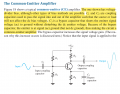
Let’s take C1 first. One end is connected to the input, the other to the base of the transistor. The base of the transistor is set to a specific voltage to bias the transistor partially on. Let’s say it is 2V.
Now let’s say the input is a sine wave the goes ±100mV from ground.
What happens if we connect the input to it without the capacitor? Is the transistor still biased the same way?
Now put the capacitor in. Does that change the situation?
The same argument applies to the output. Speakers DO NOT LIKE AC signals with a DC offset. The DC offset voltage is perfectly capable of damaging a voice coil made from very small diameter wire. The output capacitor will pass AC signals above a certain frequency, usually a typical audio range, but will block low frequencies and most importantly DC offsets at the output of the CE amplifier.
Of all the capacitors C3 is arguably the most important. It is in parallel with the emitter resistor. Question: What is the effect of the emitter resistor on the DC gain of the amplifier? Secondly what is the effect of the emitter resistor on the AC gain? To answer this question, you should compute the capacitive reactance for couple of audio frequencies and compare that value to the (constant wrt to frequency) impedance of the emitter resistor.
That's mostly because you haven't spent enough time getting a solid grasp of the fundamentals and are now trying to understand how more complex circuits work when how they work is firmly grounded on those fundamentals. You need to go back and really get those fundamentals down, otherwise you will continue digging yourself deeper and deeper holes as you try, largely in vain, to push forward without doing so.
To get a glimpse of how those fundamentals are relevant to this circuit, let's consider just the input and bias network consisting of R1, R2, and C1. Remove everything to the right of it.
Let's say that R1 and R2 are 10 kΩ each. Let's further say that Vcc is 10 V.
Now imagine replacing C1 with a variable resistor and setting it to 1000 kΩ.
What is the voltage at the junction of R1 and R2 (let's call this the output of this circuit fragment) as the input signal goes from 0 V to 10 V?
Does the output voltage change a lot as the input voltage changes?
Now imagine setting the variable resistor to replacing C1 with a 100 Ω resistor.
What is the voltage at the junction of R1 and R2 now as the input signal goes from 0 V to 10 V?
Does the output voltage change a lot as the input voltage changes?
Next, calculate the impedance of a 1 µF capacitor at a frequency of 0.2 Hz and also the capacitance of it at a frequency of 2 kHz.
Finally, recall that voltages and currents in linear circuits obey superposition, so if your input signal is made up of a low frequency component at 2 Hz and a high frequency component at 2 kHz, what would the voltage at the output be?
The concept of using a bypass capacitor in a CE amplifier to increase gain is not easy at first. Why?
The short answer, why:
There is RE and then there is the transistor's internal Re. The feedback is affecting a critical Vbe range and this parasitic capacitance needs remedy.
The NPN's electric field was carefully set with appropriate DC bias resistors but the AC Re role is playing havoc on the ability to flow AC current.
It must be realized that the AC current gain will be severely limited without C3. It is a common error to think that you have gain
when in reality there is little or no current gain, even though you have AC voltage it is nearly depleted of current and unable to do much work,
This becomes evident when measuring the output with an AC ammeter. To examine this more carefully, a fair question is; What is the purpose of the bypass capacitor? The article below approaches this subject by using simulation and allows you to interact with CE amp
As the lesson comes to a close there is a section having questions and then there is a critical thinking section.
Because of the scope of your question, a review can be lengthy for a forum to write chapters, this means there is significant work involved.
It is not a replacement for this forums usefulness but is an alternative when showing a difficult concept. The academic skill level required
by doing the math will still be around and putting into practice by lab work and emphasis on measurement analysis for problem solving.
The concept of using a bypass capacitor in a CE amplifier to increase gain is not easy at first. Why?
The short answer, why:
There is RE and then there is the transistor's internal Re. The feedback is affecting a critical Vbe range and this parasitic capacitance needs remedy.
..............................
In my opinion, the use of the symbol Re must be confusing for a beginner, because the question arises:
What is this parameter and what influence does it have on the function of the circuit?
Is Re - as it is called - really an "transistors internal" emitter resistor ?
The answer: NO !
In fact, we speak about a dynamic-differential parameter that establishes the relationship between the input voltage variation d(Vbe) and the resulting variation of the output current d(Ic).
And the quotient of both variables is the most important parameter for the amplification function of the transistor:
The transistors transconductancegm=d(Ic)/d(Vbe).
This transconductance is nothing else than the slope of the transistors control characteristic (Shockleys exponential equation) Ic=f(Vbe).
By the way - the transconductance is also the determining parameter for the FET - both types (BJT and FET) act as voltage-controlled current sources.
For reasons that I have never been able to understand, some authors consider it useful to work with the reciprocal of the transconductance (1/gm) and use the term "internal emitter resistance re" (sometimes even incorrectly Re), which is doubly wrong:
This symbol does not describe any property of the emitter and is not a resistor at all!
Yet it is so simple and logical to work with the transistors transconductance gm:
Without negative feedback through the external resistor RE and using the transconductance gm=d(Ic)/d(Vbe), the collector current variation (caused by a change in Vbe) is d(Ic)=gm*d(Vbe).
Therefore, the corresponding signal output voltage is
d(Vout)=-d(Ic)*Rc
and the signal amplification factor (gain) is Ao=d(Vout)/d(Vbe)=-gmRc.
With an external feedback resistor RE the gain will be reduced; A=- gmRc/(1+gmRE).
(When the resistor RE is bypassed with a suitable capacitor CE the parallel combination RE||(1(jwCE) approaches zero for frequencies higher than the corresponding edge frequency. As a conseqence, the signal gain assumes again the larger value without feedback. However, for DC the resistor RE still provides DC stabilizing feedback. Such DC feedback is very important for establishing the desired DC operating point)
(Comment: As can be seen, it was not necessary at all to introduce and to speak about such a term like "current gain" because the BJT is voltage driven and the ratio Ic/Ib has no influence on signal gain - it only influences the input resistance of the gain stage.)
Can you make an analogy of this, I understand that transistors work as a faucet, the more valve opens, the more water flows out. so what is the function of capacitor?
From this, I understand that the TO/the questioner is a beginner and he needs some basic explanations how the shown gain stage really works.
In my opinion, the use of the symbol Re must be confusing for a beginner, because the question arises:
What is this parameter and what influence does it have on the function of the circuit?
Is Re - as it is called - really an "transistors internal" emitter resistor ?
The answer: NO !
In fact, we speak about a dynamic-differential parameter that establishes the relationship between the input voltage variation d(Vbe) and the resulting variation of the output current d(Ic).
And the quotient of both variables is the most important parameter for the amplification function of the transistor:
The transistors transconductancegm=d(Ic)/d(Vbe).
This transconductance is nothing else than the slope of the transistors control characteristic (Shockleys exponential equation) Ic=f(Vbe).
By the way - the transconductance is also the determining parameter for the FET - both types (BJT and FET) act as voltage-controlled current sources.
For reasons that I have never been able to understand, some authors consider it useful to work with the reciprocal of the transconductance (1/gm) and use the term "internal emitter resistance re" (sometimes even incorrectly Re), which is doubly wrong:
This symbol does not describe any property of the emitter and is not a resistor at all!
Yet it is so simple and logical to work with the transistors transconductance gm:
Without negative feedback through the external resistor RE and using the transconductance gm=d(Ic)/d(Vbe), the collector current variation (caused by a change in Vbe) is d(Ic)=gm*d(Vbe).
Therefore, the corresponding signal output voltage is
d(Vout)=-d(Ic)*Rc
and the signal amplification factor (gain) is Ao=d(Vout)/d(Vbe)=-gmRc.
With an external feedback resistor RE the gain will be reduced; A=- gmRc/(1+gmRE).
(When the resistor RE is bypassed with a suitable capacitor CE the parallel combination RE||(1(jwCE) approaches zero for frequencies higher than the corresponding edge frequency. As a conseqence, the signal gain assumes again the larger value without feedback. However, for DC the resistor RE still provides DC stabilizing feedback. Such DC feedback is very important for establishing the desired DC operating point)
(Comment: As can be seen, it was not necessary at all to introduce and to speak about such a term like "current gain" because the BJT is voltage driven and the ratio Ic/Ib has no influence on signal gain - it only influences the input resistance of the gain stage.)
Can you make an analogy of this, I understand that transistors work as a faucet, the more valve opens, the more water flows out. so what is the function of capacitor?
That's mostly because you haven't spent enough time getting a solid grasp of the fundamentals and are now trying to understand how more complex circuits work when how they work is firmly grounded on those fundamentals. You need to go back and really get those fundamentals down, otherwise you will continue digging yourself deeper and deeper holes as you try, largely in vain, to push forward without doing so.
To get a glimpse of how those fundamentals are relevant to this circuit, let's consider just the input and bias network consisting of R1, R2, and C1. Remove everything to the right of it.
Let's say that R1 and R2 are 10 kΩ each. Let's further say that Vcc is 10 V.
Now imagine replacing C1 with a variable resistor and setting it to 1000 kΩ.
What is the voltage at the junction of R1 and R2 (let's call this the output of this circuit fragment) as the input signal goes from 0 V to 10 V?
Does the output voltage change a lot as the input voltage changes?
Now imagine setting the variable resistor to replacing C1 with a 100 Ω resistor.
What is the voltage at the junction of R1 and R2 now as the input signal goes from 0 V to 10 V?
Does the output voltage change a lot as the input voltage changes?
Next, calculate the impedance of a 1 µF capacitor at a frequency of 0.2 Hz and also the capacitance of it at a frequency of 2 kHz.
Finally, recall that voltages and currents in linear circuits obey superposition, so if your input signal is made up of a low frequency component at 2 Hz and a high frequency component at 2 kHz, what would the voltage at the output be?
Can you make an analogy of this, I understand that transistors work as a faucet, the more valve opens, the more water flows out. so what is the function of capacitor?
@linhvn: Please stop posting the same response multiple times. Everyone reading the thread can see every response, they don't need to wade through multiple iterations of it.
The function of the capacitor (in circuits like this) is that it can, crudely, be seen as a frequency-sensitive resistor. Any signal can be broken down into constituent parts, each part at a different frequency. For those parts at low frequencies, a capacitor looks like a very high value resistor. But for those parts at high frequencies, it looks like a very low value resistor.
If you would go back and try to actually work through the exercise I outlined in Post #9, the impact of this might become apparent. But you seem to insist that others explain to you how complex circuits work without you needing to invest the time and effort into understanding how simple circuits work.
Can you make an analogy of this, I understand that transistors work as a faucet, the more valve opens, the more water flows out. so what is the function of capacitor?
If this is how you're being taught in school; look for a better school. If you're using the water-crutch on your own; stop. The model is poor and will only cause problems. Just learn the phenomenon or find a different area to study.
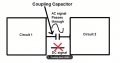
C1 and C2 are coupling capacitors.
This is the first image that came up in a Google search:
It's a pictorial representation of what was stated in the text.
Can you make an analogy of this, I understand that transistors work as a faucet, the more valve opens, the more water flows out. so what is the function of capacitor?
Yes, very true. But we want to know only the variations in the flow, not the absolute flow. Its like someone playing with the faucet and we need to know how much variation is caused to the flow.
The capacitor blocks the absolute flow, and only the variations are passed on.
Can you make an analogy of this, I understand that transistors work as a faucet, the more valve opens, the more water flows out. so what is the function of capacitor?
The analogy as mentioned by you (faucet) it not too bad.
Roughly speaking, a bipolar transistor consists of a semiconductor path with a very thin layer in the middle (without electrons), but which is somewhat “permeable” (diffusion effects). The width of this layer (and therefore also the permeability and the current flowing between C and E) can be controlled by an externally applied control voltage (Vbe).
Regarding the function of the capacitor C3 (in parallel to RE) you must try to study and understand the principle of negative feedback and its influence on the voltage gain of such a stage (see also the last part of my explanations in post#11).
All of the capacitors are doing the same thing. They allow a difference in DC voltage from one side to the other, which is important for the operation of the circuit, while passing any change to the voltage, (the signal), which is required to do the amplification.
Without the capacitors, we could not connect two nodes unless they were at the same DC voltage. This is much more complicated, but it is done in a DC coupled amplifier, like an opamp.
The solid state CE amplifier with Cb Bypass capacitor for improving gain can be explained as a circuit
even if they have to bypass the visual concept. it be fast forwarded to 5:30 and it is better that the explanation flows smoothly.
With same amount of practice the math will also.
The electrical physics inside the transistor is a good question. It is sort of not really relevant in getting the needed
skills within the scope of the macro level of the CE amplifier or the role of Cb. in improving gain. It can be approached
with AC analysis and equivalent circuit. Sadly not everyone can develop a visual thinking process
I can diverge briefly for that question as a rough sketch on how it was developed, but try to steer right back to CE example.
Keep in mind that as we divide down it is like magnifying many times and there is no faucet, and an NPN is not an Omelet sandwich.
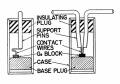
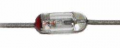
In developing visual concept for a transistors internal parasitic capacitance, you can start with a point contact diode.
It is a picture dated 1949 from the work of John Bardeen.
Looking close-up there is a diode on the left, a transistor on the right. Zoom in to that area showing 3 ports the Germanium base and contact wire then another contact wire that are made of phosphorus bronze and positioned very close together 5 thousanths of an inch. The Cb capacitor passes
the AC to the ground rail improving the congestion, The capacitor ground pathway can route AC signal back to the base called negative feedback.

 Facebook
 Google
 GitHub
 Linkedin