Facebook
 Google
 GitHub
 Linkedin

Hello all
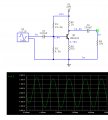
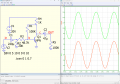
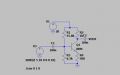
I built a common emitter amplifier with these requirements: VCC=20V, Ic=10mA Av=2
What i did is calculating RC first of all with this formula VC=(VCC-RC•IC) where i chose the vc half of vcc, to have full dynamic so VC= 10V. and i found that RC=1k, now i chose RE in order to have 2 as gain, so RE=500 Ohm
After that i calculated VE as VE=RE•iC , since ic=ie and found that VE=5V.
At this point know that VB= VE+VBE
so now i calculated VB=R2/R1+R2•VCC so 5.7=R2/(R1+R2)•20 , now if we suppose that hfe is 100 and the IR2 current needa to be 10•IB we get that R2= 6.3kohm and R1 by doing the inverse formula we obtain R1=16k
By simulating it looks working fine, but i had a question now RE the way i calculated it isnt the best for stability of the circuit cus transistor changes its parameters also with its temperature, then how can i consider that too? thanks all.
I built a common emitter amplifier with these requirements: VCC=20V, Ic=10mA Av=2
What i did is calculating RC first of all with this formula VC=(VCC-RC•IC) where i chose the vc half of vcc, to have full dynamic so VC= 10V. and i found that RC=1k, now i chose RE in order to have 2 as gain, so RE=500 Ohm
After that i calculated VE as VE=RE•iC , since ic=ie and found that VE=5V.
At this point know that VB= VE+VBE
so now i calculated VB=R2/R1+R2•VCC so 5.7=R2/(R1+R2)•20 , now if we suppose that hfe is 100 and the IR2 current needa to be 10•IB we get that R2= 6.3kohm and R1 by doing the inverse formula we obtain R1=16k
By simulating it looks working fine, but i had a question now RE the way i calculated it isnt the best for stability of the circuit cus transistor changes its parameters also with its temperature, then how can i consider that too? thanks all.
Attachments
-
 10.8 KB Views: 44