Astable multivibrator doesnt work like i want to

Thread Starter

psoke0

Joined Mar 31, 2017
205
hi i made a astable multivibrator with npn transistors. its works just fine with leds. led1 lights up 5 second and after that led2 lights up for 5 seconds. but when im using the circuit for driving a transistor thats where problem shows up. external transistor is normally draws about 300mA and when i drive this transistor with multivibrator. the transistor doesnt stays on for 5 senconds instead its much more shorter then that. so im wondering when im drawing 300mA from the power source is it posible that because of the voltage drop couses multivibrator timing to getting lower or make such error ?
 

Alec_t

Joined Sep 17, 2013
15,117
If the external transistor is drawing 300mA then its base current could be several mA, which comes from the astable circuit so may well affect the timing. We'd need a schematic of your complete circuit to see what could be adjusted to compensate.
 

Danko

Joined Nov 22, 2017
2,167
hi i made a astable multivibrator with npn transistors. its works just fine with leds. led1 lights up 5 second and after that led2 lights up for 5 seconds. but when im using the circuit for driving a transistor thats where problem shows up. external transistor is normally draws about 300mA and when i drive this transistor with multivibrator. the transistor doesnt stays on for 5 senconds instead its much more shorter then that. so im wondering when im drawing 300mA from the power source is it posible that because of the voltage drop couses multivibrator timing to getting lower or make such error ?
Drawing1.png
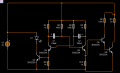
Will it helpful ?
 
Last edited:

Thread Starter

psoke0

Joined Mar 31, 2017
205
thank you before i read the answer of yours i allready try it and its working better but still less timing but i rise the capacitance and its fixed it this way . also rising cap value doesnt work with before circuit but does work with this one :D so thank you but what that resistors job is ? what does it do
 

Danko

Joined Nov 22, 2017
2,167
i guess that resistor is acting as voltage divider with main transistor right ?
Role of resistor is to eliminate drop voltage on B-E junction of external transistor (bypass collector current of multivibrator ). It's value should be about 1 kOhm. Maybe it will good for timing.
Edit: Not collector, emitter current.
 
Last edited:

Thread Starter

psoke0

Joined Mar 31, 2017
205
Role of resistor is to eliminate drop voltage on B-E junction of external transistor (bypass collector current of multivibrator ). It's value should be about 1 kOhm. Maybe it will good for timing.
Edit: Not collector, emitter current.
okay thank you :)
 

Thread Starter

psoke0

Joined Mar 31, 2017
205
If the external transistor is drawing 300mA then its base current could be several mA, which comes from the astable circuit so may well affect the timing. We'd need a schematic of your complete circuit to see what could be adjusted to compensate.
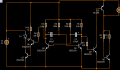
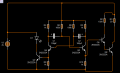
here is my circuit the emitter resistors also didnt work well its just keeps messing with timing :/ how can we avoid that
Edit: i cant just drive Q8 directly because in real life circuit that 1020 ohm resistor should drive Q8 transistor.
upload_2017-12-13_22-29-32.png
 

AnalogKid

Joined Aug 1, 2013
12,126
It is a square wave oscillator with a 50:50 duty cycle. Both output transistors can be NPN. With one NPN and one PNP, both output transistors are on at the same time rather than alternating. Is that what you want?

Also, the reason connecting the drive transistors to the multivibrator transistor emitters didn't work is because the emitter resistors completely change the equations for the timing capacitor current. Especially with such a low operating voltage.

The ratios of R3 to R4 and R5 to R6 are 100:1. For the circuit to function correctly, Q2 and Q3 must have a current gain significantly greater than 100 to guarantee firm saturation. That will not be true over time and temperature, and is not good design practice. Increase R3 and R6 to at least 3 K; 5 K would be better. The old rule of thumb would require 10 K, but these parts are way better than when that rule evolved.

ak
 

Thread Starter

psoke0

Joined Mar 31, 2017
205
It is a square wave oscillator with a 50:50 duty cycle. Both output transistors can be NPN. With one NPN and one PNP, both output transistors are on at the same time rather than alternating. Is that what you want?

Also, the reason connecting the drive transistors to the multivibrator transistor emitters didn't work is because the emitter resistors completely change the equations for the timing capacitor current. Especially with such a low operating voltage.

The ratios of R3 to R4 and R5 to R6 are 100:1. For the circuit to function correctly, Q2 and Q3 must have a current gain significantly greater than 100 to guarantee firm saturation. That will not be true over time and temperature, and is not good design practice. Increase R3 and R6 to at least 3 K; 5 K would be better. The old rule of thumb would require 10 K, but these parts are way better than when that rule evolved.

ak
hi. in my circuit on top tehre is no pnp . so can u tell me what should i change in my circuit ?
 

AnalogKid

Joined Aug 1, 2013
12,126
Because of R9 and R10, that circuit does not function like a "normal" multivibrator. To start, clean it up to get to a standard starting point.

1. Disconnect Q7 and Q5 bases from the multivibrator.
2. Delete R9 and R10; connect both emitters directly to GND.
3. Verify that the circuit behaves as predicted by calculation.

ak
 

Thread Starter

psoke0

Joined Mar 31, 2017
205
Because of R9 and R10, that circuit does not function like a "normal" multivibrator. To start, clean it up to get to a standard starting point.

1. Disconnect Q7 and Q5 bases from the multivibrator.
2. Delete R9 and R10; connect both emitters directly to GND.
3. Verify that the circuit behaves as predicted by calculation.

ak
when i do that it does operate correctly like i want to
 

Thread Starter

psoke0

Joined Mar 31, 2017
205
Because of R9 and R10, that circuit does not function like a "normal" multivibrator. To start, clean it up to get to a standard starting point.

1. Disconnect Q7 and Q5 bases from the multivibrator.
2. Delete R9 and R10; connect both emitters directly to GND.
3. Verify that the circuit behaves as predicted by calculation.

ak
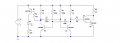
here is my new circuit
upload_2017-12-15_0-6-55.png
 

AnalogKid

Joined Aug 1, 2013
12,126
What do you want this circuit to do, and what is it doing that you do not like?

Easy parts first. Things around Q3, Q4, Q6, and Q7 look ok. There should be a current limiting resistor in series with D1.

ak
 
Top