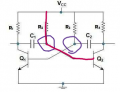
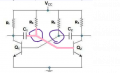
Why aren't the transistors turned on permanently in the astable multivibrator?

Thread Starter

MarkoDankic

Joined Feb 10, 2025
2
I am a beginner and I don't understand why the transistors aren't permanently on, because the current is flowing from the capacitors and from the battery to the base pin at the same time, so it should be turned on because there is a wire that connects the transistor base pin directly to the BatteryCircuit-diagram-of-astable-multivibrator.png
 

WBahn

Joined Mar 31, 2012
32,703
I am a beginner and I don't understand why the transistors aren't permanently on, because the current is flowing from the capacitors and from the battery to the base pin at the same time, so it should be turned on because there is a wire that connects the transistor base pin directly to the BatteryView attachment 342333
Highlight that wire with a colored line from the base of the transistor to the battery. You can't, because there isn't one. There is a resistor in the way.

The answer to your question is that the capacitors move the base voltage below the turnon voltage when they switch because the voltage across a capacitor can't change instantly.
 

Thread Starter

MarkoDankic

Joined Feb 10, 2025
2
There isn't in the circuit shown.
Welcome to AAC!
Highlight that wire with a colored line from the base of the transistor to the battery. You can't, because there isn't one. There is a resistor in the way.

The answer to your question is that the capacitors move the base voltage below the turnon voltage when they switch because the voltage across a capacitor can't change instantly.

But the pink wire is going from battery to the base pin and the capacitor so it should be giving current to the transistor base pin and charging the capacitor at the same time

Circuit-diagram-of-astable-multivibrator.png
 
Last edited:

AnalogKid

Joined Aug 1, 2013
12,043
You are correct - there is a point of dynamic stability where both transistors are on, both caps have Vcc across them, and nothing moves. In the real world the resistor and capacitor values are not equal down to the quantum noise level, there is an imbalance in the base currents, one transistor conducts a bit more than the other, pulling its capacitor low, decreasing the other transistor's base current, increasing the current imbalance, and the circuit oscillates.

Oscillator startup is a potential problem for many types of oscillator circuits, and a real problem with many circuit simulation programs.

ak
 

DickCappels

Joined Aug 21, 2008
10,661
When operating, whenever one transistor turns on the falling collector voltage turns the other transistor off.

Notice that the base voltage gets clamped to about 0.6 volts above ground (the emitter voltage) by the base-emitter junction’s forward drop, so any negative swing on the collector of the transistor turning on will cause the base-emitter voltage of the transistor turning off to cease to be forward biased.
 
Last edited:

WBahn

Joined Mar 31, 2012
32,703
But the pink wire is going from battery to the base pin and the capacitor so it should be giving current to the transistor base pin and charging the capacitor at the same time

View attachment 342336
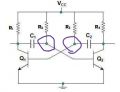
Here is your pink wire:
1739222568978.png

It is NOT connected to Vcc. There is a resistor there.

This circuit, like many oscillator circuits, has an unstable equilibrium point.

To give a mechanical image, imagine I have a brick and a sewing needle and am tasked with balancing the brick on the tip of the needle. I can draw a pretty picture of the needle standing perfectly vertical on the ground with the brick perfectly centered on it so that it is perfectly balanced. So there is a solution in theory. But, the solution was based on being able to set things up perfectly in the first place, while, in practice, I would never expect to be able to actually do it, because this theoretical balanced set up is highly unstable.

The same situation here. You can do a paper analysis that starts with the assumption that both transistors are on and that all of the components are perfectly matched and arrive at a theoretical solution that has both transistors turned on. But it is unstable. However, unlike the brick on a needle, we do have to consider just how unstable it is. Some oscillators are so unstable in these ideally balanced conditions that they simply can't, in practice, remain there. Others, including this one, are not that way and, if forced (either intentionally or accidentally) into this state, they may be stable enough to remain in that state for an extended, possibly indefinite, period of time. This is usually referred to as the oscillator being stalled.

To do a valid analysis of the operation of the oscillator, you need to start from a configuration that represents a valid one during operation.
 

crutschow

Joined Mar 14, 2008
38,316
A picture (plot) is worth a thousand words.

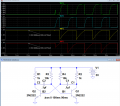
Below is the LTspice sim of the multivibrator showing both the stable and oscillating states:

Both transistors are initially ON in a quasi-stable state as shown by the both transistor collector voltages (green and blue traces) being near zero and the transistor bases (yellow and red traces) being at about 0.7V.
Eventually (here after 94.5ms or the 4.5ms point in the plot), likely some small imbalance in the (calculated) voltages, causes the circuit to start oscillating.
It then shows the cross-coupling of the collector voltage-change when the transistor turns on, through the capacitors to the opposite transistor base.

Each transistors off-time is the time it takes for the capacitor induced base voltage to charge through the 10kΩ resistors from the peak negative voltage to 0.7V, where it turns on, thus turning the other transistor off.

1739256485961.png
 
Last edited:

DickCappels

Joined Aug 21, 2008
10,661
Shouldn't that "off" be "on"?

ak
I see why this is so hard to understand :). I stand corrected and have edited my earlier post #7 so as to not mislead anybody who comes later.

Should read:
"When operating, whenever one transistor turns on the falling collector voltage turns the other transistor off." You can see this by comparing the blue and yellow waveforms that crutschow posted in post #10 above.
 
Top