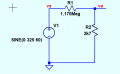
This is how to get an estimation of the expected result.
Does the capacitor make a significant difference? Its impedance is 10 times that of the parallel resistor at 50Hz, so assume it doesn’t.
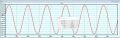
Next, pick a few points on the AC waveform: positive peak, zero and negative peak would be good choices.
Calculate the DC voltages at the output for those voltages.
It‘s a linear circuit, so it won’t distort the sinewave, so fill in where you would expect the sinewave to be.
That gives an approximate answer, so that when you fully analyse it, you know whether your analysis might be correct.
This is how to get an estimation of the expected result.
Does the capacitor make a significant difference? Its impedance is 10 times that of the parallel resistor at 50Hz, so assume it doesn’t.
Next, pick a few points on the AC waveform: positive peak, zero and negative peak would be good choices.
Calculate the DC voltages at the output for those voltages.
It‘s a linear circuit, so it won’t distort the sinewave, so fill in where you would expect the sinewave to be.
That gives an approximate answer, so that when you fully analyse it, you know whether your analysis might be correct.
The best way for you to learn is to give it your best attempt and show your work here. That way we can see where your trouble actually is and help get you on the right path. If we just show you everything, then you will think you have it down because it will seem to make sense at the moment, but there's a really good chance that, a week from now, you still wouldn't be able to solve a similar problem on your own.
This gets at the root of the problem. You don't understand the fundamentals well enough to apply them to a circuit you haven't seen before, and so you are left trying to find the work of someone else that has solved a problem exactly like the one you are trying to solve. But doing so will leave you unable to deal any differently with the next circuit you see.
Think!
For the Vac=0 situation. The AC input is joined to the output by a big resistor. The 2.5V reference is joined to the output by a small resistor. Is the output likely to be closer to the AC input or the 2.5V reference?
If you learn how to guess the right answer, then when you calculate it you'll know whether it is right or wrong.
How much sinewave are you likely to find on the output? Something to do with the ratio of the two resistors?
Hi M,
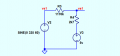
I know that the original question had a 2.5Vdc source, but in my test circuit I set it at 5Vdc.
The full equations for both source voltages would be the same, except for the voltage source values.
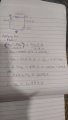
Your equations are way off the mark, so you have an incorrect answer.
eg: your (va1-2.5v)/2k7
Why (va1-2.5v), can you explain why you think this is correct?
Hi M,
I know that the original question had a 2.5Vdc source, but in my test circuit I set it at 5Vdc.
The full equations for both source voltages would be the same, except for the voltage source values.
Your equations are way off the mark, so you have an incorrect answer.
eg: your (va1-2.5v)/2k7
Why (va1-2.5v), can you explain why you think this is correct?

 Facebook
 Google
 GitHub
 Linkedin