555 voltage booster

Thread Starter

Wendy

Joined Mar 24, 2008
23,798
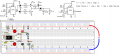
Understand I am just playing, this is not a formal circuit. If you ever have a question about my parts just refer to the above mentioned link. If I decide to publish this circuit I will clean it up but it's not gonna happen immediately. I've build the next revision tomorrow I'll give it another once over and update this thread.
 
Last edited:
Thread Starter

Wendy

Joined Mar 24, 2008
23,798
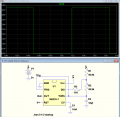
So I tried this design next:
#5d.png
and I wound up with these waveforms:
#5a.png #5b.png
555 Output ................ Transistor Output
I guesstimate the duty cycle is around 35% which I found very disappointing I will probably combine a CMOS 555 with a standard 555 to get that 50% waveform.
After I get where I want I will Test loading characteristics.
 

Ian0

Joined Aug 7, 2020
13,132
Ra is too small. Don't forgot that the discharge transistor on pin 7 has to take Vdd/Ra in addition to discharging the capacitor through Rb. I'd suggest you multiply Ra and Rb by 10 and divide C1 by 10
 

MisterBill2

Joined Jan 23, 2018
27,530
consider that the least ripple will probably not be from a perfect square wave because the charging currents for the two capacitors are not the same. that means that a perfect square wave will not deliver the lowest ripple voltage. So it makes some sense to adjust the duty cycle for the lowest ripple under load. Ripple will also be affected by differences in the ESR of the two capacitors. and the reality will differ from the simulation, which probably uses perfect components.
 

crutschow

Joined Mar 14, 2008
38,513
56Ω from the supply to the discharge pin 7 is way too low, thus it's likely not pulling the voltage to ground when the pin is trying to discharge the capacitor.

Below is an example 555 circuit which adds a small resistor in series with pin 7 to make the capacitor charge and discharge times equal, and give a 50% duty-cycle.

1656511397945.png
 

Thread Starter

Wendy

Joined Mar 24, 2008
23,798
For an approximate 50% wave form Ra should be around 1% of Rb (paying close attention to wattage).
 
Last edited:

Audioguru again

Joined Oct 21, 2019
6,826
The datasheet for the LM555 has a note that says, "No protection against excessive pin 7 current is necessary providing the package dissipation rating will not be exceeded."
 

crutschow

Joined Mar 14, 2008
38,513
The datasheet for the LM555 has a note that says, "No protection against excessive pin 7 current is necessary providing the package dissipation rating will not be exceeded."
True.
But it's obvious that, at some higher current level, the pin 7 output transistor will come out of saturation, which could cause the low duty-cycle (taking longer to discharge the capacitor) noticed by Wendy in post #42.
 

Ian0

Joined Aug 7, 2020
13,132
If you need 50% duty cycle, why use three components when it can be done with two (with a resistor from pin 3 to pin 2/6)?
 

crutschow

Joined Mar 14, 2008
38,513
If you need 50% duty cycle, why use three components when it can be done with two (with a resistor from pin 3 to pin 2/6)?
That only gives 50% if it is a CMOS IC and the output is not distorted by any load.

Edit: If it's not apparent, you need the output to go to the supply voltage for the 555 to have a 50% duty-cycle with the output connected to the timing capacitor.
 
Last edited:

Thread Starter

Wendy

Joined Mar 24, 2008
23,798
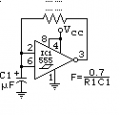
The classic hysteretic oscillator will give 50% when using CMOS every time. Which is why I started using it. Unfortunately it has very low drive characteristics, when you get to about 12 volts DC it gets better but at 5 volts not so much.

0 temp.png
 

Audioguru again

Joined Oct 21, 2019
6,826
Notice that all the schematics show "555" and not TS555 which is the Cmos 555 from ST Micro that Wendy said is used.
The original 555 was NE555 and SE555 from Signetics in 1972. Philips bought Signetics in 1975.

I have never bought or seen anything made by ST Micro or Signetics. I have used a TLC555 (Cmos by Texas Instruments) a few times.
 

Thread Starter

Wendy

Joined Mar 24, 2008
23,798
I think that there is a voltage tripler that has a common low side, input and output.

And if you really like old stuff, I have a 6502 Tandy color computer that you may be interested in. I have thought about trying a color computer as a CW send/receive encoder/decoder, adding an attached LCD screen. The program prom would live inside and fold up above, The benefit is that it would serve as a single function device with stuff inside actually serviceable without a microscope.And running a program from ROM it would be ready in just a few seconds from power on.
would you be so kind as to show me this voltage tripler?
 

Papabravo

Joined Feb 24, 2006
22,082
would you be so kind as to show me this voltage tripler?
The most likely candidate is the Cockcroft-Walton voltage multiplier.
https://en.wikipedia.org/wiki/Cockcroft–Walton_generator
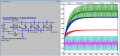
1657989931372.png
The transformer here raises the input square wave by a factor of three, the multiplier has four stages, and the blue trace shows another factor of approximately three.
The problem with this scheme as with all DC-DC conversion schemes is that the power out will always be less than the power in. When you triple the output voltage the current must be less than (1/3) of the input current, and without regulation you can expect substantial ripple and the output voltage will drop precipitously with any substantial amount of output current draw.
 

Thread Starter

Wendy

Joined Mar 24, 2008
23,798
What I am hoping for is a doubler or tripler that keeps a continuity of ground throughout. I don't know if something like that exists or not. I would like to be able to create a plus and minus 12 Volt power supply from 5 volts.
 
Last edited:

Papabravo

Joined Feb 24, 2006
22,082
What I am hoping for is a doubler or tripler that keeps a continuity of ground throughout. I don't know if something like that exists or not.
What exactly is a "continuity of ground". That is not a term I am familiar with. Besides, it is well known that: "Ground is Ground, the world around".
 

Thread Starter

Wendy

Joined Mar 24, 2008
23,798
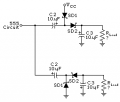
Take the voltage doubler schematic:
00.png
I can create plus and minus 10 volts just by reversing the diodes and capacitors on one of the doublers. The ground on the 555 circuit is the same as it is for the plus and minus 10 volts, I see no way of creating plus and minus 15 volts using the schematic you showed.
 

MisterBill2

Joined Jan 23, 2018
27,530
The tripler looks like the first three diodes worth of the circuit in post #55, with the common being the same as shown, and the output being at the top of D3. I will need to check my reference books for the tripler, never used one yet. The voltage rating of the capacitors varies with their position in the circuit.
Note that an actual tripler must have at least three capacitors and at least three diodes.
 

Thread Starter

Wendy

Joined Mar 24, 2008
23,798
I kind of understood the point about the parts count, I'm just looking for a tripler that maintains the ground at the output so I can create the plus and minus voltages. Good for opamps don't you know.
 
Top