I have 3VDC power supply. Is there anyway I can turn that 3vdc into 12vdc or 15vdc voltage? Any circuits you all might know that can do this using discreet transistors, inductors, resistors, capacitors efc etc but No ICs, no op amp?
The fundamental law is that if you boost voltage you lose amperage. 6 volts at 1 amp can (in theory) be boosted to 12 volts 1/2 amp. I say "In theory" because you always lose something in the translation. Yes, you CAN boost 3V into 12 or 15V but you lose a lot of amperage. 3V into 15V is a five times boost in voltage. Assuming ZERO LOSS, the amperage will be 20% of whatever your 3V source is. It's impractical. With such heavy losses you're probably better off getting a 15 volt power supply rated at sufficient amperage to run whatever it is you are needing 15 volts for. You can always buck the voltage down, which offers the inverse of going up in voltage. Namely at 15 volts and 1 amp (in theory) bucked down to 12 volts you get 1 1/4 amps. Again assuming zero losses. Real world losses apply. You won't get the full 1.25A. It depends on how efficient your buck converter is.
The fundamental law is that if you boost voltage you lose amperage. 6 volts at 1 amp can (in theory) be boosted to 12 volts 1/2 amp. I say "In theory" because you always lose something in the translation. Yes, you CAN boost 3V into 12 or 15V but you lose a lot of amperage. 3V into 15V is a five times boost in voltage. Assuming ZERO LOSS, the amperage will be 20% of whatever your 3V source is. It's impractical. With such heavy losses you're probably better off getting a 15 volt power supply rated at sufficient amperage to run whatever it is you are needing 15 volts for. You can always buck the voltage down, which offers the inverse of going up in voltage. Namely at 15 volts and 1 amp (in theory) bucked down to 12 volts you get 1 1/4 amps. Again assuming zero losses. Real world losses apply. You won't get the full 1.25A. It depends on how efficient your buck converter is.
Yes I am aware of this situation. Power is conserved. You cannot create power. P=I*V and so I would lose current by boosting voltage power equation is quite clear. However, my power stays constant.
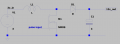
Why the restriction on no ICs or opamps? While technically possible, its a huge amount of work and components to do it properly... The basic circuit is shown below. The MOSFET is turned on for a short while, a few uS typically, charging up the magnetic field in the inductor. When the MOSFET turns off the back emf of the inductor is channeled through to the capacitor by the diode, charging the capacitor. Not shown here is the feedback loop that regulates the output voltage by varying the duty cycle (on-off ratio) of the pulse. That's the tricky bit to get right.
A)Some of inductor/transformer single switch boost converter - suitable for medium wattage like 1W-100W.
B) Capacitor Charge pump - below 1W
Both can be done easily but hardest is feedback. You can avoid feedback by placing zener on output but energy that is not used will be waisted.
What power level are you focusing?
How precise the output voltage needs to be?
Is efficiency an issue?
How your 3V source changes?
How the load changes?
The range of available boost ratios without using a transformer has 4 to 5 as a practical limit. At higher boost ratios the output becomes very difficult to control and you have a very limited range of duty cycles available to control the output.
Why the restriction on no ICs or opamps? While technically possible, its a huge amount of work and components to do it properly... The basic circuit is shown below. The MOSFET is turned on for a short while, a few uS typically, charging up the magnetic field in the inductor. When the MOSFET turns off the back emf of the inductor is channeled through to the capacitor by the diode, charging the capacitor. Not shown here is the feedback loop that regulates the output voltage by varying the duty cycle (on-off ratio) of the pulse. That's the tricky bit to get right.
I would argue that understanding how a state-of-the-art chip does it would be just as instructive, and opamps are arguably discrete parts in their own right these days. Understanding how the inductor/switch/diode/capacitor combo works and the trade-offs are exactly the same whether you use a chip with an integrated MOSFET switch, one with an external MOSFET, or your discrete solution. Once you understand the different operating modes and approaches, continuous conduction v discontinuous, diode v synchronous rectification, saturated v non-saturated inductor, etc. you will see the chip as a convenience rather than a block to learning.
I could, but you'll get a lot more value out of doing your own research. Anyway, component values depend on your input & output requirements, the limitations of your, as yet unspecified, power source, what parts are available to you (ie where you live, and your budget) and, to a lesser extent, your experience of building/designing electronic circuits and your assembly options.
What current can the 3V source supply and what current do you need at the boosted voltage?
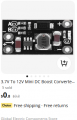
It can be done, but why bother? You can buy a step-up converter good for around 1A for less than $1.
YES, you can build an oscillator inverter using germanium transistors and a transformer with both a power winding and a feedback winding. But you will need to wind your own transformer.

 Facebook
 Google
 GitHub
 Linkedin