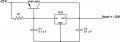
Why does the voltage sag above 1 A in this power supply?

Thread Starter

Michael George

Joined Feb 8, 2015
62
FyiwZK0V.png

Hello,
I'm trying to design this simple power supply. The load voltage slightly drops or sags as I increase the load current. When the load current is 1 A (or above 1 A), the output becomes 9.3v which is too low to my application. What can I do to keep the load at about 11v even when the load current is 1.5 A ?
Thank you, have a great day.
 

MisterBill2

Joined Jan 23, 2018
27,159
I see no connection to the power supply positive side. A VOLTAGE regulator must have an actual reference connection. Otherwise the circuit is sort of a current regulator.

ALL feedback arrangements MUST HAVE a feedback connection !
Without feedback they will not function correctly. This includes voltage regulators.
 

Thread Starter

Michael George

Joined Feb 8, 2015
62
I see no connection to the power supply positive side. A VOLTAGE regulator must have an actual reference connection. Otherwise the circuit is sort of a current regulator.

ALL feedback arrangements MUST HAVE a feedback connection !
Without feedback they will not function correctly. This includes voltage regulators.
I didn't draw it in the image but, of course, I connect the positive side of the power supply to the ground terminal of the regulator.
 

ericgibbs

Joined Jan 29, 2010
21,390
hi MG,
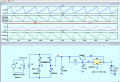
This is what LTSpice shows,
I used a different power transistor, I do not have the PHE model.
The results are OK with a 2Amp load.
The plots show the current through the transistor and 7912, also the Load.

The Hfe of your transistor is low, try a different transistor with a higher Hfe.

E

Added the Vin plot.....

EG 1732.pngEG 1733.png
 
Last edited:

boostbuck

Joined Oct 5, 2017
1,032
PHE13007 is a switching transistor with quite low gain, so having R1 value set low might cause problems due to the current limit of the 7912.

The QSX2 in the sim in #11 has a gain above 270, whereas the PHE13007 has a DC gain (min) of 8 at 2A.
 

panic mode

Joined Oct 10, 2011
4,864
without massive heatsink, regulator will reach thermal limit and because of this protective mechanism, regulator will lower the current, when that happens, transistor too will turn off. and then result is that output voltage sags. if you want to use linear regulators be aware of dissipated heat. you can increase R1 value so that regulator current is small and transistor kicks in sooner. then you may need small or no heatsink on the regulator but heatsink on transistor would need to be even larger.

with R1 value such as 5.6 Ohm, transistor would start conducting when 0.6V/5.6Ohm = 0.1 A.
and if regulator only handles 0.1A, then (21-12)V * 0.1A = 0.9W. but transistor would need to handle remaining 1.4A
(21-12)V*1.4A=12.6W.

if you do not want to worry about massive heatsinks, use switching regulator or at least make sure that voltage difference is sufficiently small (2.5-3V, not 9V). when voltage differential is large, switching regulators are strongly preferred.

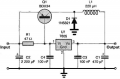
btw. with couple of additional parts (diode and inductor) one can convince linear regulators to work as switching regulators. this is typical example which is showing positive regulator but this can be adapted to work as negative type.
1758397663898.png

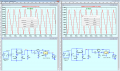
so in your case that could look something like this

1758398668914.png
 
Last edited:

ericgibbs

Joined Jan 29, 2010
21,390
Hi MG,
The LTS plots I posted were for a load current of 2 Amp, you stated you required 1 Amp, so at 1 Amp the power dissipation would be approx half of the plotted value.
Note the Average values.

This image shows the wattage in the 7912 and the Q1 transistor.
The C1 capacitor should be a higher value, say 470u or 1000u

I guess you already had realised that suitable heat sinks would be required.

E

EG 1736.png
 

Irving

Joined Jan 30, 2016
4,996
If you don't like/want the 'noise' of a switching supply, consider using a tracking switching pre-regulator followed by a linear regulator. An LM337 will deliver 2A with a fixed input/output differential of 3v, so the pre-regulator tracks Vo+ 3v.

Another option, since LM337s are cheap, is to use 3 in series, each dropping 3v, all tracking the output voltage + offset.

A 3rd option is to run 2 or more LM337 in parallel, using an opamp to provide a low-impedance common feedback voltage. The outputs of the LM337s are connected together via low value resistors, typically 0.2 - 0.5ohm to facilitate current sharing.
 
Last edited:

MisterBill2

Joined Jan 23, 2018
27,159
To repeat what has already, correctly, stated: the emitter to base resistor value is much to low! That tends to very much put all of the load current thru the regulator, as already mentioned. In addition, there should also be a series resistor between the supply and the emitter , AFTER the tap-off for the regulator. My choice would be for the regulator to pass about 25% of it's rated output, at most. IN ADDITION, adequate heat sinks are required.
Besides that, the current capability of the negative 21 volt supply could also be a challenge.
 
Top