Why does boost converter output voltage increase as load resistance increases?

Thread Starter

ANewYorker

Joined Feb 12, 2024
9
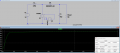
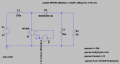
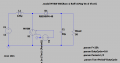
With Vin=12V and a 60% duty cycle, I was expecting a 30V output. But Instead I got a Vout=27V. I thought it was because of the diode, but its forward voltage drop is only 0.2V. So I tweaked everything and I noticed I had to make Rload=80 to get a 30V output. Why can't Vout=30V when Rload=50?
1720093586790.png
1720093679008.png
1720093930972.png
 

Attachments

BobTPH

Joined Jun 5, 2013
11,463
Each cycle of a boost converter puts a certain amount of energy into the inductor. If the load uses more or less energy, the voltage will change.

That is a simplified explanation. The real explanation requires you to understand the difference between continuous and discontinuous operation. The equation based on duty cycle only holds for continuous mode.
 
Last edited:

ronsimpson

Joined Oct 7, 2019
4,645
But somehow the output wasn't 30V. Do you know why that is?
Why is the diode working at 0.2V? The data sheet said 0.6V at 500mA.
Is there resistance in the inductor? In the switch? These voltage losses take away power and voltage.

Make the load 1,000,000 ohms and watch the voltage clime.
Post your SPICE file.
 

MrAl

Joined Jun 17, 2014
13,667
With Vin=12V and a 60% duty cycle, I was expecting a 30V output. But Instead I got a Vout=27V. I thought it was because of the diode, but its forward voltage drop is only 0.2V. So I tweaked everything and I noticed I had to make Rload=80 to get a 30V output. Why can't Vout=30V when Rload=50?

View attachment 326117
View attachment 326118
View attachment 326119

Hello there,

First, I think I understand what you are doing here and why you are asking this question. It's because you are testing a simple boost converter without feedback so you can see how the basic boost converter works. That is, how the voltage becomes higher on the output and things like that. You do not use feedback because that's a secondary thing and you just want to understand the way the voltage gets boosted, and why the output might change when there is no feedback.

The thing about boost converters is that the output depends a lot on the parasitics of the components and the basic performance of the components. That's like the inductor ESR and the switch ESR.
We see that your switch ESR looks like 1 Ohm. Is that true? If so, that's going to limit the top end output voltage. It's also going to make the output voltage 'softer' with load, meaning the voltage will decrease with load more than if the ESR was much lower.

You can try lowering the switch 'on' resistance. That's unless you really need that high of a switch 'on' resistance, which seems like a high value for most converter transistors.

Of course the diode drops voltage, so we usually see a Schottky diode being used. That might already be a Schottky I just did not check that.

This is a good exercise as this will show you why we use feedback in converter circuits. Feedback is used to help keep the output voltage constant even when we change the load resistance. Without that, the more basic operation usually allows the output voltage to change with different load values.

We could also talk about the filter capacitor and its ESR value which is an important consideration, but that gets a little more complicated.
 

ronsimpson

Joined Oct 7, 2019
4,645
I checked. It was in CCM. But somehow the output wasn't 30V. Do you know why that is?
Yes I know.
Add this to your SPICE file.
.model MYSW SW(Ron=0.01 Roff=1Meg Vt=.5 Vh=-.5)
By default, the on resistance of the switch is 1 ohm. (mentioned above) Now it will be 0.01 ohms. You were loosing voltage across the switch.
1720124843151.png
 
Top