5 volt 1000 mA regulator or reduction to

Thread Starter

Schidtztorm

Joined Oct 1, 2019
77
300 deg F is hot but not fire hot. Thank you. I'll look for a formulae for a sink that will work wiht that temp

Thank you. You guys have all been great. I'll let you know how it works when I put them together next week. I have to find some good sinks.
I have another question if you don't mind? Can you school me a bit on calculating voltage and current with transistors? FETs and BJTs. I'm savy and learn very quick. But most explanations I see are confusing.
Maybe start with the differential regulator you just designed. The reason for this is obvious. Like if I can't keep it cool enough at 1 Amp. I could drop it to 0.600mA. But I wouldn't know how exactly. Or I may want rebuild one in the future with a different supply voltage. Would you be so kind?
 

Alec_t

Joined Sep 17, 2013
15,125
Can you school me a bit on calculating voltage and current with transistors? FETs and BJTs. I'm savy and learn very quick. But most explanations I see are confusing.
Any reputable textbook will give you the basics, but a forum is not the place for lengthy tutorials. What in particular is confusing?
 

crutschow

Joined Mar 14, 2008
38,557
Can you school me a bit on calculating voltage and current with transistors?
It's really quite simple for a series regulator.
For the regulator transistor, a BJT's collector and emitter currents are nearly equal and equal to the load current.
The only difference is that the emitter current includes the base current which is typically about 1/50 to 1/100 of the collector current.

With a MOSFET, the source and drain currents are identical, since the gate is voltage controlled and draws no significant current.
Like if I can't keep it cool enough at 1 Amp. I could drop it to 0.600mA. But I wouldn't know how exactly.
For both types of transistor the power dissipated is simply the supply voltage minus the output voltage times the current.

The current is not arbitrary, it is determined by the load, so to reduce the current from 1A to 6oomA requires a load with a higher resistance/lower current requirement.
 

Thread Starter

Schidtztorm

Joined Oct 1, 2019
77
Any reputable textbook will give you the basics, but a forum is not the place for lengthy tutorials. What in particular is
Any reputable textbook will give you the basics, but a forum is not the place for lengthy tutorials. What in particular is confusing?
Sorry. I meant to send this to C
It's really quite simple for a series regulator.
For the regulator transistor, a BJT's collector and emitter currents are nearly equal and equal to the load current.
The only difference is that the emitter current includes the base current which is typically about 1/50 to 1/100 of the collector current.

With a MOSFET, the source and drain currents are identical, since the gate is voltage controlled and draws no significant current.
For both types of transistor the power dissipated is simply the supply voltage minus the output voltage times the current.

The current is not arbitrary, it is determined by the load, so to reduce the current from 1A to 6oomA requires a load with a higher resistance/lower current requirement.
So even the way it's set up now. If the load wants 3 amps, it's going to get. Or if it only needs 0.400 mA, same thing. Is that correct?
 

Thread Starter

Schidtztorm

Joined Oct 1, 2019
77
Yup.
The only thing that determines the current is what the load takes/needs.
That's actually a relief. That phone most likely will not draw an amp unless it's charging a completely dead battery while streaming video. It'll most likely be 0.500 mA.
In reference to the values and configuration of this regulator; is it the same if I used BJTs? Or would base resistor need to change? I realize that a base opens more on current. Not to mention the 0.600 V drop.
 

crutschow

Joined Mar 14, 2008
38,557
Your differential regulator you sent me. 5.V 1000mA.
It will work with a BJT pass transistor as long as the base current requirements are met (base current equal to the output maximum current divided by the Beta current gain , which may require a Darlington configuration.
 

Thread Starter

Schidtztorm

Joined Oct 1, 2019
77
Surely does not sound like a measurement. :rolleyes:

The output should be the source, not the drain.

Post a schematic of exactly what you have.
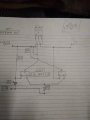
My mistake. It is the drain. I drew a schematic with actual parts how its wired so you can compare putouts. I don't think it's putting out more than 0.200 mA. IMG_20191018_150025.jpg
 

crutschow

Joined Mar 14, 2008
38,557
So post the voltages at all the nodes (base, collector, emitter, gate source drain) of all the transistors when it's delivering the maximum current.
Otherwise I can't help determine what's wrong.

What's the load for this current?
 

Thread Starter

Schidtztorm

Joined Oct 1, 2019
77
So post the voltages at all the nodes (base, collector, emitter, gate source drain) of all the transistors when it's delivering the maximum current.
Otherwise I can't help determine what's wrong.

What's the load for this current?
Unfortunately I don't have access to any instrumentation. I'm in a precurious invioronement, which is why I asked to email you a while back. Can't post this in public. So let me ask you this.
Have you looked at the datasheets for my components and determined that it should put out over an amp?
The actual load is a little over 0.500 mA while turned off. Almost 0.900 in use. ZTE Android phone.
If you crunched those numbers, then I have something wrong, or a bad part.
 

crutschow

Joined Mar 14, 2008
38,557
I'm in a precurious invioronement, which is why I asked to email you a while back.
I don't know what that means. o_O
Have you looked at the datasheets for my components and determined that it should put out over an amp?
Yes, I have looked at them, and they should work okay.
The MOSFET is rated for 20A.
That's why I asked for the node voltages to see if I could determine what might be wrong.
They should be fairly close to those shown in post #15.
The actual load is a little over 0.500 mA while turned off. Almost 0.900 in use.
That's a very small current.
Are you sure you don't mean 500mA and 900mA.
 
Top