The voltage output will be somewhat sensitive to load and temperature.
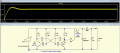
LTspice simulation of example circuit below for load varying from about 1A to 0.1A:
The gate-source operating voltage can typically vary a volt or more from unit-to-unit of the same part type, so you can either use a potentiometer to compensate for that, or select the voltage divider resistor values by trial and error (select at test) to get the output voltage you want over the desired load current range with the actual MOSFET you will use.
I don't have any good BJTs. The supply voltage is a good 12.5V switcher from a medical device. I'm sure there is very little, if any variation.
The 2 fets are>
D30NF06L (surface mount)
And
H7P0601DS
?
The gate-source operating voltage can typically vary a volt or more from unit-to-unit of the same part type, so you can either use a potentiometer to compensate for that, or select the voltage divider resistor values by trial and error (select at test) to get the output voltage you want over the desired load current range with the actual MOSFET you will use.
I would expect you want the output voltage to be within ±5% of 5V (±0.25V).
The gate-source operating voltage can typically vary a volt or more from unit-to-unit of the same part type, so you can either use a potentiometer to compensate for that, or select the voltage divider resistor values by trial and error (select at test) to get the output voltage you want over the desired load current range with the actual MOSFET you will use.
I would expect you want the output voltage to be within ±5% of 5V (±0.25V).
This is a common misunderstanding. The 5V is a limit on the negative voltage on the base with respect to the emitter.
The voltage from the base to the emitter is normally around 0.6 to 1V when the transistor is on, and less when off. Anything higher than that will cause enough current to flow to damage the transistor. The base is normally protected by a resistor, which may then be connected to a higher voltage.
This is a common misunderstanding. The 5V is a limit on the negative voltage on the base with respect to the emitter.
The voltage from the base to the emitter is normally around 0.6 to 1V when the transistor is on, and less when off. Anything higher than that will cause enough current to flow to damage the transistor. The base is normally protected by a resistor, which may then be connected to a higher voltage.
No. You drive current, limited by a resistor, through the base-emitter junction in the forward direction and the base-emitter voltage developed is about 0.6V. The junction must never be reverse-biased by more than 5V or breakdown will occur.
Wait maybe we are misunderstanding you. In an emitter follower circuit you can put 5.6V on the base and the emitter will rise to about 5V, depending on the load.
Large power MOSFETs have a high transconductance which makes for a small Vgs change with a change in output current for currents much smaller than their maximum.
No. You drive current, limited by a resistor, through the base-emitter junction in the forward direction and the base-emitter voltage developed is about 0.6V. The junction must never be reverse-biased by more than 5V or breakdown will occur.
That's what I thought. I've read the data sheet on those a while back and still remember some of the numbers. But here's a question! Will they work on Mr Crutchows differential regulator? It has a voltage divider setting a reference to 5 volts at the base.
Large power MOSFETs have a high transconductance which makes for a small Vgs change with a change in output current for currents much smaller than their maximum.
Will those little L6's work on your differential regulator?
By the way. My switcher supply voltage is actually 12.5V, so I'll have to change the value on the positive side of the divider. Correct? If the tiny bjt's will work for me that is.
Will those little L6's work on your differential regulator?
By the way. My switcher supply voltage is actually 12.5V, so I'll have to change the value on the positive side of the divider. Correct? If the tiny bjt's will work for me that is.
Here's a sim of a crude buck converter.
A standard multivibrator comprising two L6s drives a P-MOSFET to chop the 12V supply . The chopped supply has an average voltage set by the duty cycle of the multivibrator and is smoothed by L1 and C3 to give 5V out to the load. The duty cycle is adjusted by varying R2 or R3.
I would not recommend this for driving critical loads, since there is no negative feedback to regulate the output voltage.
They are npn 2SC1623-L6 There are different types. These are out of a Sony Walkman. I think this is the correct #. L6 is all that's printed on it. You have my FET info?

 Facebook
 Google
 GitHub
 Linkedin