Facebook
 Google
 GitHub
 Linkedin
Greetings,
I am trying to design and build a 6 Volt Positive ground voltage regulator for my 1949 Allis-Chalmers Model C tractor which is equipped with a 3rd-brush type generator (dynamo). This 3rd brush generator is inherently self-limited regarding current (amperage) output, so Voltage limiting is the only regulation required.
The generator is of the “A” circuit type meaning the field coil is internally connected to the generator output and the field current is controlled by externally grounding via a resistor or alternatively bypassing the field resistor, thereby “full fielding” the unit for maximum output.
This ‘regulating’ was accomplished on these old tractors by manually selecting the field circuit via the three-position light switch; pushed all the way in is Low Charge of ~3 Amps, middle position is High Charge of ~10 Amps, and all the way out is High Charge plus the headlights are On. A very primitive system indeed, but it functioned satisfactorily so long as the operator was sufficiently attentive.
There are commercially available units that do exactly what I want, but they cost $Dollars, and as an impecunious retiree who likes to tinker, I prefer to spend my time rather than $Dollars. Also, since my light switch has failed, this is a good time to upgrade.
My design goals are as follows:
1) Reliability. This is by far the most important criterion.
2) Simplicity, following the KISS philosophy with low parts count.
3) Readily available discrete components, no custom PCB.
4) Small form factor to fit inside the original Cutout Relay box. This may not be practical however.
5) Retain the 6-Volt Positive Ground feature.
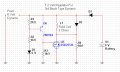
I desire your help in selecting components and improving my circuit. This is just a starting point that I did on my outdated Multi-sim student version from when I went back to college some 15 years past, and it has a very limited selection of components. The circuit did function in simulation but I had to substitute a resistor in place of the field coil, and I had to remove the cutout diode D3.
I am trying to design and build a 6 Volt Positive ground voltage regulator for my 1949 Allis-Chalmers Model C tractor which is equipped with a 3rd-brush type generator (dynamo). This 3rd brush generator is inherently self-limited regarding current (amperage) output, so Voltage limiting is the only regulation required.
The generator is of the “A” circuit type meaning the field coil is internally connected to the generator output and the field current is controlled by externally grounding via a resistor or alternatively bypassing the field resistor, thereby “full fielding” the unit for maximum output.
This ‘regulating’ was accomplished on these old tractors by manually selecting the field circuit via the three-position light switch; pushed all the way in is Low Charge of ~3 Amps, middle position is High Charge of ~10 Amps, and all the way out is High Charge plus the headlights are On. A very primitive system indeed, but it functioned satisfactorily so long as the operator was sufficiently attentive.
There are commercially available units that do exactly what I want, but they cost $Dollars, and as an impecunious retiree who likes to tinker, I prefer to spend my time rather than $Dollars. Also, since my light switch has failed, this is a good time to upgrade.
My design goals are as follows:
1) Reliability. This is by far the most important criterion.
2) Simplicity, following the KISS philosophy with low parts count.
3) Readily available discrete components, no custom PCB.
4) Small form factor to fit inside the original Cutout Relay box. This may not be practical however.
5) Retain the 6-Volt Positive Ground feature.
I desire your help in selecting components and improving my circuit. This is just a starting point that I did on my outdated Multi-sim student version from when I went back to college some 15 years past, and it has a very limited selection of components. The circuit did function in simulation but I had to substitute a resistor in place of the field coil, and I had to remove the cutout diode D3.