Designing a 5 volt voltage reference for wide input (12-310v) buck converter

Thread Starter

amh113

Joined Jun 18, 2025
11
Hello,
I want to design a 5 volt voltage reference to feed a buck converter controller. The converter has a wide range input (from 12 to 310 vdc) and provides 12 volt output. I am trying to design a voltage reference using a cascaded Zener voltage regulator, but there is a limitation with the power capability of the series resistor which found to be high for such wide input design. I want to know if there is any efficient method that can do that.
 

BobTPH

Joined Jun 5, 2013
11,487
According to the datasheet, the cathode current must be between must be between 1 and 100mA. A 100:1 ratio. So it is workable.

You would design for 1mA at 12V. The voltage across the resistor would be 12-5 = 7V. So the resistor would be 7K.

Now, with 130V in, the voltage across the resistor is 130-5 = 125V and the current is

I = V/R = 125/7000 = 17.9 mA. and the power is:

0.0179 * 125 = 2.23W

If you can tolerate that power loss it is possible.
 

Ian0

Joined Aug 7, 2020
13,113
There's nothing to be designed. An LM4040-5.0 will work at 45uA and give 0.1% accuracy. All it needs is a suitable resistor to V+.
150k would work at 12V input and still only dissipate 620mW at 310V input.
 

Thread Starter

amh113

Joined Jun 18, 2025
11
It surprises me that there is no lower voltage supply from which to power the reference. For instance, what is powering the MOSFET gate driver?
Actually i have two ic converters that have their own supply voltage generated for the voltage input, however i making some protections before these two ic converters and i need some voltage reference to feed the microcontroller
 

Thread Starter

amh113

Joined Jun 18, 2025
11
There's nothing to be designed. An LM4040-5.0 will work at 45uA and give 0.1% accuracy. All it needs is a suitable resistor to V+.
150k would work at 12V input and still only dissipate 620mW at 310V input.
thank you for your help. I will try it and give the feedback for you.
 

Thread Starter

amh113

Joined Jun 18, 2025
11
According to the datasheet, the cathode current must be between must be between 1 and 100mA. A 100:1 ratio. So it is workable.

You would design for 1mA at 12V. The voltage across the resistor would be 12-5 = 7V. So the resistor would be 7K.

Now, with 130V in, the voltage across the resistor is 130-5 = 125V and the current is

I = V/R = 125/7000 = 17.9 mA. and the power is:

0.0179 * 125 = 2.23W

If you can tolerate that power loss it is possible.
thank you for your reply,
The highest voltage input is 310 volt.
 

ronsimpson

Joined Oct 7, 2019
4,662
A voltage reference makes a voltage but does not supply current. A voltage regulator makes the current. I think you know this.

A TL431 or LM4040 needs current, and with a 100:1 input voltage ranges a simple resistor is a problem. Think about a 1mA current source that applies 1mA (or what you need). This way the current is constant at all voltages. It does not need to be accurate. I am thinking of the current source on top and a 30V Zener to keep the voltage from getting too high. Now almost any voltage reference will be happy. In the case of the TL431 1mA and limit the voltage to under 35V.
There were some high voltage junction FETs that make a simple current source.
 

Thread Starter

amh113

Joined Jun 18, 2025
11
You need a voltage REGULATOR to feed a microcontroller. A voltage REFERENCE won't supply anything, apart from an input to an amplifier or comparator.
So do we have a voltage regulator that can work for voltage input between 12 and 310 volt ???
 

ronsimpson

Joined Oct 7, 2019
4,662
I don't have the schematic in my head right now. I did this job years ago. I used a UC3842 and a MOSFET.
I don't have time right now but it is common to use a UC3824 type part (or similar) and supply it power from 350V without burning much power. Read on "power-up supply" for the UC3842. I will try to get back in a while.

What is the output current?
 

BobTPH

Joined Jun 5, 2013
11,487
thank you for your reply,
The highest voltage input is 310 volt.
OMG, I transposed that in mind.

305/7000 = 44mA and 13.3W, making the TL431 pretty ridiculous.

You need to think of a different approach here. That input voltage range is not going to be easy to deal with.
 

ronsimpson

Joined Oct 7, 2019
4,662
One of the versions of the LinkSwitch can do most of 1A. It will work well up to 700V. I think it might not start up under 20V but I don't remember.
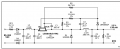
I have used this IC. This schematic is for power line applications. Remove the left side parts D3,4 & RF1, maybe L2. I think it will make 12V at 500mA with no heat. (almost no heat)
1752417571891.png
----edited----
The IC will not go to more than 66% duty cycle. So it will struggle below 20 volts at full current.
 
Last edited:

ronsimpson

Joined Oct 7, 2019
4,662
The converter has a wide range input (from 12 to 310 vdc) and provides 12 volt output.
Again, what current?

A power supply that has an input of 12V and an output of 12V is called a wire.

This is not a simple project. I feel you are a beginner. I have designed power supplies for a living starting in the mid1970s. I would find this hard to do. I have done 24V to 300V. It was not fun.

A 300V to 12V supply is very different from a 13-25V to 12V supply.

Please tell us why?

Last time, we found it was best to have two different supplies.
1- 100V to 250v ac or dc to 12V
2- 10V to 25V dc to 12V
There really was no reason to have the middle voltages.
 

Thread Starter

amh113

Joined Jun 18, 2025
11
Again, what current?

A power supply that has an input of 12V and an output of 12V is called a wire.

This is not a simple project. I feel you are a beginner. I have designed power supplies for a living starting in the mid1970s. I would find this hard to do. I have done 24V to 300V. It was not fun.

A 300V to 12V supply is very different from a 13-25V to 12V supply.

Please tell us why?

Last time, we found it was best to have two different supplies.
1- 100V to 250v ac or dc to 12V
2- 10V to 25V dc to 12V
There really was no reason to have the middle voltages.
I know that this is not a simple project , and that why i am asking here . I designed different topologies of dc-dc converters like buck, boost, multi-input and phase shifted converters, but not with such wide range input. I had a PhD in power electronics specialized with dc-dc conversion system.
There is a Chinese relay timer in the market that can work from 10 to 350 dc voltage input. I opened it and i found a simple buck converter that can do this job and it provides a 5 volt output for the relay inductor. They use an 8 bit controller ( MB95560H/570H/580H Series) to control the buck converter and the relay inductor. I want to know how they feed the microcontroller from such wide range input.
 
Top