Volt meter comparison

Thread Starter

I0sens

Joined Jul 9, 2019
21
I know that all of you know the feeling of wanting something that you really don't need.
The pain grows... and finally you bite the bullet.
You can share your experience!

Such was the case with my new (used) Agilent 344401A meter that I had set my eyes on for quite a while.

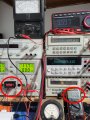
I did a test of some of the meters that I own to see what the improvement will be when measuring
rocket science experiments.:cool:

Look at the measurements, I leave the interpretation to you.

The red panel meter is this one: DC0-33V 0.36 inch LED Display 3 Wire 5-Digit High-precision Voltmeter 3 Colors | eBay Pretty amazing.

Of course, the Agilent is an excellent Ohm meter that easily measures milliohms to 100 Mego ohms, and the current measurements
are also great. Plus it has built-in math etc... So, I definitely don't regret the purchase.

What really amazes me how my 2 HP 3478A are off by a few millivolts after almost 40 years!!!


image001.png
meters.jpg
 

MisterBill2

Joined Jan 23, 2018
27,159
It looks like most of the meters are rather close. But the Simpson 260 was not connected on the negative side. Or maybe I just could not see the connexion.

Certainly there are applications where that fourth or fifth digit matter. But presently I do not get to them. I seldom use my excellent BECKMAN 4 1/2 digit meter any more.
The question is always how accurate does it need to be???
I can run a mill to +-0.05inch quite consistently. For most work that is plenty close. (NOT "good enough", though)
That extra decimal can double the price, and the one beyond that gets really expensive. I learned that from a friendly shop after I accidentally let AUTOCAD tolerance a job much tighter than it had to be. I went back and reset the tolerances to where they needed to be and that cut over $7200 out of the price. And everything still worked perfectly. That machine made the pages of "Machine Design" magazine.
 
Last edited:

MrChips

Joined Oct 2, 2009
34,627
I am not sure what you are trying to prove.
How often does one need ±0.0001% precision, that’s 1 ppm?

And the other question is, which meter is the most accurate?
 

Thread Starter

I0sens

Joined Jul 9, 2019
21
I totally agree with you. (see my first sentence).
And yes, the Simpson was not connected, since it gave me some weird readings (I will have to look into that, it's usually pretty precise, too).

My whole point was that if you need a rather precise volt-meter, you can go with the e-bay one for $10.

And to the question which meter is the most accurate...
Since I only have a Chinese voltage reference that says 9.99836 Volt - it might just be the e-bay one.;)
Have a happy solder-smoke filled weekend!
 

Futurist

Joined Apr 8, 2025
721
I bought a couple of old Fluke 8050A DVMs a few years back, no doubt they were highly regarded in their day (1979?).

1760899761377.png

They work (but give slightly different readings with the same input voltages) but the display is not illuminated and so I found them - almost - useless unless one is in a brightly lit room (which is not my workshop).
 

MrChips

Joined Oct 2, 2009
34,627
I bought a couple of old Fluke 8050A DVMs a few years back, no doubt they were highly regarded in their day (1979?).

View attachment 357346

They work (but give slightly different readings with the same input voltages) but the display is not illuminated and so I found them - almost - useless unless one is in a brightly lit room (which is not my workshop).
Those meters are notorious for having flakey switch contacts. We had a number of them in the lab. I had to clean all the pushbutton contacts with contact cleaner.
 

Reloadron

Joined Jan 15, 2015
7,852
I bought a couple of old Fluke 8050A DVMs a few years back, no doubt they were highly regarded in their day (1979?).

View attachment 357346

They work (but give slightly different readings with the same input voltages) but the display is not illuminated and so I found them - almost - useless unless one is in a brightly lit room (which is not my workshop).
I have one of those and checked the basement and there it was. Yes, the PB switches get flakey from oxidation but easily cleaned with contact cleaner. Maybe I will plug this one in and make sure it still works. :)

Ron
 

Thread Starter

I0sens

Joined Jul 9, 2019
21
I bought a couple of old Fluke 8050A DVMs a few years back, no doubt they were highly regarded in their day (1979?).
They work (but give slightly different readings with the same input voltages) but the display is not illuminated and so I found them - almost - useless unless one is in a brightly lit room (which is not my workshop).
Wow, they sell these Flukes still for $100+.
Must be for sentimental reasons..
The HPs 3478 are running circles around them. (But also don't have a back light..)
I just love those. 4Wire Ohms...
 

panic mode

Joined Oct 10, 2011
4,864
bench multimeters (like HP3478A) are awesome beasts.
i love my good old Keithley 2002. It takes a lot of realestate on my desk but it is a top notch product with beautiful and crisp display.
 

Reloadron

Joined Jan 15, 2015
7,852
In my boneyard I found my old Fluke 8502A bench meter. That was a Cadillac of it's day. Large for the bench but a nice meter. Today my bench meter is my Agilent 34401A. Somewhere I have a few early Fluke hand helds.

Ron
 

Thread Starter

I0sens

Joined Jul 9, 2019
21
I will read the article as my night read...Thanks


Look in Google books: Methods of Measuring electrical Resistance Edwin F. Northrup.
It's amazing what people came up with! We have is so easy!
 
Last edited:

MisterBill2

Joined Jan 23, 2018
27,159
The "four-wire" resistance measuring scheme can avoid lot of problems when measuring resistance in a factory production environment. An absolute problem solver!! Apply a constant current voltage to the resistance and measure the voltage. A stable current regulator delivering a specific current into a test resistance load can be quite accurate.
 
Top