4017 Frustration

MisterBill2

Joined Jan 23, 2018
27,514
Much earlier , actual QUADRANTS were suggested, which certainly would work. My suggestion of ten six minute sectors is based on similar thinking.
OF COURSE, the sectors would need to be much different from the tiny hash marks shown in the various suggestions. Of course, 12 sectors, emulating wide hour hands, could also be used, but that would add to the complexity of the counter scheme controlling them. Ten sectors would be simple, although it would require some getting used to.
 

Thread Starter

electrongod1

Joined Sep 8, 2018
40
The problem is that one LED will always be on whenever a CD4017 is enabled. So you can't use the Q0 output when the counter isn't disabled.
It was how you labeled the LEDs.
RGB LEDs will complicate the circuit I posted. I could use a single current limiting resistor for all 60 LEDs. Plus I'm switching both the anode and cathodes of the LEDs. You can't do that with RGB LEDs.
Dont know why my discussion stopped. In my design im expecting 18 4017s, 8 seconds, 8 minutes and 2 hours. The only way i can think of to accomplish this is with AND gates at all of my minutes outputs. BTW, seconds cascade is working perfectly.
 

dl324

Joined Mar 30, 2015
18,326
In my design im expecting 18 4017s, 8 seconds, 8 minutes and 2 hours.
As pointed out by one or more other members, that will be a lot of wiring.

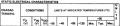
Are you still planning to drive the RGB LEDs with the CD4017 outputs without current limiting resistors? What are the brightness specifications for the LEDs? At 5V, CD4017 outputs are rated for 1.6-3.2mA at room temperature. Will the LEDs be bright enough at those currents?

From Harris datasheet:
1780179983184.png
1780180010295.png
 
Last edited:

Thread Starter

electrongod1

Joined Sep 8, 2018
40
As pointed out by one or more other members, that will be a lot of wiring.

Are you still planning to drive the RGB LEDs with the CD4017 outputs without current limiting resistors? What are the brightness specifications for the LEDs? At 5V, CD4017 outputs are rated for 1.6-3.2mA at room temperature. Will the LEDs be bright enough at those currents?

From Harris datasheet:
View attachment 367825
View attachment 367826
 

Thread Starter

electrongod1

Joined Sep 8, 2018
40
I am definitily using 3 470 ohm resistors for each LED. You posted a clock earlier which is exactly what im trying to do. The should be artistic as well as functional, the resistors will make a nice border around my LEDs. I'm wondering if i have to use an AND gate for each output of my 4017s to make the minute structure work.
 

BobTPH

Joined Jun 5, 2013
11,515
One 8-bit micro, 1 resistor, 1 capacitor and a string of 60 daisy chained WS2812 LEDs. I could have this working in one day.

Okay, you probably need buttons to set it also. I would use 1 button for fast and one for slow advance. No additional parts needed if micro has internal pullups.

Edited: As pointed out before, you need a crystal and two more caps to keep good time. But I found the 60 WS2812’s already arranged in a circle with only 3 connections needed.
 
Last edited:
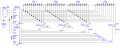
THAT drawing shows how to cascade up to 100 LED's in a chase configuration. Certainly not the circuit you're looking for. But using the MR (Manual Reset) you can count any number of LED's you wish - with one caveat - you'll need an AND gate to distinguish the output and the resetting on the clock pulse. I'll ask Tony to see if he can draw up another schematic showing 60 and 12. But it's going to be complex. Once again, others are saying to use a µC instead of all that wiring. As you can see - it's a lot of wiring that can be easily mixed up. T said when he built his 20 count chaser he initially mis-wired two LED's. I'll ask him to send that one to me. He used only 2 chips. Either that or I'll ask him to send me his TurboCAD file.
 
Last edited:

AnalogKid

Joined Aug 1, 2013
12,129
He's finally gotten around to searching for that schematic. He said he had to redraw it.
Doubt that this will work. Starting with the 1-10 decade -

When U3 out 0 is high, the Q1 Base is at 12 V - ish, and the emitter is at 11.4 V. So the lowest the saturated collector voltage can be is at 11.5 V, so the voltage at any of the LED cathodes is at 11.5 V. An individual U2 output is at 12 V, so the LED anode is at 12 V -ish. With only 0.5 V across an LED, I don't see how any LED can light.

Better to move the Q1 emitter to GND, move the LED current limiting resistor to the collector, and run the transistor as a saturated switch rather than an emitter follower. Also, I'd change the transistors to small n-channel FETs such as the 2N7000 to eliminate the base current limiting resistor. Same total number of components, way better control of the LED currents. This would be very similar to the schematic in post #70. Note that that schematic relies on the 4017 output stage current limiting / output impedance to protect the LEDs. I think this is very bad practice. A) That impedance is not tightly controlled in production, so the LED brightness can vary from chip to chip and/or from one manufacturer to another. B) that part of that chip is not designed for that function.

I suppose the circuit could light if Q1 pulls the U2 output stage down (through an LED) out of "saturation", but that never is a good idea if you want decent long-term reliability.

ak
 
Last edited:
Will check with him. His video seems to work just fine. I'm waiting to hear from him regarding a 20 step chaser using one 4017 and one 4013. 20 LED's, two transistors, some caps and resistors. I think he said it ran on 5V. Like I said - I'm waiting for him. Should hear from him by this summer. He's coming out for a visit. I'll ask him to bring his electronics files - that is if I can't get him to share those files with me via email.
 

AnalogKid

Joined Aug 1, 2013
12,129
His video seems to work just fine.
But it does not show a schematic, so a) we cannot review the design, and b) almost no one could replicate his circuit based solely on his very sparse description. There is a clue in that the circuit does not have one resistor per LED, but if you are experienced enough to catch that *and* know what it means, you probably don't need his circuit to begin with.

ak
 
Last edited:

Thread Starter

electrongod1

Joined Sep 8, 2018
40
Don't know if you are referring to my issue. I've posted a schematic and description of what I am trying to accomplish in a post titled "12 Hour Clock" (without microprocessors). Still cant get it to work. Wondering if I need to use an AND gate at every output of the minutes 4017s or if the solution is simpler. Any advice would be appreciated.
 

ThePanMan

Joined Mar 13, 2020
918
So you can ignore the suggestions in posts #86 from @MrChips and #90 from @ThePanMan.
That was merely posted to show the difficulty in going the 4017 route. I'll say it again for anyone who may have missed it: "A better approach would be to use a microcontroller and addressable LED's". And I wasn't the first to suggest that. That suggestion was made early on in the thread.
 

dl324

Joined Mar 30, 2015
18,326
A better approach would be to use a microcontroller and addressable LED's
OP already stated that he didn't want to use microcontrollers. So even though you, and others, think that's the "best" approach, it's not the approach he's chosen. And, with common cathode RGB LEDs, even a microcontroller can't work without a lot of glue logic. That would defeat the point of using a microcontroller.

I don't think using CD4017 is appropriate for a clock but, again, that's the approach he's chosen. He already knows it's going to take 18 CD4017; and a lot of wiring.
 
Last edited:
He already knows it's going to take 18 CD4017
I envision 6 CD4017's. Two for the second hand sweep (should he desire that), two more for the minute hand sweep and the last two for the hour sweep. That and some sort of clock source. And yes - a whole lot of wiring. Four if he decides against the second hand sweep.

edit: for the hour sweep (12 hours) he would need at least one AND gate to reset the hour sweep back to the first (Q0) (1:00 position) on the 13th hour.
end edit.
 
Top