4017 Frustration

ThePanMan

Joined Mar 13, 2020
921
TS wants to build a clock that 60 LEDs.
An MCU is still the simplest solution.
I missed that fact. But you can still do 60 by simply resetting the second counter after 60.

After re-examing the posts I now see both 12 and 60. I'd have to agree, an MCU would be the way to go.
 

MrChips

Joined Oct 2, 2009
34,816
Let us imagine that the clock has 12 LEDs for hour, 60 LEDs for minutes and another 60 LEDs for seconds. Only three LEDs are ever lit at one time. You can multiplex the LEDs in order to minimize the wiring required.
 

Thread Starter

electrongod1

Joined Sep 8, 2018
40
A lot of it comes down to what is it that you are trying to accomplish? If you are trying to learn how to use a 4017, then using something else won't accomplish that. But if you are just trying to make some kind of LED chaser, then using a different approach may be the way to go.

Also, if all you want is a chaser for some reason, then there are LOTS of LED chaser circuits on the Internet (and some of them actually work). But if your goal is to understand how to design a chaser, that's a completely different critter.

Also, there isn't a single "simple chaser" -- lots of variations, so you need to clearly understand (and communicate to us) exactly what you want your simple chaser to do. Without that information, telling us that something functioned as planned doesn't tell us much.
Thanks for your input. Ultmalely I want to build a 12 hour clock with 60 rgb leds, blue -seconds,green -minutes, and red hours. Im old fashioned and retired, so no microproccessors please, Ive got a lot of time on my hands. I stumbbled on the idea when I unpacked my scope and was looking for a circuit to play with it on, then I ran into 4017s and was intantly enamored. Im going to be using CD4060s for my time base and 4013s attain the correct frequency. A lready have an oscillator runnig on my circuit thats running prfectly. The circuit I posted is to help me better learn the 4017 and if my idea is plausable Sorry to bore you with all this but hopefully you'll better understand where Im comming from. Thanks again.
 

dl324

Joined Mar 30, 2015
18,329
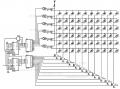
Thanks for cleaning thing up Dennis. What software did you use, and what size pull up restor at pin 13?
I use an old free version of Eagle (4.13r1). The pull-up resistor can be 10k.

I want to build a 12 hour clock with 60 rgb leds, blue -seconds,green -minutes, and red hours.
I'd use counter chips to make mod 60 and mod 12 counters.

For the minutes/seconds LEDs, I'd use the LSD counter and convert the outputs to decimal. For instance, using CD4029 as the counter (because I happen to have some) and CD4028 BCD to decimal decoder. That handles LEDs representing 0-9. Then I'd use the MSD counter with another CD4028 to decode 0-5 and use that to drive 6 banks of 10 LEDs.

For minutes (or seconds), 2 CD4029 and 2 CD4028.
 

WBahn

Joined Mar 31, 2012
32,847
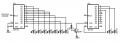
Finally here is my updated chaser circuit. Now leds 1-10 cascade as planned while led #12 stays on, On the 11th cycle, 1-10 Chase fine and after #10 lites up on its last cycle 11 and 12 alternately blink rapidly. This goes on for a few cycles and reverts to 1-10 chase while #12 stays on.View attachment 367305s to 10-10 chasing normally while #12 Stays on. I guess im getting closer. Thanks for any help.
That's a VERY incomplete schematic. It strongly implies that you are driving the LEDs direction from the 4017 outputs, which is all-but-guaranteed to cause issues. You've got no bypass capacitors on your ICs. You have four signals coming out of what appears to be a transistor.
 

Thread Starter

electrongod1

Joined Sep 8, 2018
40
I use an old free version of Eagle (4.13r1). The pull-up resistor can be 10k.

I'd use counter chips to make mod 60 and mod 12 counters.

For the minutes/seconds LEDs, I'd use the LSD counter and convert the outputs to decimal. For instance, using CD4029 as the counter (because I happen to have some) and CD4028 BCD to decimal decoder. That handles LEDs representing 0-9. Then I'd use the MSD counter with another CD4028 to decode 0-5 and use that to drive 6 banks of 10 LEDs.

For minutes (or seconds), 2 CD4029 and 2 CD4028.
Thanks again Dennis, I'll look into your idea!
 

Ian0

Joined Aug 7, 2020
13,132
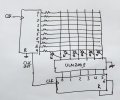
Diagram to accompany my suggestion in post #17.
IMG_2287.jpegI’ve not drawn the other 54 LEDs
a 4017 has enough output current to light a modern LED Without needing a buffer transistor. If you want more current use a 74HC4017.
Make sure that you supply voltage is less than the sum of the forward voltage and maximum reverse voltage of the LEDs.
(Still not sure how RGB LEDs are going to be used)
 

dl324

Joined Mar 30, 2015
18,329
Thanks again Dennis, I'll look into your idea!
The advantage of using up/down counters is that you can add switches to set the time. With CD4017, they can only count up.

You could also decide to supplement the time display with 7 segment LEDs.

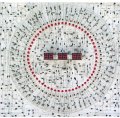
I once thought about building something like this (though I planned to have the circuitry represent circuit blocks: counters, decoders, etc):
transistorClock.jpg
The guy (I assume) included magnetic switches for setting the time.
 

Attachments

Thread Starter

electrongod1

Joined Sep 8, 2018
40
Thanks for cleaning thing up Dennis. What software did you use, and what size pull up restor at pin 13?
Dennis, I added a pull up resistor as you suggested and Im getting closer. First 10 laed cycle fine while #11 stays on, after led #10 turns on #11 turns off and #12 turns on and cycle repeats itself. Also in your diagram you are only showing 7 leds on 4017 #1 with 3 outputs tied together. Was this out of necessity or because of my crappy drawing. Thanks again, Frank.
 

Thread Starter

electrongod1

Joined Sep 8, 2018
40
The advantage of using up/down counters is that you can add switches to set the time. With CD4017, they can only count up.

You could also decide to supplement the time display with 7 segment LEDs.

I once thought about building something like this (though I planned to have the circuitry represent circuit blocks: counters, decoders, etc):
View attachment 367350
The guy (I assume) included magnetic switches for setting the time.
Wow! Identical with I am trying to do, less the digital display. In a nutshell 60 rgb leds, blue-seconds, green-Minutes, and red-hours.
Frank
 

Ian0

Joined Aug 7, 2020
13,132
Wow! Identical with I am trying to do, less the digital display. In a nutshell 60 rgb leds, blue-seconds, green-Minutes, and red-hours.
Frank
It will work with both my circuit and @dl324 's provided you use the RGB LEDs with 6 pins where cathode and anode for each LED are brought out independently. If you have common cathode or common anode LEDs it's going to take a lot more circuitry!
 

dl324

Joined Mar 30, 2015
18,329
I added a pull up resistor as you suggested and Im getting closer. First 10 laed cycle fine while #11 stays on, after led #10 turns on #11 turns off and #12 turns on and cycle repeats itself.
The problem is that one LED will always be on whenever a CD4017 is enabled. So you can't use the Q0 output when the counter isn't disabled.
in your diagram you are only showing 7 leds on 4017 #1 with 3 outputs tied together. Was this out of necessity or because of my crappy drawing.
It was how you labeled the LEDs.
Wow! Identical with I am trying to do, less the digital display. In a nutshell 60 rgb leds, blue-seconds, green-Minutes, and red-hours.
RGB LEDs will complicate the circuit I posted. I could use a single current limiting resistor for all 60 LEDs. Plus I'm switching both the anode and cathodes of the LEDs. You can't do that with RGB LEDs.
 

BobTPH

Joined Jun 5, 2013
11,516
I can do it with 3 parts, plus the LEDs. An 8 pin PIC, one resistor and 1 capacitor. The 60 RGB LEDs will be WS2812B addressable LEDs. And the wiring is trivial, 3 wires daisy chain all the LEDs
 
Top