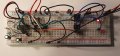
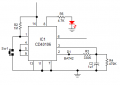
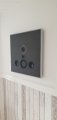
Breadboard tested the curcuit successfully, but the touch is too sensitive or something, if you connect a wire or the frame to R1 the red LED sometimes turns on forever. Please advice ? Or do I have to use a small push button after all with a switch debounce curcuit ?
Not surprised. The frame is too much metal for the touch plate.
Try increasing the value of R1, start with 1meg
Ideally the touch plate should only be about 1 square inch.
I'll check to see if I can reduce the sensitivity also.
Is there a way to make a 3 x 21700 battery pack (external BMS), 12V 4.4A, using spacers, but without soldering or spot welding on the batteries ? What about cold, chemical soldering ?
Breadboard tested the curcuit successfully, but the touch is too sensitive or something, if you connect a wire or the frame to R1 the red LED sometimes turns on forever. Please advice ? Or do I have to use a small push button after all with a switch debounce curcuit ?View attachment 286645
1) Make sure your metal frame is completely insulated from all the electronics, just one connection - the touch point.
2) Add a large metal plate to the REAR of the frame, it must be INSULATED from the frame- connect this to the GROUND of your electronics.
Now your touch circuit has capacitive coupling to the world (GND) and a nice big separate touch plate at the front.
3) adjust the sensitivity of the circuit to obtain the desired results.
I has little chance of ever working without the large reference electrode at the back.
1) Make sure your metal frame is completely insulated from all the electronics, just one connection - the touch point.
2) Add a large metal plate to the REAR of the frame, it must be INSULATED from the frame- connect this to the GROUND of your electronics.
Now your touch circuit has capacitive coupling to the world (GND) and a nice big separate touch plate at the front.
3) adjust the sensitivity of the circuit to obtain the desired results.
I has little chance of ever working without the large reference electrode at the back.
Thanks. Worth a try. The aluminium frame is already isolated from anything else, only mounted around the MDF cabinet using strong doublesided adhesive tape. How big shoul the plate be ? Could you make a drawing sketch ?

 Facebook
 Google
 GitHub
 Linkedin