You may be right. Or the diode is installed backwards. Or there's a bad connection on the breadboard. Two of those should be trivial to troubleshoot given a basic understanding of the chip.
You may be right. Or the diode is installed backwards. Or there's a bad connection on the breadboard. Two of those should be trivial to troubleshoot given a basic understanding of the chip.
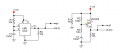
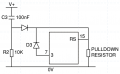
Re post #280. I did wonder about the same thing as the capacitor would slow the rising edge down. If this was the case then I would expect the counter to be in state 3 with the reset pin high. If a diode was added from the power on reset then a pulldown resistor would also be required on the reset pin or it would be left in a floating state.
Re post #280. I did wonder about the same thing as the capacitor would slow the rising edge down. If this was the case then I would expect the counter to be in state 3 with the reset pin high. If a diode was added from the power on reset then a pulldown resistor would also be required on the reset pin or it would be left in a floating state.
There is already a 10K pull-down resistor, the diode will need to be between the capacitor and the reset pin, with the resistor between the rest and common.
My analysis was based on the circuit being as shown. I was not guessing as to any possible wiring errors. Not second-guessing anybody. CMOS logic can be rather picky about rise times and even pulse widths and input voltages. Consider what the internal logic of the 4017 is doing and see that it is not simple. It may possibly be that the "3" output is reset to 0 before the counter string reset can be activated. Internal IC logic can be rather complex.
It might even be that the supply bypass capacitor between V+ and common (Vdd and Vss) at the IC must be present with this breadboard.
In a "wired or" arrangement, such as this one for having either source deliver a reset command, there is often a requirement to isolate the sources of the rising edge signal. This circuit is one of those that requires such isolation.
And now that I consider it, the possibility is that the 5volts source rises quite slowly.
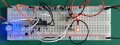
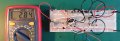
Breadboard and connections doublechecked. Everything works, except reset on output 3 (pin 7). 4017 still counts to 10. Pin 7 goes from 0 to 2.8v at count 3, or 2.1v at pin 15. At count 4 it goes back to 0v.
What was the supply voltage to pin 16 of the 4017 when you took the readings ? 2.8 volts is neither a logic high or low if the supply was 5 volts. I think the circuit may be oscillating due to the slight delay caused by the capacitor.
R2 in post #291, is not required, the capacitor should discharge during any reasonable power off time. Also, the pull down resistor can be greater than 10K ohms, 27 K should work as well.
R2 in post #291, is not required, the capacitor should discharge during any reasonable power off time. Also, the pull down resistor can be greater than 10K ohms, 27 K should work as well.
What was the supply voltage to pin 16 of the 4017 when you took the readings ? 2.8 volts is neither a logic high or low if the supply was 5 volts. I think the circuit may be oscillating due to the slight delay caused by the capacitor.
If there is nothing else connected to any parts of that circuit, you either have a leaky capacitor or a defective 4017. Try changing one or the other! Or maybe your breadboard is faulty? Move the circuit to a different section and rebuild it.
Replacing R2 with 100k in the original curcuit solved the problem. Now it works as specified.
I will also test this with another 4017 ic and 10k or 100k.

 Facebook
 Google
 GitHub
 Linkedin