Facebook
 Google
 GitHub
 Linkedin
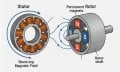
While on my journey to develop the firmware for the ESC so far I was trying to figure out how to implement all the features the original ESC has to offer in its hardware setup but then it occurred to me that I don't need most of that stuff. And a lot of the complexity that was in the original ESC firmware I also realize I don't have to recreate or reproduce in the C language with my own style and formatting but can just leave out entirely. I recalled that my plans for a long time prior to now were to have the BLDC motors operate in a blind manner. This is called open loop commutation. Back EMF normally closes the loop or a hall effect sensor closes the loop or a encoder closes the loop but I had long ago determined I don't need a closed loop. All I need is for my code to instruct the stator's rotating magnetic field to advance through each of its 6 commutation steps either clockwise or counterclockwise at a certain speed and a certain acceleration/deceleration and to do so with a certain duty cycle which will dictate how much power it is moving with. So it can move with a lower duty cycle for a gentle touch or a high one for a rough and rigid or load bearing hauling effect while under serious load etc. Now the back EMF is nice for drones because they are trying to maximize thrust and do so as efficiently as possible but I don't need all of that. If my rotating magnetic field is too fast or not high enough duty and it happens to blindly pass up the rotor because the rotor can't keep up, I call that slippage or desynchronization. And some would feel that is not acceptable and that back EMF or an encoder would prevent that. The logic there is that slippage will result in a single lost revolution perhaps more than one resolution will be lost and that will make the motor's actual rotor location begin to drift further and further from the expected location so that the resulting end stop location will be significantly different from what was expected of it and therefore the accuracy will be thrown off and people feel this is unacceptable. However, consider the 3d printer (well at least the older ones not sure on the new ones), when they hit something or w/e and have some hiccup, the stepper motors sometimes skip or have slippage as I've been describing and that throws off the whole rest of the 3d print. Those 3d printers have no feedback but just give a best guess speed and power level and assume the rotor will always keep up and stay in sync with the stator and usually this is correct. They generally work great. But when they fail a print is ruined but that didn't make them unacceptable or useless. They just had a known less than ideal quirk we'll say. But they were accepted like that. So why can't my robot's stepper like approach to BLDC motor commutation be given the same treatment? And guess what? Unlike a 3d printer, my robot's joints will have a potentiometer measuring final joint angle - so this means that if some slippage and drift did occur along the way, the arduino reading in that potentiometer angle will detect that the motor is not where it was anticipated to be and the main brains PC will be made aware of this and respond accordingly - whether that be upping the duty cycle to increase power to blow past whatever extra resistive forces had caused the delays or slowing down to deal with the extra load it is surely under or if the duty cycle is strong enough, speeding up again more than before to make up lost time and get back to the desired location quickly that it had forecasted it would be by that point in time in order to re-coordinate that joint's movement with the rest of the body's overall animation frames it had projected out into the future and get back on track that way with its plans for the animation. So then the occasional hiccup, slippage, and drift is NOT a deal breaker or something that wrecks everything after all. And over time, the AI of the main brains PC can learn through trial and error to anticipate the slippage events and preemptively up the duty cycle or lower the speed to prevent the slippage from occurring in the first place the next time it takes on a similar task or challenge that previously caused a slippage event to occur. In this way, over time, slippage events will become more and more rare. So the AI can adapt and improve on those issues. This puts the burden onto the main brains PC to deal with preventing slippage rather than on the ESC to figure that out or use BEMF or w/e to try to prevent that stuff. And the main brains PC is a big boy - he can handle that!
All of that to say, we want to keep our ESC firmware simple, dumb, and very limited. This way it can be made very bug free and made more quickly and not require frequent revisions and updates to perfect it over time. It can be a staple. And then the adaptive main brains PC AI can be doing the heavy lifting and take on the responsibility to play that ESC like a musical instrument with great skill. Keep the ESC dumb and make the main brains PC be smart in its use of it I say. Keep the complexity higher up the food chain and let the dumb worker bot ESCs and stuff stay dumb and just follow orders blindly I say.
So that is my return to my previously envisioned approach to this and I feel quite confident it will work out well and chatgpt agrees with me on that.
Moreover, our arduino will also be measuring current so if we see a current increase it can be a collision detection clue and we can report that back to the main brains PC and he can then decide to up duty cycle or slow down to address the extra load or resistive forces that have been encountered - or it could be that this just indicates touchdown - like if grasping for a cup, slippage and current spikes can indicate that we have contacted and are now actively grabbing that cup and the main brains PC can instruct the ESC to just hold steady at a single commutation angle and stop rotating because we are now actively gripping the cup or w/e. So in that case it would not matter really. In fact, I really can't think of any scenario where slippage would be disastrous in its affect for our designs. Also of note is I do plan to put strain gauges on the fingertips so that would also help to know when grip has occurred and how hard the gripping is. So we have multiple redundant clues going on.
And one more thing: because we have a 16:1 downgearing minimum on our BLDC motors, there are going to be a ton of full revolutions of the motor before significant movement of the joint even occurs. Alot of turns are just tightening up slack in the pulley system. So concerns about motor wiggle at startup and things like that making the robot seem like it has the shakes are also not going to be an issue for that reason among others. Also the fact that so many turns are involved to make a full joint rotation means that missing one revolution or two here or there from slippage is probably not even going to be perceivable because so many consecutive rotations are involved that you just wouldn't notice the slight delay that much as the rotations effect on joint rotation is so granular and small per rotation. The result of slippage would be a lot more dramatic if you had no downgearing or very low downgearing because every turn of the motor would then be much more noticeable at the point of observing the final joint rotation animation.
All of that to say, we want to keep our ESC firmware simple, dumb, and very limited. This way it can be made very bug free and made more quickly and not require frequent revisions and updates to perfect it over time. It can be a staple. And then the adaptive main brains PC AI can be doing the heavy lifting and take on the responsibility to play that ESC like a musical instrument with great skill. Keep the ESC dumb and make the main brains PC be smart in its use of it I say. Keep the complexity higher up the food chain and let the dumb worker bot ESCs and stuff stay dumb and just follow orders blindly I say.
So that is my return to my previously envisioned approach to this and I feel quite confident it will work out well and chatgpt agrees with me on that.
Moreover, our arduino will also be measuring current so if we see a current increase it can be a collision detection clue and we can report that back to the main brains PC and he can then decide to up duty cycle or slow down to address the extra load or resistive forces that have been encountered - or it could be that this just indicates touchdown - like if grasping for a cup, slippage and current spikes can indicate that we have contacted and are now actively grabbing that cup and the main brains PC can instruct the ESC to just hold steady at a single commutation angle and stop rotating because we are now actively gripping the cup or w/e. So in that case it would not matter really. In fact, I really can't think of any scenario where slippage would be disastrous in its affect for our designs. Also of note is I do plan to put strain gauges on the fingertips so that would also help to know when grip has occurred and how hard the gripping is. So we have multiple redundant clues going on.
And one more thing: because we have a 16:1 downgearing minimum on our BLDC motors, there are going to be a ton of full revolutions of the motor before significant movement of the joint even occurs. Alot of turns are just tightening up slack in the pulley system. So concerns about motor wiggle at startup and things like that making the robot seem like it has the shakes are also not going to be an issue for that reason among others. Also the fact that so many turns are involved to make a full joint rotation means that missing one revolution or two here or there from slippage is probably not even going to be perceivable because so many consecutive rotations are involved that you just wouldn't notice the slight delay that much as the rotations effect on joint rotation is so granular and small per rotation. The result of slippage would be a lot more dramatic if you had no downgearing or very low downgearing because every turn of the motor would then be much more noticeable at the point of observing the final joint rotation animation.