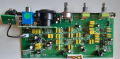
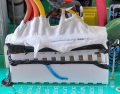
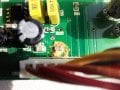
Yellow contamination on PCB. Flux? Capacitor leaked?

Thread Starter

Dave Lowther

Joined Sep 8, 2016
332
Do you recognise what this yellow stuff is?
2025-03-05 11.23.54.jpg

This is a PCB from some active speakers. It's the input board which takes the signal from the XLR connector, filters it into 3 bands (woofer, mid, tweeter) and then outputs those 3 signals to the power amplifier board. This board gets its power (+/- 12V) from the power amplifier board. The connector in the above photo is the connector for the power from / outputs to the power amplifier board.

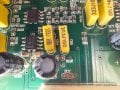
The contamination was quite easy to clean off with a soft artist's brush. No solvent was used. The following photo shows it afer cleaning.
2025-03-05 11.39.47.jpg

The two capacitors (3C1 shown in the first photo) and 3C2 in the above photo appear to be decoupling capacitors. One is between the +12V input and ground, the other one is between -12V and ground. I've checked that the contaminated capacitor isn't a short circuit. When I connect the continuity tester across 3C1 or 3C2 I hear a brief beep from it, so there are still some decoupling caps across the supply somewhere on the PCB, even if 3C2 has gone open circuit. I don't intend to remove it, as the board usually works, apart from an intermittent fault where the sound stops coming out of the speaker. ATM I'm not suspecting a power fault. I'm suspecting a volume control pot on the board. I can cause the fault to come and go by pushing on the volume knob.
 

MrChips

Joined Oct 2, 2009
34,629
Cookie crumbs left behind from the installer?
Strange things have been found in other places, such as an empty pop can in a car door panel.
 

Tonyr1084

Joined Sep 24, 2015
9,744
It’s not a leak. It looks like someone might have put it there on purpose, but I’m not sure why. The sharp round edge from about 11:00 to 2:00 on a clock dial suggests it might have been an applicator. But it doesn’t mean it was deliberately put there. I’ve seen patterns and images in clouds that look completely man-made. Once, I saw a stage coach pulled by two horses splashing through a small stream. The coach had a driver and a second person on top, and two horses riding along with riders on their backs.

For those who are curious, no, I wasn’t on drugs when I saw that. The image seemed so real, even though I knew it wasn’t. So, that blob could have been something that fell there by accident. Raindrops tend to make round spots, so I can’t say for sure what it is or was. But if cleaning it off hasn’t helped the board’s performance, I wouldn’t worry about it any further. I’d just try to figure out why the board is intermittent.

One final thought - it could have been some "Tamper Evident" compound meant to detect whether someone has opened it and voided the warranty.
 

Thread Starter

Dave Lowther

Joined Sep 8, 2016
332
Thanks for all the replies. I've not got much experience when it comes to repairing commercially made electronics. That's why I thought it best to ask here in case someone said "I know what that is, it's <this thing>".
I didn't think it was the capacitor that leaked, but I wasn't certain. It also didn't look / behave like any flux I've seen.
There was a bit of web and a spider skin at the back of the XLR connector. Before I posted here I consulted a relative who knows a lot about spiders. They assured me that it wasn't spider droppings.
So it can remain a mystery and I'll move on.
I've got to the stage where I can make the fault come and go by flexing the PCB. I'm assuming it's a dry joint or track break. I'll do some signal tracing tomorrow and see where the signal gets to before it's affected by flexing the PCB. It's got to be early on in the path, because 75% of the board is filters, and all 3 speakers go silent when the fault happens
 

Tonyr1084

Joined Sep 24, 2015
9,744
If flexing the PCB interrupts the circuit it's more likely a cracked solder joint. Reflowing any suspect joints may yield positive results. I've had the experience of failed solder joints a good number of times.
 

panic mode

Joined Oct 10, 2011
4,867
do you see the same under other capacitors? it may be fixing compound. things that are exposed to vibrations may need securing (bolt/glue/whatever) or metal pins get hardened with each mechanical oscillation and snap...
 

Thread Starter

Dave Lowther

Joined Sep 8, 2016
332
If flexing the PCB interrupts the circuit it's more likely a cracked solder joint. Reflowing any suspect joints may yield positive results. I've had the experience of failed solder joints a good number of times.
Thanks for the information about your experience.
The board is from a KRK Rokit 10-3 G2. It's got a lot of components on it, but hopefully I'll be able to make some sense of the signal path. I've not been able to get any service information. The manufacturer (Gibson now own Rokit AFAIK) ignore my e-mails. The local service agent said they couldn't sell me a service manual because of their NDA. I've never found any info from Googling.
1741196829391.png[Edit: The gouge in the bottom left is the same on the working one. I assume it's a fix for a PCB error]
 
Last edited:

MisterBill2

Joined Jan 23, 2018
27,187
Many integrated speaker/amplifier assemblies use nasty glue to prevent things from coming apart, AND some assembly processes glue parts to the PCB so that they stay in place for reflow soldering.
So I suggest using a bright light and a good magnifier to take a close look at the various parts to see if there is a tiny bit of glue visible underneath them. And inspect the whole assembly to see if they used similar glue elsewhere.

I had to scrap a soundbar because none of it could be accessed to do a repair because of the nasty stuff that was about the same color that was used to assure that nothing could rattle or vibrate. OR be repaired.
 

Thread Starter

Dave Lowther

Joined Sep 8, 2016
332
Many integrated speaker/amplifier assemblies use nasty glue to prevent things from coming apart
Indeed! It took me a while to get this connector off the board.
1741201479436.png
Thanks for the advice. I'll include that in my investigations tomorrow.
The cables from the power amp board to the speakers are wrapped in foam rubber that's been coated with contact adhesive on the inside, the wires are coated in it too. The foam was held in place by what looks like perished sellotape. It's coming apart and is a sticky mess. Worst of all is the sticky black stuff they've used where the above cable goes through a hole. It's a bit like tar. It sticks to everything. It has a similar consistency to blu tack, so when trying to remove it, it stretches into long thin strands. IPA doesn't do anything to it.
 

schmitt trigger

Joined Jul 12, 2010
2,027
Something that I personally witnessed;

A red splotch on a keypad assembly, was caused by food that was smuggled to the assembly line.
We know it was food, because the customer insisted that a chemical analysis should be conducted on the material. This was a “hi-rel” device, BTW.
The irony was that this hi-rel device was assembled inside a segregated and enclosed area to prevent foreign debris.
 

tonyStewart

Joined May 8, 2012
231
The ceramic cap has a large C value /w low voltage causes the diode beep. It's normal.
It conducts current for CdV/dt with constant current test.

Foreign mat'l looks electrically inert, likely a suspicious mfg exception.

Dual wafer volume control is wearing out perhaps a contact spray may help like WD-40.

Any moving parts on board fail faster from bass vibration, hence tar-like for removal and Polyurethane for strain-relief are common ingredients.

If you have an LCR meter, any large e-caps can be measured, otherwise, it's good to go.
 

Tonyr1084

Joined Sep 24, 2015
9,744
I've got to the stage where I can make the fault come and go by flexing the PCB.
Given that flexing the board causes the fault to occur - it's not likely going to be a cleaning issue. Fractured solder is the first most likely culprit. A cracked PCB is a distant next. Beyond that - WAY beyond that could be a bad chip or component, active or passive. If flexing the board makes it come and go - it's not a dirty anything, something is barely broken. But barely broken is still broken.

Ever see a street lamp come on for a few minutes then extinguish for several minutes then come back on and repeat the cycle? It's not a bad bulb it's a bad ballast. A wire has fractured inside the ballast. When cold that fractured wire makes contact. Current flows and the ballast heats up. And expands. And that fracture once again breaks apart and the light goes back out. Only when it cools off enough will the fracture partially weld itself back together for another several minutes. What you have going on is likely fractured solder.
 

Thread Starter

Dave Lowther

Joined Sep 8, 2016
332
Fractured solder is the first most likely culprit.
I hope so.
For anyone that's interested in the progress. I've not got a lot done today.
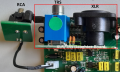
I removed the XLR/TRS Daughter Board:
1741286216570.png
It's only attached to the main board with a 3pin 0.1" pitch right angle header, soldered to both boards, in the region of the green rectangle. Before removing it I checked that the fault also happens when using the RCA input. I needed to remove it because there's stuff on the main board that it was preventing access to.
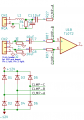
I've started tracing out the circuit diagram, starting from the inputs:
1741286401384.png
My intention is to continue tracing it out until I have all the circuitry that's common to all 3 inputs (RCA, TRS, XLR) and all 3 speakers (woofer, mid, tweeter). I'll stop when I can see that I'm looking at the filters for the 3 bands.
Then I'll put a signal into the RCA connector and trace it tharough that common circuitry while flexing the board. That will localise what I need to look at to find the fault.
I'm not going to get much more done before next week. I will definitely post when I solve it, or when I give up.
 

Tonyr1084

Joined Sep 24, 2015
9,744
I wouldn't be taking things off; there's a chance you could damage the board. Rather, I'd just start reflowing the solder joints I can reach AND reliably resolder them one by one. Every so often I'd stop to see if the fault still exists when the board is flexed. There's a good chance the fracture may very well have been between the daughter and mother board.

Do as little as possible, but enough to get the job done. Beyond that is wasted time and chance of further damage.
 
Top