Facebook
 Google
 GitHub
 Linkedin


Hey MrChips,Glad to hear that you got it working again. Fixing an intermittent problem is one of the most difficult problems to solve. You have to wait for it to fail in order to find the fault. As they say, "you can't fix it if it ain't broke".
You can try to trigger the fault by applying heat and cold, vibration, tapping and banging. Certainly, applying heat with a soldering iron may have been significant. We can try to narrow down the area to somewhere after the MCU, digital signals to the DACs and analog signals. It could also be caused by faulty power supply lines. Other suspects are bad solder joints, PCB traces, an intermittent component. Capacitors are more likely to fail rather than resistors.
Try to see if the fault is common to both the speakers and the headphones output. Next time it misbehaves, try plugging in the headphones and compare with the speakers.
/MUTE signal is still a prime suspect if the failure affects both speakers and headphones.
While it is still working, get a feel for what the signals look like on the oscilloscope, particularly at R104, R105, DAC-L, DAC-R.
In post #49 you had posted input voltages that were not quite +15 V. You may want to revisit this.
it’s been a while since I last wrote in this thread. After we got the piano working again, I played it for a few days, but life got busy — and since I was only about two months away from my wedding, I didn’t have much time to keep troubleshooting or even to check what the real root cause was. Months passed and the piano stayed in our office. A few coworkers probably tried to play it now and then, but otherwise it was untouched.
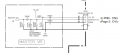
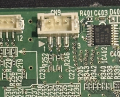
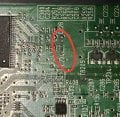
When I returned after our honeymoon and finally had time to look at the piano again, the loud buzzing sound had returned. I knew I had to revisit the problem and go through everything we had done earlier. A few days ago, I decided to analyze everything myself using the knowledge you taught me. I checked DAC-L and DAC-R with the oscilloscope first, but all I could see was noise. Since nothing interesting appeared there, I went back to L204 — the place where we originally discovered something was missing.
I thought maybe the solder joint had become weak and needed to be redone. But after working on that area, the sound completely disappeared again, which made me confident that the problem must be related to L204 and CN9.
So I went back through your old posts carefully. With a bit of help from ChatGPT, I realized that the resistor we originally placed on L204 (47Ω) which I had laying around at that time, should actually be replaced with a 100Ω SMD resistor. I found a 100Ω SMD on an old RC car board We had at laying around at the office and replaced the previous resistor.
After reinstalling the PCB, I turned the piano on — at first the buzzing noise came back, but after a few seconds I started hearing sound from the demo I had running. A few seconds later the buzzing disappeared completely and the piano played normally again.
I’m not sure if this second replacement at L204 is the final permanent fix, but for now it’s working, and I really hope it remains stable. I wanted to give you an update and also apologize for not replying for such a long time. I’m incredibly thankful for your help — even months later, your explanations allowed me to diagnose the problem again and fix it. I’m really happy that I asked my question here.
Thank you again for all your support.