Working out units in Ohm's law.

Thread Starter

Oliw312

Joined Mar 8, 2018
1
Hi all,

I'm doing a neuroscience course to prepare for my masters but it has an electronics component, something I haven't dealt with for 8 years or so!

This particular problem is working out conductance. I understand the equations, however, I do not know how to get the answer in the right units.

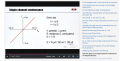
G = 10pA / 100mV = 100pS

If anyone could explain why the answer is in picosiemens or a general rule for working out the units the answer will be in, that would be incredibly helpful. Never really got the hang of it at school!

Thank you.Screen Shot 2018-03-08 at 22.07.21.png
 

MrAl

Joined Jun 17, 2014
13,702
Hi,

Just a little question comes to mine here. You are preparing for your master's and you dont know how to work out units?
R=V/I
G=I/V

M(meg)=10^6
k=10^3
m=1/10^3
u=1/10^6
n=1/10^9
p=1/10^12
etc.

m/u=(1/10^3)/(1/10^6)=k
u/m=(1/10^6)/(1/10^3)=m
etc.
 
Last edited:

shteii01

Joined Feb 19, 2010
4,644
Resistance is a measure of Material Resistance to flow of current through the Material.

What is opposite of resistance?
Conductance.
What does it show? What does it represent?
It shows how easily a current can pass through material.
 

dl324

Joined Mar 30, 2015
18,326
If anyone could explain why the answer is in picosiemens or a general rule for working out the units the answer will be in, that would be incredibly helpful. Never really got the hang of it at school!
Life was a little simpler when the inverse of ohm was called mho...
upload_2018-3-8_7-45-47.png
 

wayneh

Joined Sep 9, 2010
18,104
If anyone could explain ... a general rule for working out the units the answer will be in, that would be incredibly helpful.
Personally I find that the most reliable approach is to first convert all the pieces of the equation into the units that are proper for the equation. In other words for V = I•R, I'd convert voltage to volts, current to amps and resistance to ohms, using exponential notation as required Then convert the answer back into whatever convenient milli, micro, nano prefixed units you want.

I may take a shortcut if two of the three terms are already in the right units, for instance if V = mA • Ω, I know the voltage will be in millivolts and I don't bother expressing milliamps in amps. But shortcuts can become dangerous if you get lost and I humbly suggest that may be why you've run into trouble in the past.
 

ebp

Joined Feb 8, 2018
2,332
If I interpret the question correctly, the issue is simply "why Siemens?", nothing to do with magnitudes. dl324's answer covers that.

resistance = voltage/current (Ohm's law)
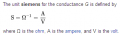
If something is expressed as the ratio current to voltage then it is the inverse of resistance which is conductance, for which the unit is the Siemen, formerly the mho (ohm spelled backward and represented by an inverted omega).
conductance = current/voltage

In dealing with biosignals (more broadly in any electrochemistry), transconductance (current out for voltage in) and transresistance (voltage out for current in) amplifiers are common things. Straight voltage gain is usually just a convenience thing for scaling.
 
Top