Wiring help, to wire up a exhaust flap actuator Kuster 3

Thread Starter

dox777

Joined Dec 8, 2024
19
Hi there,

I want to preface this by saying I am totally new to wiring up electronics and could really use a pointer. I am trying to wire up a exhaust flap actuator Kuster 3 pin) to a wireless control board (DieseRC 433Mhz Universal Wireless Remote Control Switch DC 12V).

The thing I am not certain about is where do I attach the white wire. The actuator has 3 wires, black (gnd) red (12+v) and a white (I assume is some sort of signal wire).

Here is the attachment so far:
  • DC 12V+ to 12V+ on the board
  • DC 12V- to 12V- on the board
  • Jumped 12V+ to COM on the board
  • Red wire from the actuator to NO on the board
  • Black wire to 12V- on the board

That leaves the white wire which I don't know where it should go. Note that the remove control when pressed ON or OFF doesn't do anything. However if I touch the white wire to ground on the board, the actuator will respond.

Any help appreciated.
 

MisterBill2

Joined Jan 23, 2018
27,164
Did the actuator include any information??? For starters, it seems that the link is a useless waste of time and bandwidth. all it reveals is pictures of products. AND no path to useful information.
How did the TS arrive at the identities of the three wires?? and then why were the connections made the way the were???
The normal scheme is power to power and then control input to the source of control. Which was not followed.
 

Tonyr1084

Joined Sep 24, 2015
9,744
It's possible, and as @MisterBill2 points out, we have no "useful" information to help you solve your problem. But it's possible that red and black provide power to the actuator. White may be the control wire. Connect it to positive and the motor may open the flapper. Connect it to negative and the motor may close the flapper.
BUT UNDERSTAND - THIS IS JUST A GUESS! Again, we have no useful information. There MUST be some kind of limiting scheme within the mechanism to prevent jamming of the motor either at full open or full closed. And that's just the motor & flapper.

As for the remote - until we know how to control the motor, setting up the remote will have to wait. IF my "Guess" is correct then I can come up with a way to connect things. But I won't give you that until we know exactly how the flapper works. Otherwise we could be burning up your motor and any associated electronics within. And I don't want that responsibility. None of us do.
 

Thread Starter

dox777

Joined Dec 8, 2024
19
It's possible, and as @MisterBill2 points out, we have no "useful" information to help you solve your problem. But it's possible that red and black provide power to the actuator. White may be the control wire. Connect it to positive and the motor may open the flapper. Connect it to negative and the motor may close the flapper.
BUT UNDERSTAND - THIS IS JUST A GUESS! Again, we have no useful information. There MUST be some kind of limiting scheme within the mechanism to prevent jamming of the motor either at full open or full closed. And that's just the motor & flapper.

As for the remote - until we know how to control the motor, setting up the remote will have to wait. IF my "Guess" is correct then I can come up with a way to connect things. But I won't give you that until we know exactly how the flapper works. Otherwise we could be burning up your motor and any associated electronics within. And I don't want that responsibility. None of us do.
Thanks for replying. Unfortunately I don't have any spec data on the actuator. The actuator self initializes to find the limit of rotation once it is attached to the flap which has resistance when opened/closed at 90 degrees.

The power is already hooked up correctly and working because I can see the actuator self initializing. The problem is I can't control it via the relay. Opening and closing the relay doesn't affect the actuator no matter where I put that white wire.

The only way I can get the flap to open/close is when I take the white wire and touch it on the negative terminal on the controller board. The flap opens when I touch it and closes when I remove it. That's the behavior I want but done through the relay of course.

Again, I am totally new to electronics and perhaps don't know how to ask the right questions.
 

Tonyr1084

Joined Sep 24, 2015
9,744
The only way I can get the flap to open/close is when I take the white wire and touch it on the negative terminal on the controller board. The flap opens when I touch it and closes when I remove it. That's the behavior I want but done through the relay of course.
Summary:
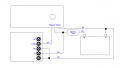
White wire to negative - flapper opens
White wire NOT to negative - flapper closes
This should work. PROVIDED your information is correct.
Screenshot 2024-12-10 at 7.43.43 AM.png
The system should be connected to a power source controlled by the presence of the ignition key being on. However, whatever state the system is in when the vehicle is shut down will leave the flapper in THAT position - whatever "That" position was. Also equally important is to have a fuse in the circuit on the positive line where it can keep everything safe. I didn't draw in a fuse and I didn't draw in the motor being constant powered. That's not difficult to do. If you need that drawing let me know.
 

Tonyr1084

Joined Sep 24, 2015
9,744
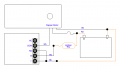
Just on the anticipation you might want a drawing that is more detailed:
Screenshot 2024-12-10 at 8.09.20 AM.png
The motor has its own fuse and is wired directly to constant power. The control module is wired to an ignition keyed source. The two squiggly lines are fuses. I didn't give you a value; that's something you'll need to determine on your own. It's possible a 2 amp fuse will work for both. But notice that each has its own fuse. It's important not to wire one fuse to both. You'll start your car and might not be able to shut it off. But what do I know?!

The lighter wires are existing wires of your vehicle. The black wires are the wires you're hooking up. The black dots are connections. Where wires cross each other, without a dot they are NOT connected to one and other.

[edit] I hope this doesn't drain your battery. That's a definite concern, since I don't know how the motor is wired internally. [end edit]
 

MisterBill2

Joined Jan 23, 2018
27,164
The setup looks a whole lot like a modern version of the exhaust cutouts that some used at my high school back in 1964. I was not aware that that was still being done.
Tony has it right, in that the red power wire is not the control wire. Is this valve actually for an exhaust cutout?? or for something else, like a turbocharger bleed control???

OF COURSE, the loud exhaust is much less offensive to hear than the much louder sound systems. The sound system is much to loud when it completely covers the sound of the "HOT" car with open lake pipes.
 
Last edited:

Tonyr1084

Joined Sep 24, 2015
9,744
The setup looks a whole lot like a modern version of the exhaust cutouts that some used at my high school back in 1964. I was not aware that that was still being done.
Back when I was road tripping, while out on the open highways I wanted a way to bypass the muffler in the hopes of getting better mileage. Back when I was a dumb kid I wanted to make noise. That's why I sometimes uncorked my headers. Got a ticket for that one. Today I'm too old to be messing with that silly stuff. IF EVER I get a turbo on my truck I'll probably opt for the same setup where I have a Wye pipe splitting off in two directions. One through the muffler and the other just straight out the back - but with a cutout on the end of that. As for a remote control - nah. Wouldn't need that. Just one more thing that could go wrong. Wouldn't want to be in a hospital zone and suddenly have the valve open up because the white wire has shorted to ground.

We all have wants, hopes and dreams. But when it comes to practicality, we often just live with 'good enough'.
 

Thread Starter

dox777

Joined Dec 8, 2024
19
Just on the anticipation you might want a drawing that is more detailed:
View attachment 337661
The motor has its own fuse and is wired directly to constant power. The control module is wired to an ignition keyed source. The two squiggly lines are fuses. I didn't give you a value; that's something you'll need to determine on your own. It's possible a 2 amp fuse will work for both. But notice that each has its own fuse. It's important not to wire one fuse to both. You'll start your car and might not be able to shut it off. But what do I know?!

The lighter wires are existing wires of your vehicle. The black wires are the wires you're hooking up. The black dots are connections. Where wires cross each other, without a dot they are NOT connected to one and other.

[edit] I hope this doesn't drain your battery. That's a definite concern, since I don't know how the motor is wired internally. [end edit]
Hi Tony,

Thanks for the additional diagram. I have one additional question if you don't mind. Does the actuator need to be on constant power? Currently I have the actuator power/negative connected to the controller. Then I have the controller powered by a switched 12v.
 

Tonyr1084

Joined Sep 24, 2015
9,744
Does the actuator need to be on constant power?
The actuator does not need to be connected to constant power. However, if you're running pipes open when you shut the car off - when you start up again your pipes will still be open. So you don't HAVE to run constant power. In fact, I'm a little concerned that constant power could drain your battery. Like I said before, I have no idea how the internal electronics are wired, or how much power they draw during actuation or in standby. The choice is yours.
Currently I have the actuator power/negative connected to the controller. Then I have the controller powered by a switched 12v.
Little unclear on your statement: The negative is connected to the negative on the controller? If so - that shouldn't be a problem.
Question for clarity:
Where is the actuator positive wire connected?
Where is the actuator negative wire connected?
Where is the controller positive wire connected?
I'm assuming the controller negative is attached to a convenient chassis ground. Right?
And that wire should also be jumpered to the NO contact on the controller. The white wire, we chose to connect that to COM(mon).
Do you have any fuses in line to protect the wiring?
Is your switch wired to constant power or to a keyed source?

And you thought this was going to be easy.
 

Thread Starter

dox777

Joined Dec 8, 2024
19
The actuator does not need to be connected to constant power. However, if you're running pipes open when you shut the car off - when you start up again your pipes will still be open. So you don't HAVE to run constant power. In fact, I'm a little concerned that constant power could drain your battery. Like I said before, I have no idea how the internal electronics are wired, or how much power they draw during actuation or in standby. The choice is yours.

Little unclear on your statement: The negative is connected to the negative on the controller? If so - that shouldn't be a problem.
Question for clarity:
Where is the actuator positive wire connected?
Where is the actuator negative wire connected?
Where is the controller positive wire connected?
I'm assuming the controller negative is attached to a convenient chassis ground. Right?
And that wire should also be jumpered to the NO contact on the controller. The white wire, we chose to connect that to COM(mon).
Do you have any fuses in line to protect the wiring?
Is your switch wired to constant power or to a keyed source?

And you thought this was going to be easy.
> Where is the actuator positive wire connected?
The positive wire is going to the controller's 12V+

> Where is the actuator negative wire connected?
The negative wire is going to the controller's 12V-

> Where is the controller positive wire connected?
The positive wire goes to a tapped fuse 7.5amp on switched.

> I'm assuming the controller negative is attached to a convenient chassis ground. Right?
That is correct.
 

Thread Starter

dox777

Joined Dec 8, 2024
19
In the other thread you linked to this:
https://www.kuester.net/en/products/actuators/59-exhaust-systems/127-exhaust-systems
Still, it doesn't give any information on how the unit is wired or how it functions. You might not want it slewing full left and full right to calibrate - but that may just be something you're going to have to live with. Or find a different cutout exhaust valve.
OEM uses the same exact actuators. The only difference is I am not using the car's internal computer system to control it. I am assuming the car is using some sort of LIN bus system but the question is -- does it provide constant power? If the answer is "yes", I would assume it also slowly drain the battery which I know some current draw is acceptable but not 50+ mA I would think.
 

Tonyr1084

Joined Sep 24, 2015
9,744
Here's one on Amazon. Only $97 (US dollars).
https://www.amazon.com/Peastorm-Electric-Exhaust-Wireless-Controller/dp/B0C6J673KC/ref=sr_1_3
Even still, I don't know how it's wired. Appears to be just two wires to a control box. On assumption, the box controls the motor open and close function, and quite possibly has limit switches of some sort. The problem is that nobody is telling us how it works; limit switches, limit sensing or just time slewing control (i.e. runs the open function for - say - 10 seconds) and vice versa.
Bottom line - we don't know.
 

Thread Starter

dox777

Joined Dec 8, 2024
19
Here's one on Amazon. Only $97 (US dollars).
https://www.amazon.com/Peastorm-Electric-Exhaust-Wireless-Controller/dp/B0C6J673KC/ref=sr_1_3
Even still, I don't know how it's wired. Appears to be just two wires to a control box. On assumption, the box controls the motor open and close function, and quite possibly has limit switches of some sort. The problem is that nobody is telling us how it works; limit switches, limit sensing or just time slewing control (i.e. runs the open function for - say - 10 seconds) and vice versa.
Bottom line - we don't know.
Its quite strange I am not able to find any schematics on these actuators...
 
Top