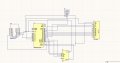
So what do you think is missing or is wrong? A quick look sees that VIN (and other connections on that bus) on the arduino nano pin 30 looks questionable.
The way to learn is not for someone else to tell you. Look at the datasheet connections diagrams and schematics for each part, look at other similar projects. Understand what you want to do in detail and how it's possible. Have your worked with this type of controller before? If you haven't, then look for a simple blink LED example, then move forward, step by step to something like the LCD display next.
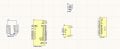
View attachment 341842 help Need help connecting the arduino nano (A1), RTC module (CT1), SD card module (S1), LCD display (L1), and ultrasonic sensor (U1) together
Based on your description, the primary issue seems to be the power distribution and pin mapping rather than the code itself as you have mentioned.
The most critical mistake is using VIN as a 5V source. On an Arduino, VIN is for unregulated power input (7V-12V). If you are powering 5V modules, you must use the regulated 5V pin. another advice is to ensure you have a common ground across all modules, or the signals will be floating and inconsistent.
I'd also recommend sticking to the hardware-specific pins for your communication protocols:
SPI (SD Card): Use pins 11, 12, and 13 (on an Uno).
I2C (RTC/LCD): Use A4 (SDA) and A5 (SCL).
The best way to troubleshoot this is to test one module at a time. Get the RTC working first, then the SD card, and only then combine them. If you can post a photo of your current wiring or a simple schematic, we can help you spot any other potential shorts or misconfiguration

 Facebook
 Google
 GitHub
 Linkedin