Facebook
 Google
 GitHub
 Linkedin

Hello all. I am working on a BMS board for a rocketry project and I need to be able to charge the battery pack while all the electronics are still running. Of course the battery would have to power the circuitry if the charger is not connected. At first I thought of using a power path management IC to safely isolate the battery from the circuit. That way the charger current would power the electronics (a couple of boards, servomotors, even some actuators) and then pass through a CCCV charging IC in order to charge the battery. However, I was prompted to omit the power path IC and connect the output of the CCCV IC, the battery and the load all in parallel (providing a high level block diagram/circuit of how this would work(?)).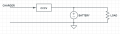 So I was wondering, won't that pose any threat to the battery charging? For example during the CC phase, what happens if the current drawn from the load varies? How will the CCCV IC respond to that? Won't there be problems with the battery? During the CV phase, what happens if the load starts drawing more current? Will the CCCV IC provide more or will it limit it? Does the IC dictate how much current it gives for charging during CV or does it provide as much as it is asked for? But even then, won't I be having problems with determining how much the battery has charged? Basically I'm asking, is it worth the risk (if there is any) to remove the power path manager IC or would I be better off with it?
So I was wondering, won't that pose any threat to the battery charging? For example during the CC phase, what happens if the current drawn from the load varies? How will the CCCV IC respond to that? Won't there be problems with the battery? During the CV phase, what happens if the load starts drawing more current? Will the CCCV IC provide more or will it limit it? Does the IC dictate how much current it gives for charging during CV or does it provide as much as it is asked for? But even then, won't I be having problems with determining how much the battery has charged? Basically I'm asking, is it worth the risk (if there is any) to remove the power path manager IC or would I be better off with it?