Why won't my linear stepper motor work?

shortbus

Joined Sep 30, 2009
10,050
After doing some reading about Back Irons
Back iron is just the term, it doesn't mean that it has to be on the back of a coil. But that said more magnetic force would be available if the edges of the bobbin were on the inside of the coil do to having both pole of the magnet available. In your instance, just way way harder to do if not impossible. But if you look at a flat linear motor that is how they are made.
 

Thread Starter

Ben Varvil

Joined Apr 30, 2018
197
I'll try to draw up what I mean, and post it. Just like with a stepper the motors like your trying to do only have the coil sets that are lined up with the metal or magnet(depending on the motor type) on at one time. The other metal or magnet is close to the next coil to be turned on on either side of the one that is on. Depending on which coil(set) gets turned on next, is what determines the direction it moves. Just the same as it does in a stepper. Easy to see when drawn out but hard to describe.
Hi, any progress on your drawing?
 

Thread Starter

Ben Varvil

Joined Apr 30, 2018
197
Hall sensors were still discouraging.
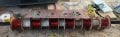
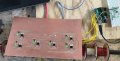
I redirected efforts to assembling the full 6 coil system and connecting it to the PCB. (is it still called a "PCB" if it was milled not printed?) I'm not using the halls yet, so a regular Arduino is enough for now.
Judith shooter control 2.jpg

Judith shooter control.jpgWorking on the code.
 

shortbus

Joined Sep 30, 2009
10,050
Hall sensors were still discouraging.
They will continue to be. The same problem will crop up in the actual mover. Too much distance between the steel slug and the magnet. If you look at how motors are made .they have a very small gap between the rotor(mover in your case) and the stator/coils. Just the thickness of the carbon fiber tube is too much. Then like me and Alec T both said, once the coils start magnetizing your halls will really go nuts. The halls should have a "gap" distance somewhere in the data sheet, you can't expect them to work beyond that distance.

Now if the slugs were magnets instead of just steel, you would go along way to both better position detection for commutation and to increase the power in the movers output. You could also change to an AC type output into the coils that wouldn't need the halls, but that's a whole different ball game from what you "want".
 

Bernard

Joined Aug 7, 2008
5,784
Might be back to zebra stick with 1/16 in. bands of white or silver on flat black background with reflective
optical sensor like OPTEK K2362. With 1/8 in spacing a count of 256 would give 16 in of stick. Maybe a CD4040 12 bit counter
with a pair of 74C85 4 bit magnitude comparators for each coil. Programing with DIP switches or solderless
breadboard.
Needing only 8 bits a 74HC521, 8 bit comparator could be used with slightly simpler wiring.
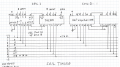
I tried to present a rough outline using 74C85.Coil Timing.png
 

Thread Starter

Ben Varvil

Joined Apr 30, 2018
197
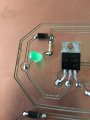
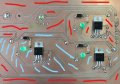
I uploaded the code, then connected the 12V battery. Immediately, this trace smoked: IMG_2078.JPG
No current should have been flowing.
I didn't expect the board to work first try, but I also didn't expect it to fail this early.
I replaced the burnt trace with a jumper of wire then used a multi-meter to check connections. It became clear that much of the board is connected directly to ground. I'm assuming this is how the current was flowing when all the the mosfets gates were low.

I went through isolation routes with the tip of a wood screw to try to ensure everything is isolated. Finding the leak, if that is what it is called, is tedious. When I ran out of time for the day, I got to the point where the blue area in the pic below is completely isolated from everything red. It is completely isolated... except that it is still connected to ground electrically. I'm stumped. Any suggestions welcome. labeled control board isolation routes_LI.jpg
 

Thread Starter

Ben Varvil

Joined Apr 30, 2018
197
Bag the hall sensors!!!
You are asking for trouble!

Use a non-magnetic position sensing technology.
Every time you fire up a coil, those sensors are going to go haywire.
I submit. I agree.
Hall sensors was a bad route.
I've learned and will remember that halls are great to detect a door closed or something very binary like that, but not for repeatable positioning.
I'm sure I could have read that somewhere.
 

Sensacell

Joined Jun 19, 2012
3,785
I submit. I agree.
Hall sensors was a bad route.
I've learned and will remember that halls are great to detect a door closed or something very binary like that, but not for repeatable positioning.
I'm sure I could have read that somewhere.
"Using the hall sensors in your application is like using a humidity sensor at the bottom of a swimming pool"
 

Thread Starter

Ben Varvil

Joined Apr 30, 2018
197
Might be back to zebra stick with 1/16 in. bands of white or silver on flat black background with reflective
optical sensor like OPTEK K2362. With 1/8 in spacing a count of 256 would give 16 in of stick.
I'm with you.

Maybe a CD4040 12 bit counter
with a pair of 74C85 4 bit magnitude comparators for each coil. Programing with DIP switches or solderless
breadboard.
The counter counts pulses and maintains position data while the comparators determine when to fire?
I'm unfamiliar with programming using DIP switches, but I'm guessing that's how you communicate the trigger point to each comparator?

Needing only 8 bits a 74HC521, 8 bit comparator could be used with slightly simpler wiring.
I tried to present a rough outline using 74C85.
I love this drawing. Beautiful. Thank you. I'm glad to see I'm not the only one who uses a pen and a notebook.
However, I have to be honest, I'm out of my element in regards to what you're describing.
Care to elaborate in more general terms about how this system works?
 

shortbus

Joined Sep 30, 2009
10,050
I've learned and will remember that halls are great to detect a door closed or something very binary like that, but not for repeatable positioning.
I'm sure I could have read that somewhere.
Not true, they are doing it every day when you drive your car, if it is fuel injected. Or has ABS brakes. It is the distance from your steel slugs in the carbon fiber tube and the proximity to big electromagnets that is the problem. Many BLDC motors use them but they are separated from the magnets and electromagnets of the motor by the end bell of the motor.
 

Thread Starter

Ben Varvil

Joined Apr 30, 2018
197
Not true, they are doing it every day when you drive your car, if it is fuel injected. Or has ABS brakes. It is the distance from your steel slugs in the carbon fiber tube and the proximity to big electromagnets that is the problem. Many BLDC motors use them but they are separated from the magnets and electromagnets of the motor by the end bell of the motor.
Hmm. Are the halls in fuel injected cars closer to the piston heads (or valve covers?) than 1/16" inch?
In testing, I could adjust the sensitivity of the hall's detection of the steel slug by moving the biasing magnets closer or further. I could definitely detect the slug, just not in the same place each time and the detection point was different than the release point. Since it wasn't reliable on the testing table, I never bothered adding the complication of the electromagnets, so I can't confirm they would have been a problem. Again, the collection of halls would have been separated from the coils by at least 5 inches, likely further than what you describe in BLDC motors.
 

-live wire-

Joined Dec 22, 2017
959
Bag the hall sensors!!!
You are asking for trouble!

Use a non-magnetic position sensing technology.
Every time you fire up a coil, those sensors are going to go haywire.
"Using the hall sensors in your application is like using a humidity sensor at the bottom of a swimming pool"
Yeah, hall sensors do not make sense. Have a laser diode or LED shining on a fast photodiode. You will need to drill a hole in the pipe for this. When there is an interruption in the laser/LED, you know the object is passing through. You can get laser diodes at 10-20 cents apiece. Photodiodes are also pretty cheap.
 

shortbus

Joined Sep 30, 2009
10,050
Are the halls in fuel injected cars closer to the piston heads
No, there is one on the crankshaft, and one on the cam shaft, no where near the pistons. They are inside the automatic transmission they are at each brake disc. There are probably more than that but those are the most well known ones. The old distributors that were without points used them too.
 

Bernard

Joined Aug 7, 2008
5,784
I did find a 8 bit comparator from Digi-Key, SN74HC688 for about a buck. They also have SN74HC4040 & a bunch of DIP switches like 206-8ST, PN: CT2068ST-ND. Drawing is just an outline. Assume that sensor is sitting on black lust before first silver ( aluminum tape ) stripe. A pushbutton fires first coil; stick starts moving; we want second coil to fire at 1.875 in. so DIP ( dual inline plastic ) SW first 4 are ON = count of 15 or 15 x 1/8 in = 1.875 in.
When sensor passes over 15 stripes, counter will read, 1, 2, 4, 8 same as DIP, then the P = Q output will go
low giving signal to fire second coil.
Darn- scanner is down.
 

shortbus

Joined Sep 30, 2009
10,050
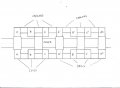
As promised earlier I made some crude drawings. Drawing 1, shows the orientation of the mover and the coils. I only showed 3 plus 1 of them, using more will give more force. The coils would switch on all of a letter at a time. Depending on the order they are switched on the movement direction changes. Just like in a stepper or in this case a
SRM.

ben v 1 2018-08-22 001.jpg

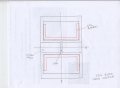
Drawing 2 shows how I would make the coil arrangement for the most magnetic force. It is what I came up with for my SRM I want o build, if I live that long. It's a version of what is called a "short magnetic path" The coil is retained in a cavity in between two steel blocks. There is a gap in the center that has to be there , where the rod/mover goes. But the rest of the block has to touch, for 2 reasons, 1. to hold the coil, 2. to make the magnetism go clear through the steel, that makes up the "back iron". Think of it like a transformer "pot" core.

With the gap there is both a North and South pole available. Twice the magnetism for just one coil. This is how the electromagnets in a magnetic grinding chuck or a scrapyard lifting magnet works. Even though the blocks are harder to make, there are two advantages easier coil winding, and twice the magnetism which equals more force.
ben v 2 2018-08-22 001.jpg
 

Thread Starter

Ben Varvil

Joined Apr 30, 2018
197
As promised earlier I made some crude drawings. Drawing 1, shows the orientation of the mover and the coils. I only showed 3 plus 1 of them, using more will give more force. The coils would switch on all of a letter at a time. Depending on the order they are switched on the movement direction changes. Just like in a stepper or in this case a
SRM.

View attachment 158538

Drawing 2 shows how I would make the coil arrangement for the most magnetic force. It is what I came up with for my SRM I want o build, if I live that long. It's a version of what is called a "short magnetic path" The coil is retained in a cavity in between two steel blocks. There is a gap in the center that has to be there , where the rod/mover goes. But the rest of the block has to touch, for 2 reasons, 1. to hold the coil, 2. to make the magnetism go clear through the steel, that makes up the "back iron". Think of it like a transformer "pot" core.

With the gap there is both a North and South pole available. Twice the magnetism for just one coil. This is how the electromagnets in a magnetic grinding chuck or a scrapyard lifting magnet works. Even though the blocks are harder to make, there are two advantages easier coil winding, and twice the magnetism which equals more force.
View attachment 158539
Thank you for taking the time to draw this out.
In the first drawing, it seems that B fires if the rod is to move left, C to go right. However, the mover piece is 0% into either of those coils... some experimenting I've done and CMartinez's deconstruction of a solenoid support the idea that at least half (2/3rds is better) of the metal should be within the coil if energizing it is to create usable force. Starting from rest, in the position as drawn, I don't believe this design moves. Perhaps if another set of coils, half step out of phase is used, those can help get the mover started, enabling B or C of the coils shown to do work.

I'm still working to understand drawing number 2.
 
Top