Why won't my linear stepper motor work?

Thread Starter

Ben Varvil

Joined Apr 30, 2018
197
You might need a bigger kick on the first stage to over come friction & have some velocity when slug reaches
the grasp of the second coil. Maybe step up voltage to charge a capacitor bank ?
I thought about using a capacitor bank. And, I did some testing down that route. Initially, I thought this whole part of the project would just be a big steel slug in a cue stick and one big coil. I made that, charged some capacitors and discharged them through the coil... The result was not close to what I observed just connecting the coils directly to the batteries. Admittedly, I don't have much experience with capacitors. But, I didn't see the advantage in my testing so I steered away from them in the design development.

I do know, however, that the static friction in the system is large, larger than I want. I've just been assuming more voltage and lots of hope would over come it. Capacitor is a nice addition to my things to try. I'll see if I can dig up footage of my capacitor testing.
 

Thread Starter

Ben Varvil

Joined Apr 30, 2018
197
Hey Bernard, here's the capacitor bank test.

Admittedly, I have relatively little experience with big capacitors. Please help me understand. If the capacitors are charged to ~24v and the batteries are at 24v, what is the capacitor bank doing? Giving a larger on-rush current? Is the battery system relatively slow and the capacitor bank fast?
I know of capacitors used in beefy car audio systems to supplement the current draw needed when the bass drops. I guess the initial push to overcome static friction in my situation is like a big bass drop... ?
 

cmartinez

Joined Jan 17, 2007
8,768
Hey Bernard, here's the capacitor bank test.

Admittedly, I have relatively little experience with big capacitors. Please help me understand. If the capacitors are charged to ~24v and the batteries are at 24v, what is the capacitor bank doing? Giving a larger on-rush current? Is the battery system relatively slow and the capacitor bank fast?
I know of capacitors used in beefy car audio systems to supplement the current draw needed when the bass drops. I guess the initial push to overcome static friction in my situation is like a big bass drop... ?
The capacitor bank is there to help the system with the sudden current demand when you switch on the mosfets, this is because the batteries (or power supply) that you use always have an internal resistance that limits current flow and affects the rate at which the magnetic field rises in the solenoids.
 

Bernard

Joined Aug 7, 2008
5,784
I was thinking of something a little bigger like 1000 uF @ 800V which might give a 1 kg stick a velocity of around 1 / 5 m/s ? Mostly an educated guess as my math skills are long gone.
 

Thread Starter

Ben Varvil

Joined Apr 30, 2018
197
I was thinking of something a little bigger like 1000 uF @ 800V which might give a 1 kg stick a velocity of around 1 / 5 m/s ? Mostly an educated guess as my math skills are long gone.
Wow. 800V.
My math says this would be duping quick burst of 200A through the coils. I feel like that'd toast them... or is the current dump finished so quickly that everything is.... ok? Also, 800V sounds dangerous for my machine's level of human interaction. Yes? No?
 

Bernard

Joined Aug 7, 2008
5,784
A big YES, it could be a lethal combination in the wrong hands. High Vs are not as common as in the vacuum tube days where 350- 500 v were common; now seems that 48 v is high V.
 

shortbus

Joined Sep 30, 2009
10,050
Wow. 800V.
This is why the commercial motors use between 100 and 400 volts. At the size of your coils and theirs they need the volts to do the work. Even though you and your "supporters" seem not to believe me. But just looking at the data available tells a different story. You can make something move at 12V just not do much work.
 

Bernard

Joined Aug 7, 2008
5,784
This might be comparing oranges to lemons but back to solenoid & golf ball. Discharging a 8300 uF C
charged to 26 V into .5 ohm solenoid causes armature to strike a 54 gram golf ball driving it in a 52 deg. arc on 200 cm arm of ballistic pendulum raising ball 3 in. which = about .066 m/s. We would like to have 1 kg moving 2 m/s from first coil so 2m/s / .066m/s = 30 X the power applied to solenoid. 8300 uF X 26 V X 30 = 1000uF X
6400 V. Assuming that the solenoid is more efficient than air coil then maybe 800 V isn't too far off. Vs can be traded for C as long as C can discharge when stick moves about 2 in. ?
 

Thread Starter

Ben Varvil

Joined Apr 30, 2018
197
A big YES, it could be a lethal combination in the wrong hands. High Vs are not as common as in the vacuum tube days where 350- 500 v were common; now seems that 48 v is high V.
One of the design requirements is that I'm not worried when people are interacting with the machine. So, I have to Veto the high voltage...
 

Thread Starter

Ben Varvil

Joined Apr 30, 2018
197
48V is the shock threshold of the human body, if I remember correctly .
a quick search on "shock threshold" shows there is a spectrum of feeling/impacts to humans for various currents/voltages... Not sure what happens at 48V to make it a threshold, but good to know that 24V is considered to be safe.
 

Thread Starter

Ben Varvil

Joined Apr 30, 2018
197
This might be comparing oranges to lemons but back to solenoid & golf ball. Discharging a 8300 uF C
charged to 26 V into .5 ohm solenoid causes armature to strike a 54 gram golf ball driving it in a 52 deg. arc on 200 cm arm of ballistic pendulum raising ball 3 in. which = about .066 m/s. We would like to have 1 kg moving 2 m/s from first coil so 2m/s / .066m/s = 30 X the power applied to solenoid. 8300 uF X 26 V X 30 = 1000uF X
6400 V. Assuming that the solenoid is more efficient than air coil then maybe 800 V isn't too far off. Vs can be traded for C as long as C can discharge when stick moves about 2 in. ?
That is great experimental data.
I see how you step from .066m/s to 2m/s, but when (in the calc) is the 54g converted to 1kg?
It seems like the end number needs another X20...

Regardless, the preliminary math is saying a professional level break shot isn't in the cards. Damn.

Pool books and old men in bars like to say, "there are two kinds of shots in pool, Soft and Softer." Perhaps this style shooting system will still yield high resolution speed control in the soft shot realm.
 

cmartinez

Joined Jan 17, 2007
8,768
One of the design requirements is that I'm not worried when people are interacting with the machine. So, I have to Veto the high voltage...
Magnetic field strength is directly proportional to the amps times the number of wire turns in a coil, so in theory you could use very thick wire to compensate for the low voltage. But thicker wire also means a larger diameter coil, and that could also affect performance.

Now for my 2¢ on this discussion:

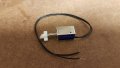
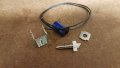
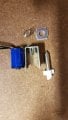
Here's a picture of a solenoid I recently took apart just to have a look at it:

03.jpg

01.jpg

07.jpg

04.jpg

I noticed that, in its resting state, the plunger sticks at least 1/3 of its length into the front solenoid, and the back of the solenoid contains a rod also of 1/3 of its length. So only 1/3 of the total coil length is free for the solenoid plunger to travel into. My take is that the rod at the bottom of the solenoid is there to help concentrate the magnetic field's lines created by the coil when it is activated, and so that rod is turned into a magnet when that happens, just as the plunger is too. This creates the triple effect of: 1) magnetizing the bottom rod, 2) magnetizing the plunger, and 3) the magnetic field in the free space inside the coil itself. This configuration makes both rods behave like a couple of magnets that are strongly attracted to each other, and aided by the magnetic field present in the coil's empty space. The closer the rods get, the stronger their attraction is, making the velocity motion profile an exponential one.

Now, the configuration you're using does not allow for an auxiliary bottom rod, since you'll be placing the iron cores distributed along the cue.

It is my opinion that said iron cores should stick at least 2/3 of the way into each of your device's coils before activating them. Or at least make sure that your design allows for a wide adjustment of each of its hall sensors to make sure that optimal switching sync is achieved.
 

shortbus

Joined Sep 30, 2009
10,050
My first quote still stands . Unless you have an extension on the moving part of the solenoid that is non magnetic. A solenoid can only pull the armature into the coil.

I also don't see the reluctance to using a higher voltage on this. Since you talked in other posts about aesthetics, you don't plan on having exposed wires do you? Most things in even a home type environment are using 120V.

And you do know the original pool playing robot used two different actuators, one for most shots and another just for breaks.
 

shortbus

Joined Sep 30, 2009
10,050
It is my opinion that said iron cores should stick at least 2/3 of the way into each of your device's coils before activating them. Or at least make sure that your design allows for a wide adjustment of each of its hall sensors to make sure that optimal switching sync is achieved.
But that is not how a variable or switched reluctance motor works, in real life. The next coil turns on when the next rotor pole is "near" not under the coil pole piece. It's kind of like the advancing of the ignition in a car engine.
 

cmartinez

Joined Jan 17, 2007
8,768
But that is not how a variable or switched reluctance motor works, in real life. The next coil turns on when the next rotor pole is "near" not under the coil pole piece. It's kind of like the advancing of the ignition in a car engine.
Yeah, I get it ... I'm just saying that Ben should be prepared to face all possible scenarios and experiment on them ... on the other hand, this is not a variable nor a switched reluctance motor ... it's a CLiSA, remember? :D:p
 
Top