Ben, I've been doing some experimenting with solenoids lately. Would you mind reminding me exactly how you plan to mechanically configure the coils, guides and all? I might be able to give you some feedback on my experience.
So, a problem with how your video is explaining your motor. In an BLDC, or a SRM or VRM, there is more than one coil on at a time. In all of those motors, the coils are A, B, C. Or what ever you chose to call them. But they are also in phases. Say you have a 12 pole motor, that gives you coils numbered, "A", "A1", "A2", "A3". And so on with the B and C phases.
This is how the motor gets it's 'punch' or power. One coil on at a time, and not as a phase, cuts down on the available power of the motor and is a waste of wire for that power. It is also what allows all of the motors listed above use only 3 sensors to do what you want to do with 5. And it wouldn't change whether the motor was a rotary or linear motor, they would be same-o, same-o.
I'm not even sure what questions to ask here, but this is very foggy to me. I'll do more digging on the difference between distributed windings and what I'm doing, but if you have a different way to describe, might help. This is the crap I'm wading through now...https://www.quora.com/What-is-distributed-winding-and-concentrated-winding. I'm thinking you are alluding to the center taping concept Be80be has been supporting. Foggy.
I also have some PDFs showing the rod with paired magnets in stead of slugs of steel. That type of linear motor has two advantages, more energy per pound and no sensing of where the rod is. That is the way most commercial linear rod motors are done today.
I'm still processing the four you posted earlier. Although, I'm traveling for a week, so will have flights to read. Go ahead and post. I'll not get to it for a bit though. THank you. I do want to repeat that NOT having magnets in the cue is an advantage for the rest of the machine which has magnetically sensitive sensors.
In an BLDC, or a SRM or VRM, there is more than one coil on at a time. In all of those motors, the coils are A, B, C. Or what ever you chose to call them. But they are also in phases. Say you have a 12 pole motor, that gives you coils numbered, "A", "A1", "A2", "A3". And so on with the B and C phases.
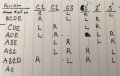
I explained in the video, and showed that there are 2 coils on at a time. One activated coil is one half step ahead of the other activated coil. Since you saw the video and know this, I'm assuming I'm still not getting what you're saying. For clarity, here is a close up of the coil status vs position table:
Coils at the top. (My naming convention fell apart... but you get the idea) Hall sensors that are "on" along the left. L means fire if you want to go left, R for Right.
'm not even sure what questions to ask here, but this is very foggy to me. I'll do more digging on the difference between distributed windings and what I'm doing, but if you have a different way to describe, might help. This is the crap I'm wading through now...https://www.quora.com/What-is-distributed-winding-and-concentrated-winding. I'm thinking you are alluding to the center taping concept Be80be has been supporting. Foggy.
No nothing to do with what bebop has been preaching, wrongly I will add again. The drawings and cartoons of how a stepper is wound are just that cartoons. There aren't 4 different coils in 4 different positions and none of them are center taped in any stepper. It is just shown that way to keep things simple for people that don't know any better.
Have you ever looked at the stator of an AC induction motor? Or the armature of a DC motor? The winding coils are distributed, the go over more than one pole of the metal core at a time.
I explained in the video, and showed that there are 2 coils on at a time. One activated coil is one half step ahead of the other activated coil. Since you saw the video and know this, I'm assuming I'm still not getting what you're saying. For clarity, here is a close up of the coil status vs position table:
Coils at the top. (My naming convention fell apart... but you get the idea) Hall sensors that are "on" along the left. L means fire if you want to go left, R for Right.
I'll try to draw up what I mean, and post it. Just like with a stepper the motors like your trying to do only have the coil sets that are lined up with the metal or magnet(depending on the motor type) on at one time. The other metal or magnet is close to the next coil to be turned on on either side of the one that is on. Depending on which coil(set) gets turned on next, is what determines the direction it moves. Just the same as it does in a stepper. Easy to see when drawn out but hard to describe.
Good explanation. Questions, what are the overall dimensions of the final arrangement? What will the total travel length of the cue be? How much does the ball and the cue weight?
Ahhh. I HAVE seen that.
So the activated coil magnetizes multiple cores. Then as the next coil activates and the first deactivates some magnetized cores can stay magnetized.... and this sharing of cores is therefore more efficient than fully magnetizing and deactivating each core individually, sequentially.
Yes?
The other metal or magnet is close to the next coil to be turned on on either side of the one that is on. Depending on which coil(set) gets turned on next, is what determines the direction it moves.
Good explanation. Questions, what are the overall dimensions of the final arrangement? What will the total travel length of the cue be? How much does the ball and the cue weight?
Thanks. The steel slugs and coil lengths are 1.75". The slug diameters are 5/8", which fit perfectly inside 19mm carbon fiber RC tubing.
The length of the cue is TBD and can be a driven dimension. Ideal stroke length would be 15ish". Cue ball is 6 oz. Stick will be 5-6x that.
Conservation of momentum says M1(V1) + m1(v1) = M2(V2) + m2(v2)
So, if I can get a good energy transfer between the stick and ball, I should only need to get the stick going a fraction of the speed I'd like obtain for the cue ball: (25mph, 11Mps)
Ok I guess if you put 2 coils on one bobbing and tie there ends there is no center tap it's just 2 wires coming from nowhere.
there is 4 coils ones with center taps are unipolar.
But what the hell does that have to do with what Ben Varvil is making he's not trying to spin a gear here he is moving a rod
And from controlling point a unipolar is a hell of a lot easier then what he been doing.
Thanks. The steel slugs and coil lengths are 1.75". The slug diameters are 5/8", which fit perfectly inside 19mm carbon fiber RC tubing.
The length of the cue is TBD and can be a driven dimension. Ideal stroke length would be 15ish". Cue ball is 6 oz. Stick will be 5-6x that.
Conservation of momentum says M1(V1) + m1(v1) = M2(V2) + m2(v2)
So, if I can get a good energy transfer between the stick and ball, I should only need to get the stick going a fraction of the speed I'd like obtain for the cue ball: (25mph, 11Mps)
You almost have the answer to my next, and last, couple of questions. How much energy do you need to pump into the cue to obtain what you want? And how much time do you have to apply that energy to an accelerating cue? (this last question is about power) After you've calculated that, assume a 60% efficiency on the system you're designing.
You almost have the answer to my next, and last, couple of questions. How much energy do you need to pump into the cue to obtain what you want? And how much time do you have to apply that energy to an accelerating cue? (this last question is about power) After you've calculated that, assume a 60% efficiency on the system you're designing.
Let's talk it out...
the final kinetic energy needed in the cue ball is 1/2MV^2 or 1/2(.2KG)(11M/s)^2 = 12J
Let's say 60% of the energy transfers from the cue stick to the cue ball on impact. Then, Cue stick energy before impact = 20J
Stick kinetic energy is 20J = 1/2MV^2 , M = 1kg then V = 6M/s
Stick final velocity = 6m/s, starting velocity = 0m/s. Distance traveled = 0.4m
If we assume constant acceleration, d = 1/2(V0+Vf)t or 0.4m = 1/2(0+6m/s)t time = 0.13 sec
20J in 0.13 sec = 154W
60% efficiency means I need to put 256W into the system.
"Draining a swimming pool through a drinking straw" efficiency means I need to put in 1,500W
This is clearly back of the envelope, gentle on my errors please.
Let's talk it out...
the final kinetic energy needed in the cue ball is 1/2MV^2 or 1/2(.2KG)(11M/s)^2 = 12J
Let's say 60% of the energy transfers from the cue stick to the cue ball on impact. Then, Cue stick energy before impact = 20J
Stick kinetic energy is 20J = 1/2MV^2 , M = 1kg then V = 6M/s
Stick final velocity = 6m/s, starting velocity = 0m/s. Distance traveled = 0.4m
If we assume constant acceleration, d = 1/2(V0+Vf)t or 0.4m = 1/2(0+6m/s)t time = 0.13 sec
20J in 0.13 sec = 154W
60% efficiency means I need to put 256W into the system.
"Draining a swimming pool through a drinking straw" efficiency means I need to put in 1,500W
This is clearly back of the envelope, gentle on my errors please.
I don't know about your errors ... but 1,500W sound about right, and your mosfets should be able to handle them for such a short period of time. The key for your system to work at all will be perfect sync. You said you'll be using an Arduino to control the thing? If so, I'd consider writing a program for your PC/Laptop that allowed you to quickly adjust and calibrate all of the timing parameters, and transmit them to the controller via UART/USB. After you've determined the best settings, then you'd proceed to include them in the controller's firmware.
Well, there aren't any timing parameters, except maybe a "max coil-on" time.
The halls are positioned, and the control table is written, so that coils only fire if they are capable of pulling, which is position dependent.
Say we continue with needing to put in 1500W...
Power=VI, if V =24V, I = 62.5 Amps. Uh oh.
I'll be using 2 simultaneous coils (4ohm each), pulling 16Amps at 24V. That's 384W. Not close.
Ok I guess if you put 2 coils on one bobbing and tie there ends there is no center tap it's just 2 wires coming from nowhere.
there is 4 coils ones with center taps are unipolar.
I'm assuming that was directed at me. So I will try to make you understand.
The unipolar steppers are easier to drive, I agree. But the coils are only center tapped in that the one side of each of 2 coils is at ground or common. Not what is normally considered as center tapped. And the drive is still sequential to change direction. probably not the correct sequence being used but it would be close enough for an example of what I'm talking about - move right A - B - C - D, move left B - A - D - C. Because the as you say, "center tap" is at common, only one side of any coil is live at a time. Not both like in a normal center tapped coil.
But what the hell does that have to do with what Ben Varvil is making he's not trying to spin a gear here he is moving a rod
And from controlling point a unipolar is a hell of a lot easier then what he been doing.
He is not doing what you're calling a linear stepper, what he called it in the thread title. None of the linear motors, BLDC, VR or SRM type use 4 coils. They are in groups of 3 or in other words 3 phase motors, just in DC not AC.
He is not doing what you're calling a linear stepper, what he called it in the thread title. None of the linear motors, BLDC, VR or SRM type use 4 coils. They are in groups of 3 or in other words 3 phase motors, just in DC not AC.
The rod moves linearly. The rod advances one step at a time. It feels justified to call it a linear stepper motor, even if it doesn't fall into one of the existing motor acronyms.
The rod moves linearly. The rod advances one step at a time. It feels justified to call it a linear stepper motor, even if it doesn't fall into one of the existing motor acronyms.
It may seem like it should be that way but the makers don't agree with you. They use the same convention that is used on a rotary motor of the same make up, just adding "linear" to it. This is because stepper motor have 4 poles/2 phases. Where as the others use poles that are based on multiples of 3. One of the reasons is to make the electronic commutation easier.
The rod moves linearly. The rod advances one step at a time. It feels justified to call it a linear stepper motor, even if it doesn't fall into one of the existing motor acronyms.
I already have some "positive feedback" to give you, Ben. But it's gonna have to wait until tomorrow morning. But I promise you it'll be focused around helping you make your current configuration work.
You might need a bigger kick on the first stage to over come friction & have some velocity when slug reaches
the grasp of the second coil. Maybe step up voltage to charge a capacitor bank ?

 Facebook
 Google
 GitHub
 Linkedin