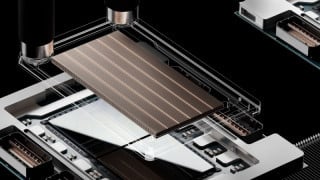
Much thicker traces, double sided tape and a couple of engraving bits later... View attachment 157509 View attachment 157510
My first circuit board. It's fun assembling everything once the board is cut. I didn't expect that.
I imagine so.
I'm being sure to enjoy the making part, and how cool it looks now, because I can't imagine those thin strips of copper film withstanding the 4 amp bursts I'll be drawing. (8 amps if I go to 24V). We'll see. Maybe it won't be an issue, but I predict to see black spots where the traces burn open.
Again I know this will be seen as a criticism, but from the bottom of my heart it's not meant to be. Like all of my posts, it is all meant to get your project to work, and work good. I come from a place of practicality, that is the way I do things. You need it to be practical then you work that into aesthetics.
The one thing I noticed was you seem to have your mosfets mounted parallel to the board. This to me, brings up two things -
1.Are the tabs of the mosfets touching the board? If so they may be shorting out since it doesn't look like there is an mounting pad between the PCB and the tab. The tab is connected internally to the mosfet and will be live(hot) when it is.
2. And this is the big one, the small area of the mosfet/PCB interface won't be a very good heat sink. Power mosfets like in this type of circuit should have some sort of heat sink to help keep them cool.
I'm being sure to enjoy the making part, and how cool it looks now, because I can't imagine those thin strips of copper film withstanding the 4 amp bursts I'll be drawing.
Then why not just make them wider when you mill them? There are charts that will tell you how wide a trace needs to be to support a given number of amps.
1.Are the tabs of the mosfets touching the board? If so they may be shorting out since it doesn't look like there is an mounting pad between the PCB and the tab. The tab is connected internally to the mosfet and will be live(hot) when it is.
I have the pads that shipped with my small heat sinks. My plan is to screw the mosfets parallel to the board with the pads providing insulation from the board. I simply ran out of time.
To be honest, I'm viewing this board as somewhat of a rough draft. I skipped the schematic step of the PCB design process so I want to confirm the wiring actually works. I plan to use low voltage and to increase it until something fails. Then, optimize based on what I learn, likely using even wider traces and making space for heatsinks. OR, the bursts of current I need will be so short, heat won't be an issue and this board will be fine... I'll learn a lot from testing.
Then why not just make them wider when you mill them? There are charts that will tell you how wide a trace needs to be to support a given number of amps.
I did not know these charts existed. It seems obvious when I read it now, but until now, I had no idea. Part of being a nube I suppose. I'll google. Thanks for the heads up.
I did not know these charts existed. It seems obvious when I read it now, but until now, I had no idea. Part of being a nube I suppose. I'll google. Thanks for the heads up.
I have the pads that shipped with my small heat sinks. My plan is to screw the mosfets parallel to the board with the pads providing insulation from the board. I simply ran out of time.
Generally, that's true. However, this pool cue pusher will, if it works, be active for less than a second or so at a time, with each coil being energised for, say, only 1/4 second. I doubt the FETs would get noticeably warm, yet alone hot enough to justify a heatsink.
Interesting.
It's cool how you can manipulate the numbers to get what you need. If I can score 3 oz/ft^2 pcb blanks, I can use my existing mill paths and handle 8 amps... In theory... with little margin of error
The copper thickness description is a little unclear for what I bought. I think I'm working with 6.2 mils. If that is the case, I only need 1.18mm traces for 8 amps, meaning the board should be fine. Encouraging, but I'm skeptical of numbers that just happen to work out, so I'll believe it when I see it.
Generally, that's true. However, this pool cue pusher will, if it works, be active for less than a second or so at a time, with each coil being energised for, say, only 1/4 second. I doubt the FETs would get noticeably warm, yet alone hot enough to justify a heatsink.
This is my hope as well.
The ideal duty cycle: a few back and forth "practice strokes" behind the cue ball then the real recoil and full stroke/follow through. Probably 3 seconds of action total. Then rest for 70-90 seconds before repeating for next shot.
The not ideal, more realistic situation, is that the cue will get physically stuck at some point and two coils will get turned on indefinitely. No hiding from the heat issue.
It all boils down to this if you are firing coils wrong you will wast power and end up with lot's of heat.
You really need to work on moving the stick with little power then speed up.
I have a stepper I burnt up a 2 amp stepper controller the stepper wasn't the problem it now runs happy on a 800 mA
the problem was how I was using the stepper in code I was firing one coil at wrong time it killed my stepper controller really fast.
Like to old saying baby steps fire 1 turn off fire 2 turn off 3 same and the same for 4
get it moving then fire faster
I really don't think this would need even a amp to knock the ball off the table once you get the stick right to match the coils then the code right to match the step's
Thanks be80be. Lower voltage would definitely be nice for the circuit board. I'm a little nervous about the static friction. When I move the cue stick (rod of spaced steel slugs) by hand, it takes a hefty pull to get things going. The force I felt from one coil at 12V made me think two coils at 24V would be necessary to get it moving.
Like the system in shortbus's article, I'm trying to control the firing of the coils based on position, not time. They use a linear encoder, I'm trying halls, but both position based, not time.
There's just something about how people think today. Red to red blue to blue
Don't mean the same thing as 1 to 1 and 2 to 2 even if red is 1 and blue is 2.
A stepper is a the same even if you change it's shape from round to a long rod.
Same with a 3 pole motor even the rod needs 3 poles .
And yet again this build defies all convention. I understand it is only moving a pool cue, but there is much more power used in doing that then is being shown here.
Without having fact based numbers to work with on how much energy doing the pool cue thing really takes, how can this be designed with any hope of it working? do you guys that design things for a living do it with out real numbers to start with? I don't think so, when in many of your postings you berate members for not giving the "real life " numbers to work with. Just can't understand why this project would be any different????
Again, I know I'm stepping on toes, but just throwing things out there that "might", "could" work isn't fair to Ben.
There's just something about how people think today. Red to red blue to blue
Don't mean the same thing as 1 to 1 and 2 to 2 even if red is 1 and blue is 2.
A stepper is a the same even if you change it's shape from round to a long rod.
Same with a 3 pole motor even the rod needs 3 poles .
Ben, I've been doing some experimenting with solenoids lately. Would you mind reminding me exactly how you plan to mechanically configure the coils, guides and all? I might be able to give you some feedback on my experience.
Without having fact based numbers to work with on how much energy doing the pool cue thing really takes, how can this be designed with any hope of it working?
Good point. It is easy enough to measure the force necessary to move the cue and the force provided by one coil at 12/24V.
I have some new data acquisition gear I need to set up anyway.
Just moving it is one thing, but providing enough force to accelerate the mass of the cue sufficiently is another thing. Might be worth studying video of break shots and computing from successive video frames just what acceleration is involved in practice.
Good point. It is easy enough to measure the force necessary to move the cue and the force provided by one coil at 12/24V.
I have some new data acquisition gear I need to set up anyway.
This is also one of those misconceptions about regular stepper motors. That there are just 4 independent coils inside. While there are 4 coils they are also wound like an AC motor, or the rotor of a DC motor. They are "distributed" coils, not coils wound in separate quadrants. This gives the motor more "punch" when operating.
I also have some PDFs showing the rod with paired magnets in stead of slugs of steel. That type of linear motor has two advantages, more energy per pound and no sensing of where the rod is. That is the way most commercial linear rod motors are done today.
wow, not sure how the coding would look to put a time limit on coil activation.
"while timer is true, and move left is true, fire coil 1, timer = timer - increment"
then reset timer upon turning off the coil... Something like that maybe.
In this example from Shortbus earlier, they have current sensors on each phase and then limit the current to their desired level. I'm not sure how they control the current level. I suspect that is the "Buck Converter's" role?
I'm actually not sure why they monitor the current. In my simplified understanding, it seems like firing the coils with a fixed, safe, voltage based on position like they do should accomplish the task. Are they sensing the current just to create the impedance chart, just to optimize switching positions? If so, do they discontinue monitoring the current after optimization, for the production model of this device?
Side note, I'm surprised at how much information can be left out of a project and yet it gets formally published.

 Facebook
 Google
 GitHub
 Linkedin