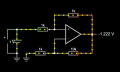
Why isn't this Op Amp saturated ?

Status
Not open for further replies.

Thread Starter

Xenon02

Joined Feb 24, 2021
504
You seem to be asking a lot of questions to which you could easily find answer on your own, rather than engaging in long, drawn-out discussions who would like to help you. This is not only true of this thread, but others on this site.

For your op-amp questions, I have some suggestions.
On this site: https://www.allaboutcircuits.com/textbook/semiconductors/
Burr-Brown Operational Amplifier Handbook
Handbook Of Operational Amplifier Active RC Networks

If you have difficulty with any particular terms or concepts in these tomes you are welcome to ask for specific help on this site. Dragging individuals with good intentions into endless conversations are frowned upon.
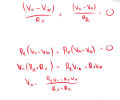
I understand, I will only get the information on how to get Vx and I'm finishing this post.


There is no I in the diagram. Try to write an equation in terms of Vin and Vout.

Could you tell me how to get Vx ? I'll finish this after this answear because I found how to solve it but I need to know how to calculate Vx.


Thank you.
 

Thread Starter

Xenon02

Joined Feb 24, 2021
504
Why don't you do that first? Why are you bothering with OpAmps if solving simpler circuits is not your second nature?
Most of this method I've seen on youtube, they calculated those nodal potentials but they knew what was the current and where it was flowing.

So I ask how it was calculated and I know the rest. Like a tutorial. I just need to see it.
 

dcbingaman

Joined Jun 30, 2021
1,065
But I have seen some examples where there are used two feedbacks at the same time.
View attachment 272750

So I was curious how people are solving it. Because I know how it works with only positive or only negative. But if there is both? Is it like one of them is dominating or what? Or how does it work ?
You have to use 'superposition'. That is short Vs2 and calculate the output then short Vs1 and calculate the output. The output is then the sum of these two. For more info see superposition on line.
 

panic mode

Joined Oct 10, 2011
5,002
... they calculated those nodal potentials but they knew what was the current and where it was flowing.
no... when you start analysis, nobody knows what the currents are and in which direction they flow (unless it is specified).
then YOU mark currents and voltages at each node. current direction is arbitrary (you chose it - even randomly if you like).
and then YOU write equations based on the circuit and things you marked.
and then you solve those equations and get bunch of results.
if result is negative, it simply means that assumed direction was wrong but the value is still correct.
 

panic mode

Joined Oct 10, 2011
5,002
after you learn how to solve basic circuits in number of ways, then you gradually add more complex elements (diodes for example) and practice some more.

after you can do analysis of discrete circuits, you may start looking into opamps.
working with opamps starts by learning about ideal OpAmp and it's characteristics. keeping those in mind is essential when doing nodal analysis on OpAmps.

again, that takes some more practice... but... now you should easily apply nodal analysis etc to create set of equations and start solving the OpAmp problems.

Instead of that you are asking others what the equations are for different circuits or how to find Vx. one must learn to walk before running, learn alphabet before reading... there is no easy shortcut (unfortunately)
 
Last edited:

dcbingaman

Joined Jun 30, 2021
1,065
Ok this is wierd I didn't know there would be two outputs.

But still I didn't get the answear to my question :

View attachment 272766

The link didn't consist the circuit with two feedbacks and 1 output.

Because this one has one output.

View attachment 272767

Like here 2 feedbacks 1 output.
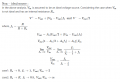
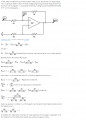
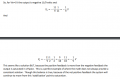
I was curious so I solved the generalized equations for this. Note if the positive feedback is greater than the negative feedback the output will saturate at one of the power rails. Also if the ratio of R3 to R4 is the same as the ratio of R2 to R1 the transfer function has a pole at this location indicating infinite gain.
 

Attachments

Thread Starter

Xenon02

Joined Feb 24, 2021
504
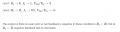
I was using this equation from this site :
1659386667595.png

This equation with "lim" was more universal so I like this one. It's easier to use it to identify what is the feedback.
I know there are other methods like trying to solve it as it is negative feedback which is IN+ = IN - , like here :

1659386474555.png

But I think the method with "lim" is easier.

I didn't know this would be that complicated.
 

Thread Starter

Xenon02

Joined Feb 24, 2021
504
But there is a problem with this method.

Because it didn't tell me what happens if Rs is bigger than R, Rs>R.
So the Vout/Vin is negative so is it saturated or is it still negative feedback dominance?

There are 2 cases where Rs is equal 0 (negative feedback), and Rs = R where positive feedback dominates. But what if Rs is bigger than R ? Then I have Vout/Vin = negative. For example Rs = 2k Ohm and R = 1k Ohm so yea.

I wonder if it is still negative feedback.


That is why these days, in practice, we use simulations rather than doing it all by hand.
True but you know to simulate something I need to understand what is happening. Or something similar.
 

dcbingaman

Joined Jun 30, 2021
1,065
I was using this equation from this site :
View attachment 272798

This equation with "lim" was more universal so I like this one. It's easier to use it to identify what is the feedback.
I know there are other methods like trying to solve it as it is negative feedback which is IN+ = IN - , like here :

View attachment 272795

But I think the method with "lim" is easier.

I didn't know this would be that complicated.
yea, that answer is the same after some algebraic manipulations as what I have. It provides the same solutions just expressed in a different way.
 

dcbingaman

Joined Jun 30, 2021
1,065
I was using this equation from this site :
View attachment 272798

This equation with "lim" was more universal so I like this one. It's easier to use it to identify what is the feedback.
I know there are other methods like trying to solve it as it is negative feedback which is IN+ = IN - , like here :

View attachment 272795

But I think the method with "lim" is easier.

I didn't know this would be that complicated.
What is important is not knowing where to find the 'equations' online but more importantly how to derive the equations from the schematic. With the latter you can solve just about any problem, with the former it is nothing but a specific case in point.
 

Thread Starter

Xenon02

Joined Feb 24, 2021
504
yea, that answer is the same after some algebraic manipulations as what I have. It provides the same solutions just expressed in a different way.
It is simplier for me at least.
And it is like a universal way to calculate it. I like something that is universal :D
 

dcbingaman

Joined Jun 30, 2021
1,065
But there is a problem with this method.

Because it didn't tell me what happens if Rs is bigger than R, Rs>R.
So the Vout/Vin is negative so is it saturated or is it still negative feedback dominance?

There are 2 cases where Rs is equal 0 (negative feedback), and Rs = R where positive feedback dominates. But what if Rs is bigger than R ? Then I have Vout/Vin = negative. For example Rs = 2k Ohm and R = 1k Ohm so yea.

I wonder if it is still negative feedback.


True but you know to simulate something I need to understand what is happening. Or something similar.
There is no problem with the 'solution'. It actually is a valid answer. IF it could just sit there the equations work. BUT with positive feedback the circuit automatically moves away from this point because it is not stable. Like described earlier, it is like a ball balanced on top of a hill, it is bound to come down on one side or the other.
 

Thread Starter

Xenon02

Joined Feb 24, 2021
504
There is no problem with the 'solution'. It actually is a valid answer. IF it could just sit there the equations work. BUT with positive feedback the circuit automatically moves away from this point because it is not stable. Like described earlier, it is like a ball balanced on top of a hill, it is bound to come down on one side or the other.
Yes I know when it is saturated then no matter what I will change with R1 it will be still saturated.
I just wanted to check if it's still negative feedback if the Vout/Vin is equal negative for example Vout/Vin = -2.

I know that when the circuit was in positive feedback "dominance" then changing R1 will change nothing.

EDIT:

Although I didn't understand this part :

1659389256224.png

you have calculated that Negative feedback is dominant so why is it going into saturation ?
Like in this part where Vout/Vin is fin :

1659389360261.png

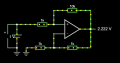
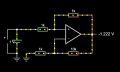
i have something like this from the simulation :

https://tinyurl.com/2xp7x9rq

1659389708131.png

This is the second case where R3 = 10k

1659389971789.png
 
Last edited:

dcbingaman

Joined Jun 30, 2021
1,065
Yes I know when it is saturated then no matter what I will change with R1 it will be still saturated.
I just wanted to check if it's still negative feedback if the Vout/Vin is equal negative for example Vout/Vin = -2.

I know that when the circuit was in positive feedback "dominance" then changing R1 will change nothing.

EDIT:

Although I didn't understand this part :

View attachment 272806

you have calculated that Negative feedback is dominant so why is it going into saturation ?
Like in this part where Vout/Vin is fin :

View attachment 272807

i have something like this from the simulation :

https://tinyurl.com/2xp7x9rq

View attachment 272809
Yes, notice the positive feedback is 1/11 and the negative feedback is 1/2 thus the negative feedback is greater than the positive feedback and the circuit is stable. Also a negative gain does not indicate positive feedback for every circuit (it just so happens to work out that way) for this specific circuit.

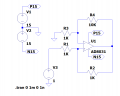
The last one you are looking at does saturate as shown here:

1659390297044.png
Here the negative feedback is 1/11 and the positive feedback is 1/2 thus the solution in not stable and saturates at one of the rails.
Notice this one is drawn with the non-inverting pin on the bottom of the schematic.
 
Last edited:

Thread Starter

Xenon02

Joined Feb 24, 2021
504
Yes, notice the positive feedback is 1/11 and the negative feedback is 1/2 thus the negative feedback is greater than the positive feedback and the circuit is stable. Also a negative gain does not indicate positive feedback for every circuit (it just so happens to work out that way) for this specific circuit.
Hmmm interesting.
I used this R3 = 10k on the simulator and it was okey, but I dunno.

1659390053173.png

But maybe you are right.
At least I know that for the gain = positive it is negative feedback, for gain = infinite is positive feedback but for the gain = negative then it can be positive or negative feedback. But I dunno about this negative gain.
 
Status
Not open for further replies.
Top