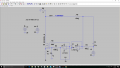
Why doesn't this circuit work?

DickCappels

Joined Aug 21, 2008
10,661
As pointed out but OBW0549 but you apparently missed is the fact that your feedback is positive feedback, not negative feedback. You need *negative feedbackfor the circuit to operate. U2 inverts the signal, but so does your MOSFET, making the feedback positive and as OBW0549 said, tuning your circuit into a latch.

You can correct this by changing U2 into a noniverting amplifier. If you heavily lowpass the feedback as you are trying to do, you can achieve your goal of a high impedance and high frequencies and low impedance at low frequencies.

*Negative feedback: Occurs when the feedback signal is inverted,
 

Thread Starter

coinmaster

Joined Dec 24, 2015
502
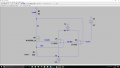
So I put this circuit onto the breadboard today and it doesn't work.
This is the result I get
2017-06-29 (5).png
U2 swings high and U1 swings low and I get nothing at the output.
In spice it works fine.
 

Bordodynov

Joined May 20, 2015
3,431
So I put this circuit onto the breadboard today and it doesn't work.
This is the result I get
View attachment 130019
U2 swings high and U1 swings low and I get nothing at the output.
In spice it works fine.
Your last option has a low output impedance (small impedance). I suspect that you do not represent your goal correctly (not counting the main goal: to make it be good).
The ideal solution to your first task is not! You want the circuit to be both a voltage source and a current source. Usually make a voltage source and limit the current.
 
The ideal solution to your first task is not! You want the circuit to be both a voltage source and a current source. Usually make a voltage source and limit the current.
A better way to say the above is that you set a "compliance voltage" with a set current. The "compliance voltage" will be the max voltage seen at the terminals with no current regulation.

Take Keithley's, Keysight or (blank's) SMU's (Source Measure Units), you can:
1) Measure V
2) Measure I
3) Source V, measure I
4) Source I, measure V.

These are capable of 4-quadrant operation where the signs of voltage and current can be either positive, negative or zero independently.

An "active load" allows constant I, constant V, constant R and constant power.
 

Thread Starter

coinmaster

Joined Dec 24, 2015
502
The ideal solution to your first task is not! You want the circuit to be both a voltage source and a current source. Usually make a voltage source and limit the current
We've been over this already. I need a high AC impedance and a specified DC voltage across the load.
My breadboarded circuit is not the end circuit it's just a test circuit to make sure the opamps are doing what they should. Which they aren't.
 

Thread Starter

coinmaster

Joined Dec 24, 2015
502
I've tried screwing around with the feedback configurations and U2 is always swinging low no matter what because U1 is swinging either high or low to ensure it. I don't know how U1 can know whether to swing high or low because its feedback is stuck at 0v either way unless for some reason it is striving for 0v but there's no reason that should be the case.
 

Thread Starter

coinmaster

Joined Dec 24, 2015
502
So I tried to use an OPA445AP instead of a LF356N and the OPA worked with the above circuit while the LF did not. Why would this be?

I moved on to try to get this circuit to work on the breadboard.
2017-07-07 (1).png
and it's back to its old tricks again. Actually this time both U1 and U2 swing positive.
I don't get it..
 
Top