Why doesn't this circuit work?

Thread Starter

coinmaster

Joined Dec 24, 2015
502
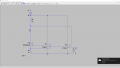
2017-05-24 (2).png I'm trying to make a high performance current source that strives to reach a reference voltage (V2) at the output.
I used an opamp current source with integrator feedback for the current source Vref.
Based on basic opamp theory, U2 should bias the current source so that the voltage at the output is equal to V2. But in simulation and practice U2 swings low putting almost no current across the load.
Why won't this work properly?
 

OBW0549

Joined Mar 2, 2015
3,566
I haven't a clue what you're trying to do with U2, or why you think it's necessary; get rid of it, and connect V2 directly to the (+) input of U1.
 

Thread Starter

coinmaster

Joined Dec 24, 2015
502
It's supposed to be a high impedance voltage source.
Without U2 the voltage will change with the load. I need the voltage to stay centered at Vref no matter the load while still providing a very high impedance. I guess I might want to add a capacitor to U2 for that actually but for now I just need to get the DC conditions to work.
 

OBW0549

Joined Mar 2, 2015
3,566
Nope. It ain't gonna work like that, no matter what you do. You cannot drive a constant current into a variable load resistance and have a constant voltage across that resistance at the same time.
 

Thread Starter

coinmaster

Joined Dec 24, 2015
502
I don't want a constant current. I just want a stable DC voltage with a high AC impedance.
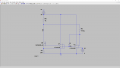
Here, I updated the schematic.
2017-05-24 (3).png
 
Last edited:

AnalogKid

Joined Aug 1, 2013
12,130
It's supposed to be a high impedance voltage source.
That is one definition of a current source. A voltage source has a low output impedance.
Without U2 the voltage will change with the load.
That is the definition of a current source.
I need the voltage to stay centered at Vref no matter the load
That is the definition of a voltage source.
while still providing a very high impedance.
That is the definition of a current source.

My point is that your requirements are in direct contradiction. If you visualize a high impedance voltage source as a normal voltage source with a high value resistor in series with the output before the load, it is easy to see with Ohm's Law that as the load resistance varies the "output voltage" at the 2-resistor load will vary.

You posted again while I was writing...
I don't want a constant current. I just want a stable DC voltage with a high AC impedance.
That is a *very* different thing from post #1. Solutions include an inductor, a gyrator or synthetic inductor, and using both positive and negative feedback to set an opamp's output impedance at a specific number. RTS did this to power their intercom system in the 70's, although I think that output impedance was 200 ohms.

ak
 
Well, to me it looks like it might control a dogs ear. The dog can put ti up and relax it but not much else.

I built a 4-terminal I-V converter with bias an supress for 100, 10, 1 and 0.1 mA FS @ 10 V. It also had +-50 mA of suppress if the bias was under between +-5V. It had good AC performance because that's what it was designed to do. Offsets get in the way for DC performance, I had 40 pA of DC offset

In order to get any sort of AC performance you have to be able to source and sink current or in my case, I needed 4-quadrant operation, If there is L and C involved then it's likely you might have +V and -I and vice versa,

It was tricky to be able to drive a capacitive load. That was my initial problem. It worked for our research devices, but not on our calibration devices.
 

Thread Starter

coinmaster

Joined Dec 24, 2015
502
Sorry, I should have been more clear in the beginning. I forgot to add the capacitor to the integrator so I can see how it looked like I was trying to break physics.

The schematic of the my original post was of the breadboarded version I was trying to get working to see if spice was giving me incorrect results which is why I simply wanted to know why U2 wasn't working.
Here is a more complete explanation of what I need.


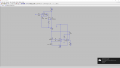
2017-05-24 (7).png The goal is to create a high impedance across the load, isolating it from the power supply on both ends.
My plan is to use a current source on one end of the load and a gyrator on the other end.

I need there to be 0.7V across the load and I want to do it automatically without trimming.
The problem is, for some reason I can't fathom the above circuit doesn't work.
 
Last edited:

crutschow

Joined Mar 14, 2008
38,506
If you have a constant current source, than that current and the load resistance determines the voltage across the load.
The rest of the circuit can then have no effect on that.
So if want 0.7V across the load, independent of its impedance than you need a constant voltage source across the load, not a constant current.
You can't do both at the same time.
 

Thread Starter

coinmaster

Joined Dec 24, 2015
502
As I said in my last post I only need constant current above DC. I need a high impedance not a high resistance.
The circuit functions as I wish if I force the proper voltage on to the input of U1.
The problem is that U2 is not properly servoing the voltage on its own.
It should be a simple task for the opamp U2 to compare the Vref with the voltage at the load and bias the current source but it just doesn't, I don't know why.
 
Not sure about the full function of the design, but the LT1012 is not necessarily going to be happy with 0.7v at its input. Check the input and output voltage ranges of the devices. Voltages are guaranteed within 1 - 1.5v of the supply voltages.
 

OBW0549

Joined Mar 2, 2015
3,566
The problem is that U2 is not properly servoing the voltage on its own.
It should be a simple task for the opamp U2 to compare the Vref with the voltage at the load and bias the current source but it just doesn't, I don't know why.
It can't, given how you've connected its inputs: you made it so the feedback is positive, not negative, therefore the circuit will just sit there, locked up, with either zero load current or the maximum possible load current.

As for your "more complete" diagram, note that everything connected to the top end of R2, your load resistor, is completely superfluous since all it does is hold the top end of R2 at ground potential. You'd get the same effect by trashcanning all that stuff and just connecting the top end of R2 to ground directly.
 

Thread Starter

coinmaster

Joined Dec 24, 2015
502
The stuff on the "top" is a gyrator, it's an electronic inductor.
I switched the inputs on of U2 and finally the circuit works as I want :) thanks for that.
I clearly don't understand opamps enough. Would you mind explaining why my configuration was a positive feedback configuration?
 

OBW0549

Joined Mar 2, 2015
3,566
I clearly don't understand opamps enough. Would you mind explaining why my configuration was a positive feedback configuration?
Sure. Just trace around the feedback loop (starting anywhere in the loop) and note polarities.

For example, suppose a small perturbation (noise, whatever) causes M1 to conduct slightly less. The decrease in M1's drain current causes the voltage on the lower end of R2 to change in the positive direction. The increased voltage is applied through R3 to the (-) input of U2, causing its output to change in the negative direction. U2's output is connected to the (+) input of U1, causing U1's output to change in the negative direction as well. This reduces the gate drive on M1, causing it to conduct even less. Thus, positive feedback-- and, given the huge loop gain provided by U2, eventual lockup.
 

crutschow

Joined Mar 14, 2008
38,506
An easy way to notate the feedback type is to go around the loop, applying a plus or minus sign at each signal node, indicating whether the signal is in phase with the previous node (+ + or - -) or opposite phase (+ - or - +), until you complete the loop back to the start.
If the phase is the same as the one you started with, it's positive feedback.
And obviously if the phase is opposite, then it's negative feedback.
 

ian field

Joined Oct 27, 2012
6,536
It's supposed to be a high impedance voltage source.
Without U2 the voltage will change with the load. I need the voltage to stay centered at Vref no matter the load while still providing a very high impedance. I guess I might want to add a capacitor to U2 for that actually but for now I just need to get the DC conditions to work.
Get rid of U2 - you don't need it.

Just feed the spare pin on U1 with an appropriate Vref.
 

MrAl

Joined Jun 17, 2014
13,704
Hello there,

It sounds to me like you just want a floating voltage source. A floating voltage source has neither end grounded and so if either end changes (but not both) then the supply voltage at the other terminal follows that voltage change also without changing the differential voltage between terminals.
So if you had a float voltage of say 5v and the bottom end was 1v, the top end would be 6v, and if the bottom end changed to 2v, the top end would change to 7v. Similarly, if the top end changed to 8v the bottom end would change to 3v.

The simplest example of a floating DC voltage source is a battery that normally does not have either end connected to ground but has some type of impedances at both ends.

Creating this kind of power supply is different because we often dont want to use a battery. There are different way of doing this. The simplest method is to create a DC power supply that can both source and sink current as a secondary circuit, and powered through an AC power source (like the line voltage) .Then only the output is used in the primary circuit. This DC supply then appears to float in the primary circuit.
If you dont want to use an AC line input you can chop up the primary circuit DC and use that as the AC.
If you dont want to do that either you can create a differential power source using op amps.

The main difference between these circuits and your current circuit is that they wont be frequency sensitive.
 

ian field

Joined Oct 27, 2012
6,536
Hello there,

It sounds to me like you just want a floating voltage source. A floating voltage source has neither end grounded
.
Pretty unlikely - U1 compare the voltage developed across the source resistor with Vref on its other input. Both the resistor voltage and Vref are ground referenced.
 
Top