When is an Isolation transformer not an isolation transformer?

Thread Starter

ApacheKid

Joined Jan 12, 2015
1,762
This all seems to suggest then that if all equipment (scopes, devices etc.) in an electronics workshop were only ever plugged into to a (single) isolation transformer outlet then one could never get an electric shock unless one somehow touched two points in a circuit that carried voltage between them.

So if someone rewired their workshop so that all wall outlets were actually wired to the secondary of some substantial isolation transformer (and the power into the room went only to the transformer primary) one could never get a shock from touching any single point in any part of any circuit, even the "live".

It seems the ground concept solves one problem yet creates others.
 

Reloadron

Joined Jan 15, 2015
7,893
Years ago all of our early data acquisition systems (mid 60s and up through early 90s) were run on Isolation Transformers, I recall the name Topaz being popular. Their use was not about safety and really had nothing to do with safety.

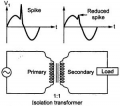
The input and output powers in a transformer are magnetically coupled since the transformer design is made by using a dielectric insulation barrier. An isolation transformer isolates load in an electrical system to prevent the equipment from getting spikes and harmonics from the mains as shown in the figure. Such a transformer is also known as an insulating transformer.
Isolation Trans.png

An Isolation transformer with an electrostatic shield is used for sensitive equipment such as computers and laboratory instruments. The turn ratio determines whether the transformer is used: to step-up or step-down or for unchanged voltages. This transformer can be used in different applications like portable electric tools and electric traction, and so on.
The above image and quotes were taken from here.

The capacitance was always a key player in choosing transformers and as can be seen above trash on mains like harmonics, hum and noise could be greatly reduced. Anyway it is worth keeping in mind that isolation from mains power is not always accomplished in the interest of safety or how a scope is grounded.

Ron
 

Thread Starter

ApacheKid

Joined Jan 12, 2015
1,762
Years ago all of our early data acquisition systems (mid 60s and up through early 90s) were run on Isolation Transformers, I recall the name Topaz being popular. Their use was not about safety and really had nothing to do with safety.


View attachment 231569


The above image and quotes were taken from here.

The capacitance was always a key player in choosing transformers and as can be seen above trash on mains like harmonics, hum and noise could be greatly reduced. Anyway it is worth keeping in mind that isolation from mains power is not always accomplished in the interest of safety or how a scope is grounded.

Ron
Thanks, yes I read of that and it is pretty important, I neve really appreciated their value in that way, it would be interesting to get some basic 1:1 transformer and compare the primary with the secondary on my scope (of course as soon as I do that I'd ground one side of that secondady! but no harm - for this comparison).
 

crutschow

Joined Mar 14, 2008
38,555
It seems the ground concept solves one problem yet creates others.
Yes.
The reason for grounding the neutral side of the line is to prevent static build in the lines which could raise the voltage to ground above the breakdown value of the wire or transformer insulation.

If you use an isolated transformer it might be a good idea to connect a large resistor (1meg or so) from one of the hot wires to safety ground.
That will prevent any static buildup, but will not allow enough current to flow to electrocute you.
 

Tonyr1084

Joined Sep 24, 2015
9,744
An interesting topic would be a "Ferroresonant Transformer". I have several laying around. They're good for about 20 amps. Not big but not small. They're protected by a 15 amp breaker, so I assume they can handle at least 15 amps. However, ferroresonant transformers are not very efficient. Yet they can tolerate fairly wide variations in input voltage while maintaining a fairly constant output voltage - despite the fluctuations in the input voltages.
 

nsaspook

Joined Aug 27, 2009
16,359
That article from Tektronix has to be trusted, but I do not understand something and this is what's coming up time and again as we discuss this, here a snapshot from that article:

View attachment 231559


Surely, if neither the UUT nor the scope are grounded (e.g. they are both fed by the secondary of an isolation transformer and that secondary has no concept of a grounded side) then V1 will always be zero volts?

There is simply no "galvanic" path between an operator touching the scope/UUT and ground. The ground only has a galvanic path to the transformer primary, because the outlets neutral is - to all intents and purpose - tied to ground, but the secondary has no connection whatsoever to ground.

So how can V1 not be zero volts?

(The diagram and explanation makes sense (to me) only if the UUT is grounded, but they don't call that out clearly in that article).
The main problem is saying "V1 will always be zero volts" if the UUT is 'floating', it might be close to zero under X UUT test conditions but change to something dangerous (involuntary movements can happen a low levels of current even at 110VAC) under other conditions while probing or testing a potential fault. ANY ungrounded test equipment (that normally has a chassis ground) creates ambiguity---i.e. you do not have any way of knowing what potential will appear on the case.

First you don't need a complete good conductor galvanic path for electrical energy to move because electrical energy (AC in this case) actually moves in space and follows the path of conductors. The space between the 'floating' devices contains the electric field of V1 in the capacitive reactance (and resistive leakage) between the ground and the devices at X potential. You are also a reactance that can make a circuit loop across V1 from the scope chassis causing current to flow into your body with earth ground as a circuit conductor.
 

Thread Starter

ApacheKid

Joined Jan 12, 2015
1,762
The main problem is saying "V1 will always be zero volts" if the UUT is 'floating', it might be close to zero under X UUT test conditions but change to something dangerous (involuntary movements can happen a low levels of current even at 110VAC) under other conditions while probing or testing a potential fault. ANY ungrounded test equipment (that normally has a chassis ground) creates ambiguity---i.e. you do not have any way of knowing what potential will appear on the case.

First you don't need a complete good conductor galvanic path for electrical energy to move because electrical energy (AC in this case) actually moves in space and follows the path of conductors. The space between the 'floating' devices contains the electric field of V1 in the capacitive reactance (and resistive leakage) between the ground and the devices at X potential. You are also a reactance that can make a circuit loop across V1 from the scope chassis causing current to flow into your body with earth ground as a circuit conductor.
Consider a mechanically driven alternator, perhaps attached to a stationary bike in my workshop, situated on the concrete floor.

Now I pedal the bike and I use my handheld, battery powered voltmeter to measure the voltage, I see 120 V AC at 60 Hz (yes I'm a very steady pedaler!) across the two terminals.

Now imagine an accomplice, they take the meter and - while I continue to pedal - connect one side to one of the terminals of the alternator and the other they connect to ground, say a steel bolt embedded in my floor.

What voltage will we see on the meter?

Yes this is contrived and yes it is a simplification but I want to establish what we'll observe in this test before taking this further.
 

Tonyr1084

Joined Sep 24, 2015
9,744
You can get your own answer by taking a 12 volt car battery and your test meter. Touch any terminal, positive or negative, and measure the voltage between the isolated battery plates and some earthly ground. You will find exactly zero volts, less for say stray induced voltage from noisy equipment in the environment.

Current flows in a circle. That's why it's called a "Circuit". Energy will not travel to some unrelated point just because someone called it a "ground". The ONLY way your stationary bike and alternator rig will produce a voltage between the alternator and ground is if the frame of the bike is also grounded. Then and only then do you have a circuit. The body of the alternator is grounded and is part of the negative pathway for charging a car battery.

Don't overthink it. Simply put, if you hold one meter lead and I hold the other - there will be no measured voltage because there is no circuit. Unless we're both bare foot and standing on something conductive. HOWEVER, there CAN be an exchange of current, but that is purely in owing to static electricity. Like when you shake someone's hand and get a snap (shock) from static electricity. You and I can be both positively charged. Say, you're charged at 20KV (static) and I'm charged at 50KV (static). As soon as we touch the difference in static potential will equalize and 30KV will transfer from me (higher charge) to you (lower charge). But that's current. If you had a meter that could read that high voltage it would still register no voltage because it's not measuring the potential voltage of a circuit.
 

Thread Starter

ApacheKid

Joined Jan 12, 2015
1,762
You can get your own answer by taking a 12 volt car battery and your test meter. Touch any terminal, positive or negative, and measure the voltage between the isolated battery plates and some earthly ground. You will find exactly zero volts, less for say stray induced voltage from noisy equipment in the environment.

Current flows in a circle. That's why it's called a "Circuit". Energy will not travel to some unrelated point just because someone called it a "ground". The ONLY way your stationary bike and alternator rig will produce a voltage between the alternator and ground is if the frame of the bike is also grounded. Then and only then do you have a circuit. The body of the alternator is grounded and is part of the negative pathway for charging a car battery.

Don't overthink it. Simply put, if you hold one meter lead and I hold the other - there will be no measured voltage because there is no circuit. Unless we're both bare foot and standing on something conductive. HOWEVER, there CAN be an exchange of current, but that is purely in owing to static electricity. Like when you shake someone's hand and get a snap (shock) from static electricity. You and I can be both positively charged. Say, you're charged at 20KV (static) and I'm charged at 50KV (static). As soon as we touch the difference in static potential will equalize and 30KV will transfer from me (higher charge) to you (lower charge). But that's current. If you had a meter that could read that high voltage it would still register no voltage because it's not measuring the potential voltage of a circuit.
Bear in mind, I was reacting to Doctor Strange's post, his remarks made me contrive this imaginary experiment because - I think - he may disagree in some way, I'm not an expert but a very rusty former student of electronics and this is helpful to dig down.

So my question was really to see how he responds, we're not talking DC either so I wanted to use an alternator as an equivalent to the transformer secondary but with no reference to a primary or a house electrical system, supply.
 

Tonyr1084

Joined Sep 24, 2015
9,744
AC is just confused DC. Doesn't know which way it wants to go. That and there's an RMS calculation difference.

Simply put - you can not read a voltage between a battery terminal and nothing. Same would go for AC. One leg of a transformer measured against nothing is going to be zero volts. Measuring between either leg of the secondary output and ground will be the same as measuring to nothing. There is no circuitry.

The primary IS referenced to ground as shown in the first image I posted. Neutral at the power pole and ground are both connected to the same thing. So touching any live line and ground would be the same as touching a live line and neutral. The secondary is isolated. That's why it's called an isolation transformer. There IS no circuit between the secondary leads and ground. Not unless you build one in.
 

Thread Starter

ApacheKid

Joined Jan 12, 2015
1,762
I think one thing I know is that static electricity, accumulated charge, does lead to a voltage relative to the physical ground, much as there's a voltage, tension between a cloud and the earth during a storm.

So in that sense there is the possibility for something not connected to the earth to nevertheless have voltage relative to it.

And of course the physical ground can be regarded as one plate of a capacitor with the air in the room as a dielectric.

Two terminals of a capacitor are not galvanically connected but there can easily be a voltage across the capacitor.

Maybe Doctor Strange was referring this kind of thing...
 

nsaspook

Joined Aug 27, 2009
16,359
Consider a mechanically driven alternator, perhaps attached to a stationary bike in my workshop, situated on the concrete floor.

Now I pedal the bike and I use my handheld, battery powered voltmeter to measure the voltage, I see 120 V AC at 60 Hz (yes I'm a very steady pedaler!) across the two terminals.

Now imagine an accomplice, they take the meter and - while I continue to pedal - connect one side to one of the terminals of the alternator and the other they connect to ground, say a steel bolt embedded in my floor.

What voltage will we see on the meter?

Yes this is contrived and yes it is a simplification but I want to establish what we'll observe in this test before taking this further.
What you read (with a high impedance meter) depends on the physical dimensions (capacitance) of the objects attached to the terminals in relationship in space (electric fields) to each other and earth ground. It's possible to minimize that voltage to just about zero in a contrived example but that's not the reality of using floating instruments to isolate faults or measure signals in a complex environments with many different sneak paths for electrical energy.

I have motor generator isolated AC power for high voltage systems with floating DC potentials up to 200KV on small car sized enclosures. I would never even think of trusting the one side grounded standoff insulators, water cooling circuits, air cooling tubing, etc ... connected to actual floating industrial systems to provide protection from shock by using that floating AC power for measurement instruments exposed to personal.
 

Tonyr1084

Joined Sep 24, 2015
9,744
the physical ground can be regarded as one plate of a capacitor with the air in the room as a dielectric.

Two terminals of a capacitor are not galvanically connected but there can easily be a voltage across the capacitor.
While that's 100% true and accurate, you can not measure the charge of a capacitor by just touching one lead. And lightning is static until it moves. It has a potential but no current. But when you test a battery for voltage your meter completes a circuit and therefore is able to read out a voltage.

You can not get a shock from a charged line if the other end of the line is not connected to - in this case - ground. You can not measure a voltage by touching a single line, you have to complete a circuit. So the secondary leads of your transformer can be at thousands of volts but neither lead connected to ground, touching EITHER ONE ( NOT BOTH ) you won't get a shock. Birds land on high voltage transmission lines all the time and they don't get a shock. There's a 7KVAC distribution line running down the block in between everyone's houses. At various places that 7KV line is connected to a step-down transformer. That transformer won't do anything unless one lead is connected to ground (as in my illustration). From 7KV down to 240VAC (with center tap) standard house power comes in split phase. Two lines and one neutral. And for safety reasons and for the functionality of the transformer, ground. In fact, it's grounded in multiple places. There's even a ground line running from pole to pole. In MY yard there's a pole with two copper lines running down the side of the pole into the earth. There are also guy wires that support the pole from the weight of the line that runs perpendicular. Two of them. One is insulated with a glass insulator (or ceramic or whatever they're made of). The other, also in my yard, goes directly into a long rod that both supports the pole and provides yet another pathway to ground. In my yard alone the transformer is grounded three times. Hence, if I touch either line (L1 or L2) I will get an UN-healthy shock. Because I complete a circuit between L1 (or L2) and ground. Yet, just touching either line and NOT being grounded, no shock. The isolation transformer creates its own circuit. And to get a shock from the transformer you need to complete a circuit. Otherwise, just touching a single transformer secondary lead and ground - you won't get a shock. And if you won't get a shock you won't blow up your scope. But I must confess, I have trepidation about using my scope and the same issue of potentially blowing it up by touching the wrong thing because even if I don't use the ground lead of my test lead, the scope being grounded can provide a pathway for excessive voltage and current to ground. The weaker of the two, the device under test or the scope, the weaker will blow.
 

nsaspook

Joined Aug 27, 2009
16,359
"You can not get a shock from a charged line if the other end of the line is not connected to - in this case - ground" I wish that were true but those of us that work with high AC/DC potentials know that isolation from ground is a matter of degree not an absolute.. Matter (air) ionizes, insulators leak, conductors charge and people are conductive.

A bird is a tiny capacitor plate to a ground reference, the energy transfer into that capacitance as it lands on the distribution line is small. The complete circuit is the universe, much like RF energy moves with no physical connectors into space.

https://physics.stackexchange.com/q...-voltage-transmission-line-and-linemen-approa
 

Tonyr1084

Joined Sep 24, 2015
9,744
All very true nsaspook. However, we're talking about an isolation transformer who's voltage will be either 240 or 120 VAC.

Yes, touching something that is potentially charged to 50KV (such as static charge) will give you quite a snap when you touch it. But that's because you are at a different potential. I've demonstrated (with volunteers until OSHA made me stop) that two people could both be charged to high but opposite potentials. Two guys sitting on plastic lawn chairs on a rug, both wearing sweat pants and shirts and sneakers and holding short lengths of copper pipe; one person would stand up while the other sat. The two volunteers would touch their pipes together and you'd see and hear quite a snap. THEN the standing person would sit down and the sitting person would stand up. Then when they touched their pipes together there would be a very loud snap and the guys would jump and wince at the pain of the transference of energy. This demonstration was performed when humidity was very low.

What was going on was when one person stood up from a chair he generated static charge either positive or negative - I don't know. The other person sitting in the chair hadn't yet developed a high potential charge. So when they tapped the copper pipes together one volunteer could have been at 30KV and the other - for sake of argument lets say - zero volts. Upon tapping the copper pipes together their charges would equalize. The standing person would drop down to 15KV and the sitting person would charge up to 15KV. But once the charges were equalized there was no longer a transfer of charge.

Yes, you can touch something that is charged and get a good shock out of it. And yes, a bird on a wire IS a capacitor plate. In humid conditions it may be more unpleasant for birds to sit on those wires, but I'm not a bird and I've never sat on a wire.

In my demonstration after having the two volunteers switch from sitting or standing positions I demonstrated that there was no transfer of charge when they were at the same potential. Hence, with both standing, after equalizing their charges, they sat and again tapped the pipes together with no visible, audible or sensational detection of shocking from static electricity.

For the sake of this thread, we have to remain in the realm of reality. In this case, we're dealing with 120 volts or maybe 240 volts. We're not dealing with static charges or transmission lines. We're dealing with isolation of power. Hence, the isolation transformer. When the secondary is not grounded at some point then touching one or the other lead will not result in a shock. Touching both leads will shock you. But standing bare foot in wet grass touching a single secondary lead will have no effect. That's where I was trying to take the TS in understanding how the high voltage is transformed to a lower household voltage - and is grounded at the transformer in numerous places. Touching any lead of a powered circuit and touching ground is outright dangerous. Unless an isolation transformer is used, then one can safely (accidentally) touch the SECONDARY leads without fear of electrocution. Provided provisions for grounding the secondary has not been made.
 

MrChips

Joined Oct 2, 2009
34,908
While that's 100% true and accurate, you can not measure the charge of a capacitor by just touching one lead. And lightning is static until it moves. It has a potential but no current. But when you test a battery for voltage your meter completes a circuit and therefore is able to read out a voltage.

You can not get a shock from a charged line if the other end of the line is not connected to - in this case - ground. You can not measure a voltage by touching a single line, you have to complete a circuit.
That is not true. Capacitance matters.
Watch the High Voltage Cable Inspection video at 1:00 when the linesman on the helicopter approaches the HV cables, and again at 2:48.
One would assume that the helicopter is not "grounded".


MrChips

Joined Oct 2, 2009
34,908
You do not need a circuit in a closed loop for current to flow.
If the potential between point-A is different from that at point-B there will be a potential difference and hence an electric field.
It is the electric field that drives the current when a conducting path is supplied.
 

MrChips

Joined Oct 2, 2009
34,908
Charge cannot cross the plates of a capacitor since there is an insulating layer between the plates. However, there can still be current flow external to the plates when AC voltage is applied.

A transformer has capacitance between windings and also between the winding and the transformer casing. Current can still be induced into the case and the secondary winding owing to the effective capacitance.
 
Top